
‘Anabta, ‘Azzun, Deir Sharaf, Irtah (Sha’ar Efrayim), Jubara (Kafriat), Qalqiliya, Ras ‘Atiya, Sun 1.11.09, Afternoon
On driving back from the OPT today, Tennyson's "The Brook" came to mind. Maybe the poet won't mind his words being transposed to meet the exigencies of Occupation in today's Middle East: "For men may come and men may go, but I (the occupation) go on forever." Instead of the "men," we have checkpoints and barricades which are put up and taken down, checkpoints that are manned or unmanned. No matter, the Occupation continues. In fact, one of the most serious aspects of what we observe in the OPT these days is the situation at the Seam Line, at the Separation Barrier.
12:45 Ras Atiya
We've passed the works near Alfe Menashe where the Separation Barrier in all its individual concrete slabs is being erected slowly and carefully, blighting the landscape and, for sure, deepening the distress of the Palestinians who happen to live or own fields around it.
The children are coming out of school across the Separation Barrier, walking stoically past the three soldiers on their way home, usually in the next village, except for the Bedouin kid who lives in the tent alongside the checkpoint. The three soldiers take turns in telling us that we cannot take photos, but already a Palestinian youth has told us that the commander is "good." He does, in fact, chitchat with us, and doesn't bother about where we stand or what we do.
13:15 Qalqiliya
This week there's nothing to write about. No checkpoint functioning, just a lone soldier in the military lookout tower, fiddling with his mobile phone, and vehicles, both Israeli (yellow license plates) and Palestinian travel freely, seemingly wherever they want to go.
We note the large US AID advertisements on either side of the dormant checkpoint as well as along Route 55. On one, a mother looks fondly at her small child, on another a young woman is learning to handle a video camera.
Azzun
As last week, the town is not barricaded with the monstrous mound and concrete blocks provided, every now and again, by the Occupier.
Deir Sharaf
The four soldiers loll about at the side of the checkpoint, and vehicles, both Israeli (yellow license plates) and Palestinian, travel freely.
14:45 Anabta
Vehicles also travel in both directions freely here, but there is a blue police jeep, standing at the side, and a policeman, wandering into the center of the roadway, bent on stopping vehicles.
15:00 Jubara
There are eight soldiers at the checkpoint; a change of shift is evident. The commander says "It's good to see you," and soon after sends a soldier over to unlock the gate, so that we can drive up to the village and on to:
15:15 Gate 753
Two miserably torn and dirty Israeli flags flutter in the breeze. A car and a truck are ready to cross from the east side of the Separation Barrier. A group of four men who live in Sur but work in Jubarra have to get out of the car in which they've been traveling from the village and, as at the big checkpoints in the past, have to go one at a time towards the checking booth – here nothing but a makeshift tent – where the usual laborious process takes place. The men know the routine and wait patiently as the soldiers check their IDs and permits against the list they have at their side. A detainee sits by the open gate, but immediately after we park our car, the soldiers go up to him, evidently tell him to stand up, and he begins to walk, and then run across the Separation Barrier and on in the direction of A-Ras. Clearly, the arrival of MachsomWatch has had an impact!
15:45 Shaar Efrayim/Irtah
We have to wonder if our presence didn't also have an impact here. When we arrive there's a line of men waiting to get into the "terminal." When we get to the turnstiles at the entrance, we see that the area of the terminal has been cut in half, since there's a folding metal door across the width of the hallway. Only one window has been open, but by the time we look inside, there are two working. Passage is quick, and Palestinians, almost to a man, and one woman, complain about the mornings. "You should be here in the mornings." As we leave, we see one of the terminal's civilian operators at an open window right above the entrance. He follows us with his eyes, going to another open window, as we make our way back to the car in the parking lot. We wonder!
'Anabta CP
See all reports for this place-
'Anabta CP
The checkpoint is located south of the village of 'Anabta, at the intersection of Road 60 (leading to Nablus at the entrance to Area A), with Road (57, 557, 5576) facing west towards the Einav settlement and the checkpoint at the exit from the West Bank - Figs checkpoint. Until 2010 we used to watch the intersection and report the long columns created due to a slow inspection of the vehicles in both directions.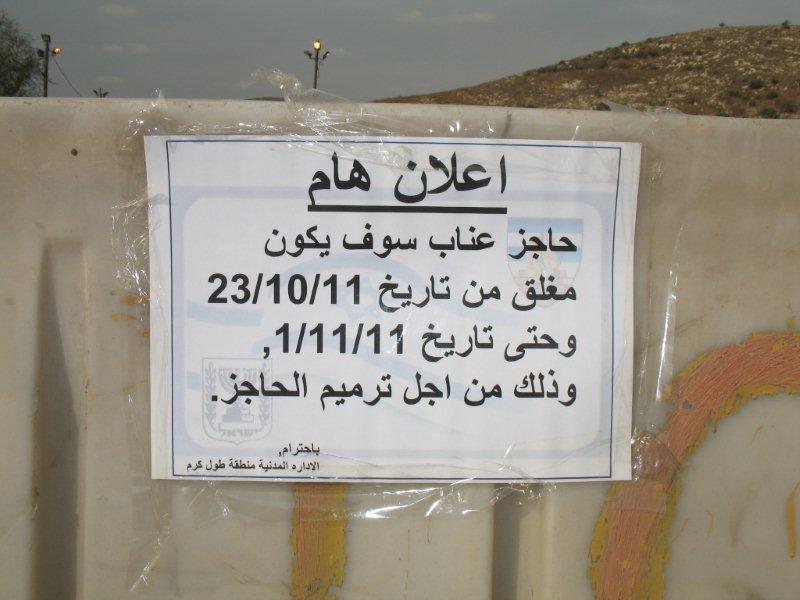 Oct-28-2011Anabta checkpoint 24.10.11
-
'Azzun
See all reports for this place-
Azoun (updated February 2019)
A Palestinian town situated in Area B (under civil Palestinian control and Israeli security control),
on road 5 between Nablus and Qalqiliya, east of Nabi Elias village. The inhabitants are allowed to construct and improve infrastructures. The Separation Fence has confiscated lands belonging to the town's people. In 2018 olive tree groves owned by one of its inhabitants were confiscated for the sake of paving a road to bypass Nabi Elias. Azoun population numbers 13,000, its economic state dire. Its infrastructures are poor, neglect and poverty rampant. In the meantime, the town council has completed paving an internal road for the inhabitants' welfare.
Because of its proximity to the Jewish settler-colony of Karnei Shomron and its outposts, the town suffers the intense presence of the Israeli army, especially at nighttime: soldiers enter homes, arrest suspects, trash the house and sometimes ruin it, as they do in numerous places in the West Bank. At times a checkpoint closes the entrance to the town, so no one can come in or get out.
-
Deir Sharaf checkpoint
See all reports for this place-
Deir Sharaf checkpoint is located west of Nablus and south of the settlement of Shavei Shomron, at the entrance to the village of Deir Sharaf on the road leading to Nablus. The checkpoint was activated in early March 2009 after the Beit Iba checkpoint was closed. Palestinians are allowed through the checkpoint , but not for Israelis. Unlike the checkpoints leading to Qalqilya and Tulkarm, crossing of Israeli Palestinians is only allowed on Saturdays.
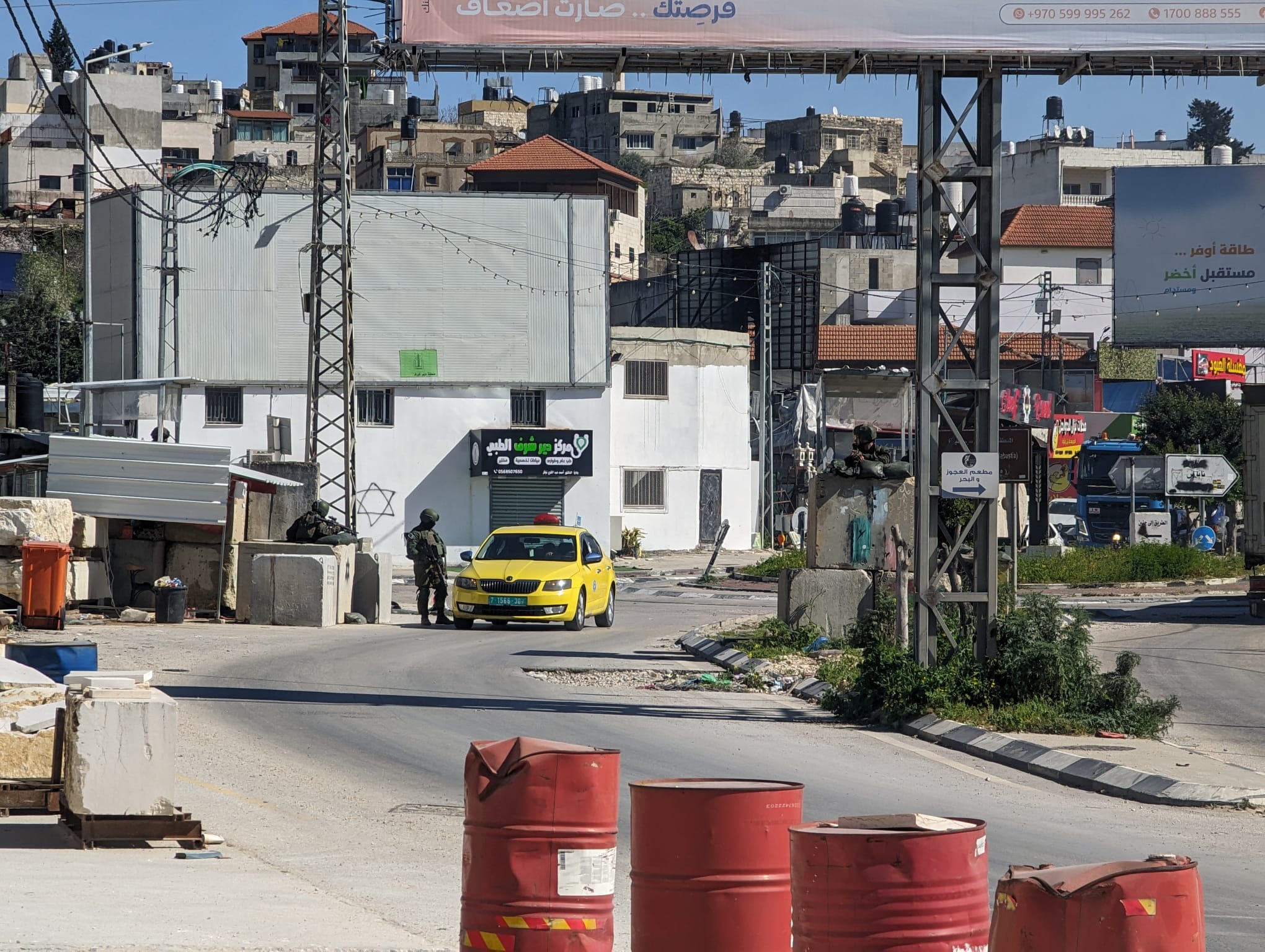 Nina SebaFeb-28-2024Deir Sharaf - the entrance to the village
-
Irtah (Sha'ar Efrayim)
See all reports for this place-
The checkpoint is for Palestinians only. It is the main barrier to the passage of workers from the northern West Bank to Israel. Workers with a permit to work in Israel and also for trade (with appropriate permissions), medicine, and visiting prisoners. One can cross the checkpoint only on foot. The checkpoint is located north of Road 557 and south of Tulkarm. Operated by a civil security company, opening hours: between 4:00 and 19:00 on weekdays. As members of Machsom Watch, we began our shifts to this location in 2007. We arrived before it opened at 4 in the morning and report since, on the harsh conditions and the long and crowded queues of workers. The workers who pass by continue their journey by transportation to work throughout Israel. In the first period of its activity, about 3,000 and then 5,000 people passed through this checkpoint every day. Due to the small number of checking points and arbitrary delays for long periods of time in the "rooms", workers feared losing their transportation. Hence workers leave their homes at 2:30 at night to be among the first. Today, 15,000 pass and the transition is faster. Workers are still leaving their homes very early to get past the checkpoint at 7 p.m. In an adjacent compound, there is a terminal for the transfer of goods on a commercial scale, using the back-to-back method.
-
Jubara (Kafriat)
See all reports for this place-
The Jabra checkpoint was on Road 557, south of Tulkarm, on the side of the Figs Pass, which is located within the Palestinian Authority (a few kilometers east of the Green Line), and serves as an entry barrier from the territories to Israel. The checkpoint to the village of Jubara, which until 2013 was in the seam area, blocked and surrounded by a fence, was intended for the passage of the family members of the house next to the checkpoint, and also for the MachsomWatch volunteers (with special permission only), on their way to checkpoint 753. on the other side of the village. The soldiers supervising the "fig crossing" also supervised the crossing at this checkpoint, in our shifts we often waited a long time until the key was found and the gate opened. The checkpoint was abolished and became part of the separation fence that was moved west following the High Court.
-
Qalqiliya checkpoint
See all reports for this place-
Qalqilya is surrounded on all sides by the separation barrier. The only exit from the city is in the east of the city on the road that leaves the city in an easterly direction. This is where the checkpoint was located. When the checkpoint was active until 2009 our shifts watched long queues of cars being inspected at the only exit from the city to the West Bank. The checkpoint was canceled, but there is a military presence at the entrance to the city.
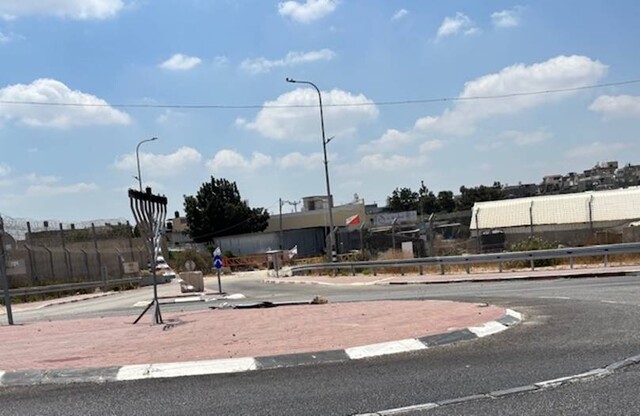 Nina SebaAug-18-2025Azzun: Enclosed by a high fence and the gate to the village is closed
-
Ras 'Atiya
See all reports for this place-
The checkpoint is presently on the Separation Barrier roadway, manned and open 12 hours a day, from 6:30 to 18:30. West of it is the large Seam Line village whose school is attended by children from the nearby villages east of the Barrier and many of whose inhabitants have permits to work in Israel. How long this checkpoint will remain in place is unknown, since construction of the Separation Wall, just by the settlement of Alfe Menashe, east of the present Separation Barrier, is endless, as is the creation of a new road and, obviously, a new checkpoint.
-