
‘Anabta, Deir Sharaf, Habla, Irtah (Sha’ar Efrayim), Thu 21.1.10, Afternoon
Habla
13:55 – The agricultural gate is closed.
The settlement Shvut Ami
14:10 – A man carrying a package is walking briskly inside the plot toward the house. He must be a settler.
Deir Sharaf (The Barrels) checkpoint
14:15 – The post is empty of soldiers. Soldiers are watching from a vehicle parking close to the turn of the new road, built for the exclusive use of Shvut Ami settlers (an apartheid road).
Near the turn from road 60 to the village of Beit Lid an Israeli flag has been stuck to mark the place where a settler was shot last month.
Anabta checkpoint
14:20 – Green traffic lights and vehicles travel in both lanes. We don't see any soldiers in the posts. Although it's hard to see, we think from what we have learned in the past, the watch tower is manned.
Irtah checkpoint (Efrayim Gate)

14:40 – There is a line at the entrance to the checkpoint although there are scarcely any vehicles that transport workers returning from work. The Palestinians tell us that they have already been waiting for half an hour near the turnstile. Over the wall we can see the security people standing and talking outside the enclosures. The people waiting there have been told that the computer is down. When we say that we are not allowed to get in and see what is going on there, one of the workers says that I'd better not go in there and see how they are treated, transferred from one place to another like pigs.
At the crossing to Israel, on the other side, three men are standing in the mud in front of closed turnstiles, having been there for an hour. We have tried to call the Humanitarian Center and the Tulkarm DCO for help [District Coordination Office of the IDF Civil Administration that handles passage permits] but to no avail. Calls directed at the cameras in the place haven't helped either.

Finally, they are able to enter but the instructions over the loudspeakers are in Hebrew and when one of them tries to say they don't speak Hebrew, he gets a rude answer over the loudspeaker, "I am in charge of the place, not you". All this takes place in front of a huge sign saying in Arabic, Hebrew and English, "All of us share the hope". (A photo will be enclosed).
15:15 – A line builds up in next to the turnstile of the people that leave Israel, most of whom come back after visiting prisoners. Suddenly they let them all in at the same time. Maybe our presence here has to do with it.
We go back to the turnstiles for entering Israel where a woman and small kids have been waiting for the father in a cab in the parking lot. The Palestinian has been told to cross at Irtah but has had to stand in front of the entering turnstiles being unable to enter the inspection area at all. Over the loudspeaker they tell him, an elderly woman and another man to show the permit. It happens even before the turnstiles are opened. (Photo enclosed).
15:50 – The turnstile leading to the inspection area opens, but the woman has already left.
'Anabta CP
See all reports for this place-
'Anabta CP
The checkpoint is located south of the village of 'Anabta, at the intersection of Road 60 (leading to Nablus at the entrance to Area A), with Road (57, 557, 5576) facing west towards the Einav settlement and the checkpoint at the exit from the West Bank - Figs checkpoint. Until 2010 we used to watch the intersection and report the long columns created due to a slow inspection of the vehicles in both directions.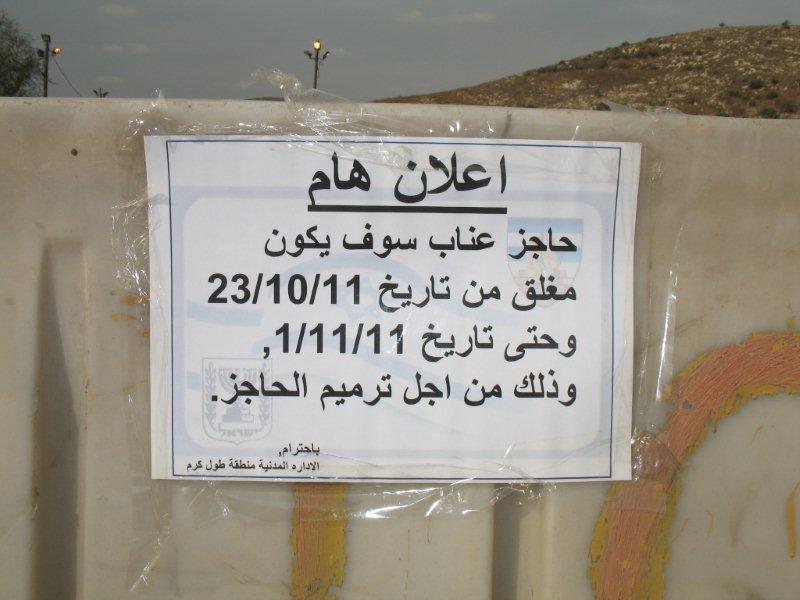 Oct-28-2011Anabta checkpoint 24.10.11
-
Deir Sharaf checkpoint
See all reports for this place-
Deir Sharaf checkpoint is located west of Nablus and south of the settlement of Shavei Shomron, at the entrance to the village of Deir Sharaf on the road leading to Nablus. The checkpoint was activated in early March 2009 after the Beit Iba checkpoint was closed. Palestinians are allowed through the checkpoint , but not for Israelis. Unlike the checkpoints leading to Qalqilya and Tulkarm, crossing of Israeli Palestinians is only allowed on Saturdays.
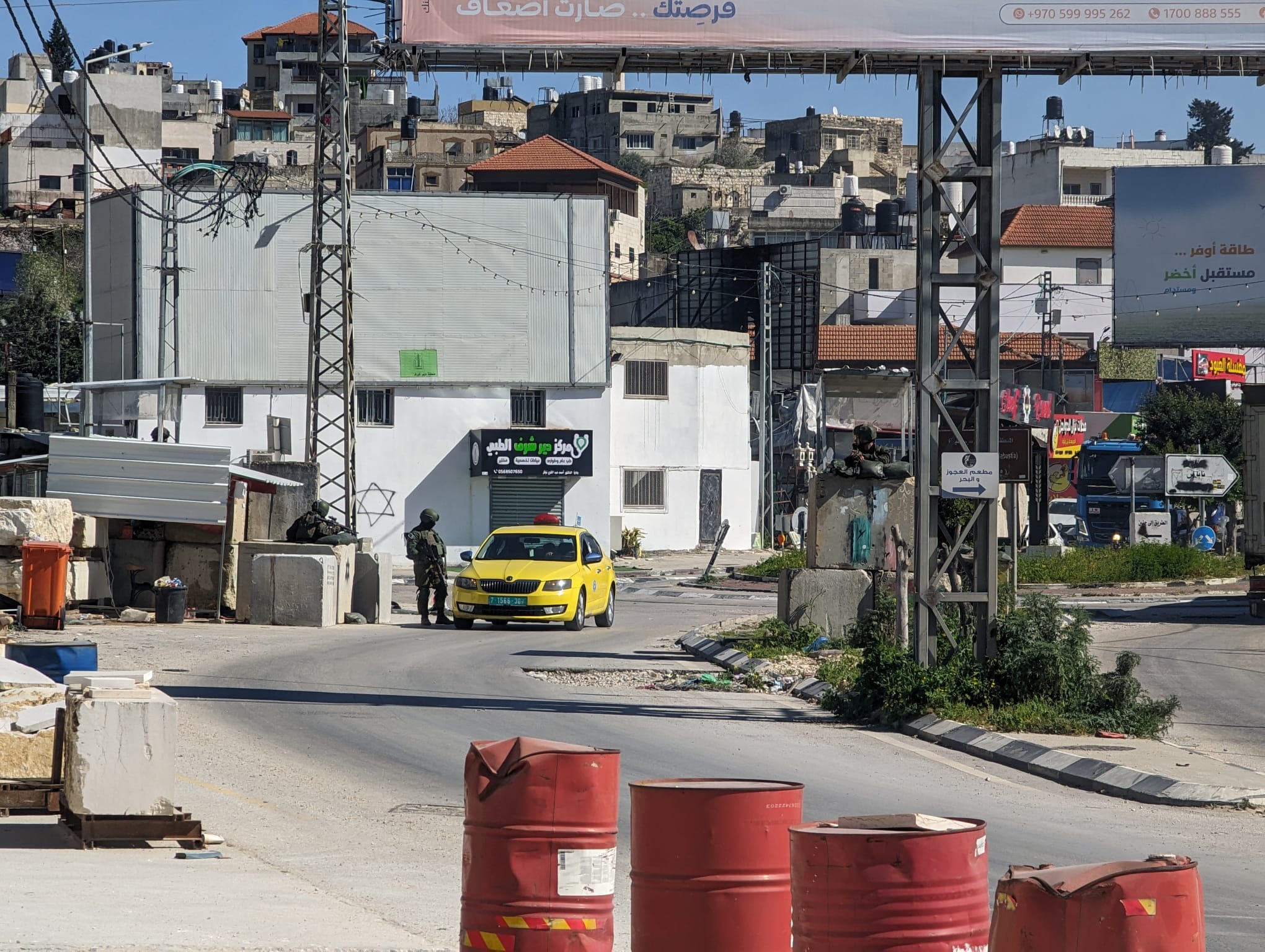 Nina SebaFeb-28-2024Deir Sharaf - the entrance to the village
-
Habla
See all reports for this place-
Habla CP (1393)
The Habla checkpoint (1393) was established on the lands of the residents of Qalqilya, on the short road that
connected it for centuries to the nearby town of Habla. The separation barrier intersects this road twice and cut off the residents of Qalqilya from their lands in the seam zone.(between the fence and the green line).
There is a passage under Road 55 that connects Qalqilya to the sabotage This agricultural barrier is used by the farmers and nursery owners established along Road 55 from the Green Line and on both sides of the kurkar road leading to the checkpoint.
This agricultural checkpoint serves the residents of Arab a-Ramadin al-Janoubi (detached from the West Bank), who pass through it to the West Bank and back to their homes. The opening hours (3 times a day) of this agricultural checkpoint are longer than usual, about an hour (recently shortened to 45 minutes), and are coordinated with the transportation hours of a-Ramadin children studying in the occupied in the West Bank.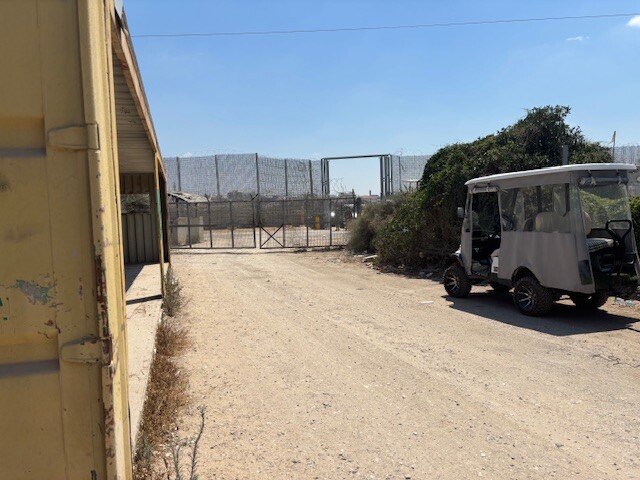 Nina SebaAug-18-2025Habla: The gate is in the process of closing
-
Irtah (Sha'ar Efrayim)
See all reports for this place-
The checkpoint is for Palestinians only. It is the main barrier to the passage of workers from the northern West Bank to Israel. Workers with a permit to work in Israel and also for trade (with appropriate permissions), medicine, and visiting prisoners. One can cross the checkpoint only on foot. The checkpoint is located north of Road 557 and south of Tulkarm. Operated by a civil security company, opening hours: between 4:00 and 19:00 on weekdays. As members of Machsom Watch, we began our shifts to this location in 2007. We arrived before it opened at 4 in the morning and report since, on the harsh conditions and the long and crowded queues of workers. The workers who pass by continue their journey by transportation to work throughout Israel. In the first period of its activity, about 3,000 and then 5,000 people passed through this checkpoint every day. Due to the small number of checking points and arbitrary delays for long periods of time in the "rooms", workers feared losing their transportation. Hence workers leave their homes at 2:30 at night to be among the first. Today, 15,000 pass and the transition is faster. Workers are still leaving their homes very early to get past the checkpoint at 7 p.m. In an adjacent compound, there is a terminal for the transfer of goods on a commercial scale, using the back-to-back method.
-