
‘Anabta, Deir Sharaf, Habla, Jubara (Kafriat), Sun 12.2.12, Afternoon
Summary: mourning in the afternoon
After years traveling to and observing at checkpoints in the OPT, meeting and befriending Palestinians and their families, it is unavoidable that we could have stayed ignorant about Islam and the beliefs revealed to us by our Palestinian friends and acquaintances. Early on we inferred that being a Muslim meant “one who submits to the will of Allah.” That implied that no Muslim could ever be too boastful or too despondent. The death of a woman and her son, in a home accident, in one of the villages near the infamous checkpoint of Beit Iba and even nearer to the settlement of Shavei Shomron and the meeting with the a women of the family today showed us, once again, that when yet another tragedy struck this family whose lives have long been disturbed and disrupted by the endless humiliation and harassment of the Israeli Occupation, we found neither despair nor frustration, but patience and humility. If only we could learn….. no matter how difficult or tragic a situation, we cannot let it paralyze us.
12:50 Habla Agricultural Gate
The group of reservist soldiers arrive in their Hummer from the Israeli side of the agricultural gate, early, and the waiting Palestinians are soon allowed to cross; on the far side of the gate, sheep can be herd bleating and soon are met by the son of the Palestinian we’ve known for years, whom we’ve nicknamed the “cowboy” (hat and blue eyes). The usual odd car, truck and Palestinians of various ages all pass quickly. This group of soldiers wants to get the work done, and get it done quickly.
The Routes
Along Route 55, many more Israeli licensed cars (yellow plates) than a few months ago, or is that our vivid imaginations at work? Perhaps not, since Israeli flags are draped all over, alongside the various settlements we pass and at a variety of stone monuments, set up alongside the road, on every route we drive on. Moreover, at Jit Junction, the Judea Samaria flag accompanies the Israeli flag. Near Shavei Shomron, not only at the new road leading up to it, but also at the junction of Routes 57 and 60, a not uncommon brown sign (marking places of interest in Israel, this one including a bed) indicates “Midreshet Shomron,” meaning Samaria College (a sleep over college at that) is at hand. It begins to feel more and more like one state around here, but the state is Israel and not Palestinian whose land it is. The few, paltry Palestinian flags are all that remain of the hope, just a few months ago, of UN recognition of Palestine as an independent country.
Near the junction of Routes 57 and 60, on the way to Nablus, the Bedouin tents which were always encamped there, on the hill, in winter, are no more. Just a plethora of sheep, and no tents anywhere in site, even in the far off hills towards Jenin.
Hummers on Route 55
13:30 Hidden, off the side of the road at the eastern part of the village of Nabil Elias
13:33 Three minutes later, hidden, off the side of the road, on the northern side of the road
13:50 A Blue Police Hummer comes out of the Qedumim settlement, or the DCL offices, on to the roadway of Route 55.
Beyond Jit Junction, the new housing of Qedumim settlement is now in view. Where before, everything was well hidden from the road, now the piles of white gravel and building material are flaunted, seemingly, with pride as more and more two storey building go up.
Deir Sharaf
The signs indicating the sewage project, funded by the Federal Republic of Germany, still stand, but no ditches or work in sight this side of the village: perhaps the work is still going on near the former checkpoint of Beit Iba, but, today, our task is to visit a family, or visit the women of the family, who are on their third day of mourning for the death of a mother and her 14 year old son. We visit the matriarch of the family, stoic and strong, surrounded by her other daughters, who seem, somehow, weaker and sadder than the mother who has borne 13 children, and whose land was taken away by Israel already years ago and who husband was taken “by Allah” just two short years ago. We leave to continue on our shift when other older women who are not relatives appear, to make their condolence call
Anabta
14:35 nothing untoward, merely that needlessly dazzling lights brighten the already clear day and the checkpoint.
Not far from the settlement, another new brown sign appears, marking a tourist place of interest: a Roman column is depicted alongside the word “stables.”
Jubara
14:50 A long, long line of Palestinian Israeli vehicles, all of whom bear yellow license plates stand in line for checking which is very slow. We, against our will, go to the settler line where there is nobody. Moreover today, we have a male driver and no MachsomWatch flag fluttering from the window. Magically, we are asked neither for our Identity Cards, nor where we’ve been or where we live. A smile from the soldier and we are out of the OPT or of the facts on the ground seeming to demarcate a “one state solution” as well as the continuing state of Occupation. Mourning will not be confined to only three days ….
'Anabta CP
See all reports for this place-
'Anabta CP
The checkpoint is located south of the village of 'Anabta, at the intersection of Road 60 (leading to Nablus at the entrance to Area A), with Road (57, 557, 5576) facing west towards the Einav settlement and the checkpoint at the exit from the West Bank - Figs checkpoint. Until 2010 we used to watch the intersection and report the long columns created due to a slow inspection of the vehicles in both directions.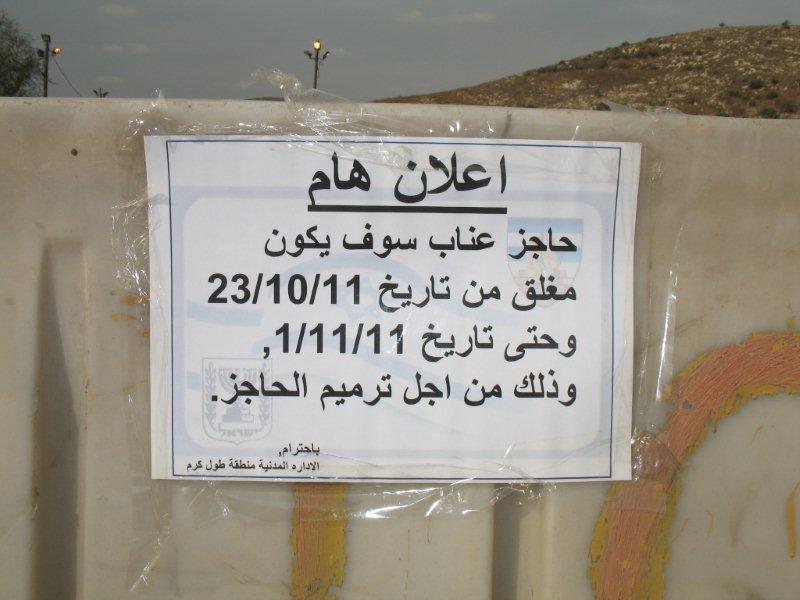 Oct-28-2011Anabta checkpoint 24.10.11
-
Deir Sharaf checkpoint
See all reports for this place-
Deir Sharaf checkpoint is located west of Nablus and south of the settlement of Shavei Shomron, at the entrance to the village of Deir Sharaf on the road leading to Nablus. The checkpoint was activated in early March 2009 after the Beit Iba checkpoint was closed. Palestinians are allowed through the checkpoint , but not for Israelis. Unlike the checkpoints leading to Qalqilya and Tulkarm, crossing of Israeli Palestinians is only allowed on Saturdays.
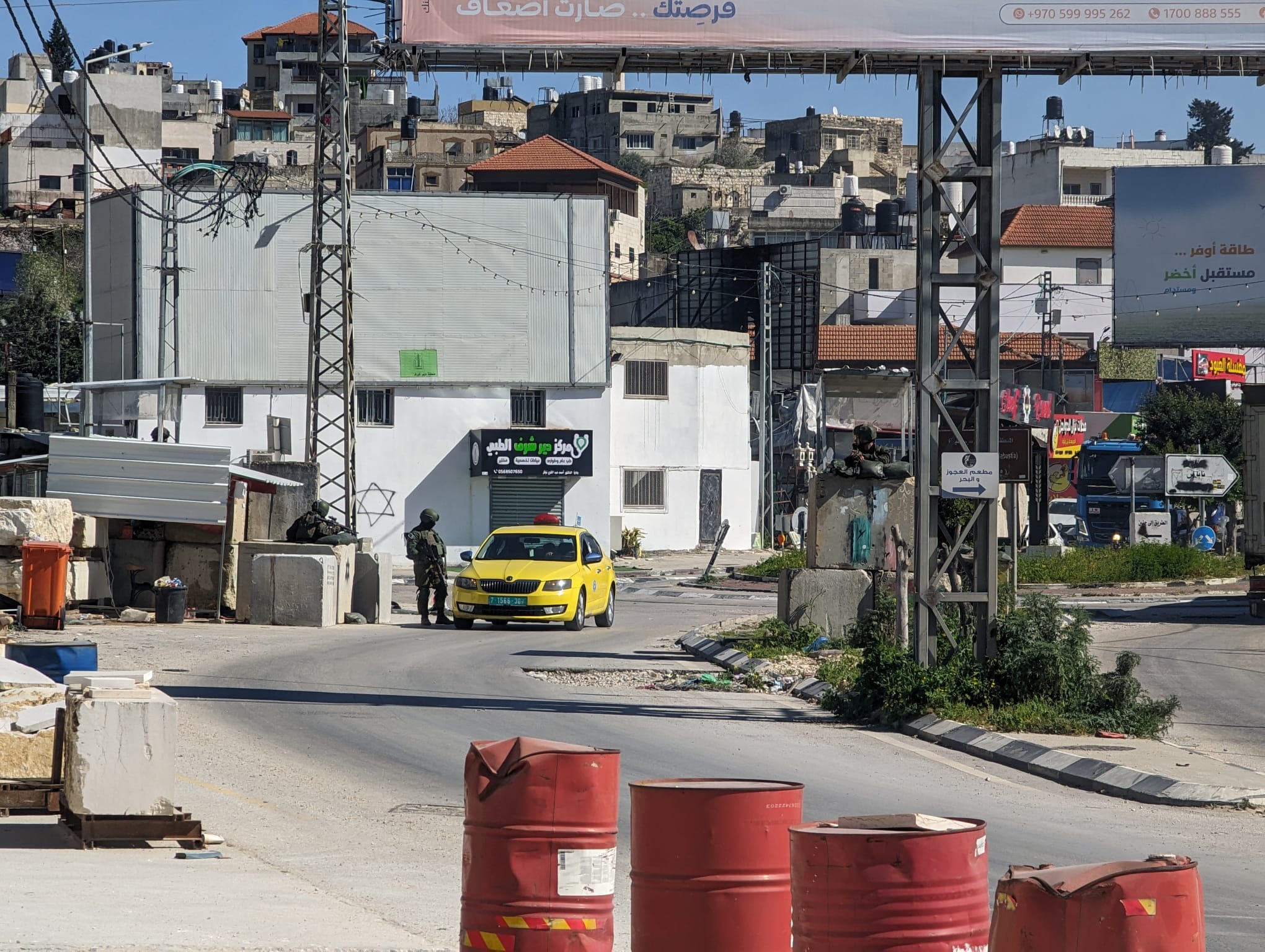 Nina SebaFeb-28-2024Deir Sharaf - the entrance to the village
-
Habla
See all reports for this place-
Habla CP (1393)
The Habla checkpoint (1393) was established on the lands of the residents of Qalqilya, on the short road that
connected it for centuries to the nearby town of Habla. The separation barrier intersects this road twice and cut off the residents of Qalqilya from their lands in the seam zone.(between the fence and the green line).
There is a passage under Road 55 that connects Qalqilya to the sabotage This agricultural barrier is used by the farmers and nursery owners established along Road 55 from the Green Line and on both sides of the kurkar road leading to the checkpoint.
This agricultural checkpoint serves the residents of Arab a-Ramadin al-Janoubi (detached from the West Bank), who pass through it to the West Bank and back to their homes. The opening hours (3 times a day) of this agricultural checkpoint are longer than usual, about an hour (recently shortened to 45 minutes), and are coordinated with the transportation hours of a-Ramadin children studying in the occupied in the West Bank.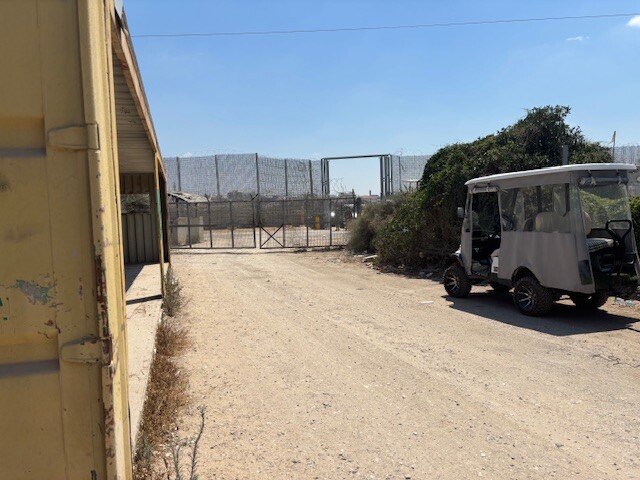 Nina SebaAug-18-2025Habla: The gate is in the process of closing
-
Jubara (Kafriat)
See all reports for this place-
The Jabra checkpoint was on Road 557, south of Tulkarm, on the side of the Figs Pass, which is located within the Palestinian Authority (a few kilometers east of the Green Line), and serves as an entry barrier from the territories to Israel. The checkpoint to the village of Jubara, which until 2013 was in the seam area, blocked and surrounded by a fence, was intended for the passage of the family members of the house next to the checkpoint, and also for the MachsomWatch volunteers (with special permission only), on their way to checkpoint 753. on the other side of the village. The soldiers supervising the "fig crossing" also supervised the crossing at this checkpoint, in our shifts we often waited a long time until the key was found and the gate opened. The checkpoint was abolished and became part of the separation fence that was moved west following the High Court.
-