
‘Anabta, Eliyahu Crossing, Habla, Te’enim Crossing, Sun 26.9.10, Morning
Habla
06:55 – The gate, which is supposed to open at 06:45, is still closed. Two buses filled with children wait to enter the village. About 50 Palestinians wait to exit behind the inner fence.
The soldiers standing next to the closed gates explain to us that the fault lies with the Palestinians: they made trouble at the farther gates that opened earlier. Some came to the wrong gates and some had the wrong permits. Others argued and got into fights and delayed the opening of those gates. That’s why the soldiers arrived late to Habla and the female MP’s who do the inspections still haven’t arrived.
07:07 – The MP’s arrive. The first outer gate opens.
07:15 – The first bus approaches, after the driver went to and returned from the inspection booth. Two soldiers enter the bus, walk through it and get off. Outside they also check the baggage compartment.
07:25 – The second bus moves and undergoes the same procedure, and we ask ourselves why the IDF cares who enters the Palestinian area of Habla?
The first five residents are inspected, the second five are waiting and there are already arguments among the others.
Eliyahu crossing (Agricultural gate 109)
07:35 – Two Palestinians wait there.
Jayyus north
07:45 – The gate is empty. Johan, the ecumenical from the USA, says everyone went through without problems. We had a chance to speak to him and hear about his experiences during the past three months. He said the soldiers were usually polite. We also met two reservists, one with a Shakespearean beard that was impossible to ignore. Johan says the number of exit permits for agricultural work on land belonging to Palestinians declined from 400 last year to 300 this year. He mentioned Abu Is’am , an important public figure in the village whose permit was cancelled after many years. They were told he’d become a security risk.Before the gate was closed, Fa’iz abu Na’il and his children returned from the fields with a pail of black olives, and he told us that hundreds of his trees had been cut down to pave the security road. 08:15 The soldiers close the gate but promise to open it for any latecomers. But they drive to the southern gate; we also do so, on dirt roads, guided by Johan.
Jayyus south 08:30 – Again we drive through the village, this time southward, and take a route where the security fence was to have been erected, and many olive trees had been cut down. The fence was subsequently moved, and Johan showed us the shed erected by the landowner in a new olive grove he’s cultivating lovingly and with dedication.
The soldiers from the northern gate arrived at the same time we did. An elder Palestinian passed with his donkey. Then Stella, from the Ecumenicals, who was to have been at this gate, arrived and says that the mother of the Palestinian we had just seen is at home, dying, and she’d been asked by neighbors and members of the family to visit her. The Ecumenicals have become part of the village.
Falamiya 09:05 – Mustafa comes back from the gate with a pail full of olives. A returning tractor pulls a wagon loaded with lovely guavas. We see large areas of za’atar, but there was no longer anyone we could ask what they do with such a big amount.
Sebastya
10:10 – After driving through Kafr Tsur and Beit Lid, we got on the road to Deir Sharaf, and then north toward Shavei Shomron. We looked for the checkpoint next to Sebastya. We saw two concrete cubes by the side of the road, but the road was open. Soldiers stood only next to the entrance to the army camp, but we didn’t see them stopping anyone.
‘Anabta
10:25 We entered, drove around in the checkpoint area and left. We didn’t see any soldiers; not in the tower either.
10:40 – Te’enim crossingNo lines of people waiting to exit. What we did see, in Israeli territory:We saw an army Hummer parked facing east on the right side of the road, only a few meters from the junction with Route 444, opposite Taybe. A civilian car with an Israeli license plate stood facing it, and four or five Arab villagers standing alongside with two soldiers checking their IDs. We tried to understand what was going on, drove to the junction, turned around and came back. The Hummer had disappeared, the civilian car was still there and the villagers climbed up the hill carrying sticks to harvest the olives.Is it possible that the army will stop an Israeli car in Israeli territory because the passengers might be there illegally? Isn’t that the job of the police?
'Anabta CP
See all reports for this place-
'Anabta CP
The checkpoint is located south of the village of 'Anabta, at the intersection of Road 60 (leading to Nablus at the entrance to Area A), with Road (57, 557, 5576) facing west towards the Einav settlement and the checkpoint at the exit from the West Bank - Figs checkpoint. Until 2010 we used to watch the intersection and report the long columns created due to a slow inspection of the vehicles in both directions.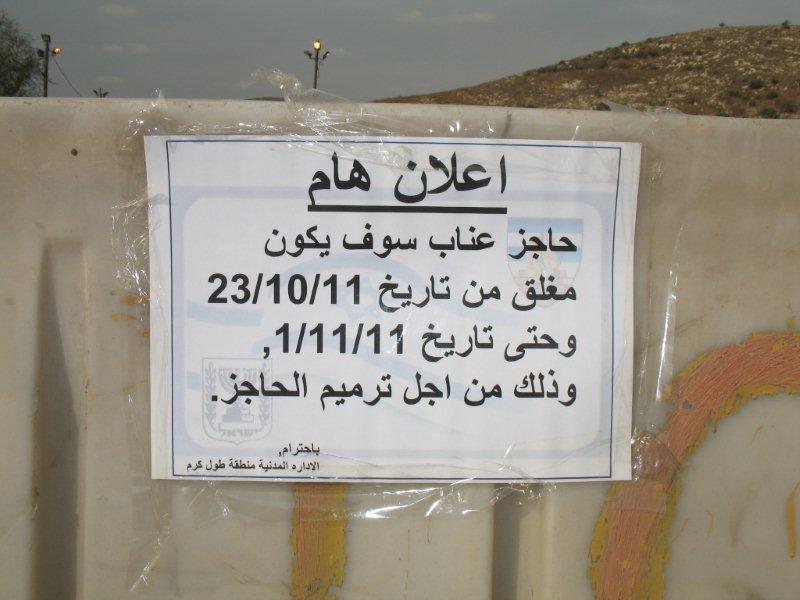 Oct-28-2011Anabta checkpoint 24.10.11
-
Eliyahu CP (109) / Crossing
See all reports for this place-
Eliyahu CP (109) / Crossing This checkpoint, also known as the Fruit Crossing, is one of the main checkpoints between Israel and the West Bank. It is located on Route 55 between Alfei Menashe and the turn to Qalqilya and Zufin, more than 4 km east of the Green Line, in the separation fence, which separates Qalqilya from its lands to the south, thus leaving Alfei Menashe West of the fence - the Seam Zone. This checkpoint, a few kilometers across the Green Line, is intended for "Israeli settlement in the West Bank and the population of the Seam Zone." It is managed by a civil company. Palestinians with a special permit for their lands in the seam area are also allowed to pass through it, on foot, and sometimes by car.
-
Habla
See all reports for this place-
Habla CP (1393)
The Habla checkpoint (1393) was established on the lands of the residents of Qalqilya, on the short road that
connected it for centuries to the nearby town of Habla. The separation barrier intersects this road twice and cut off the residents of Qalqilya from their lands in the seam zone.(between the fence and the green line).
There is a passage under Road 55 that connects Qalqilya to the sabotage This agricultural barrier is used by the farmers and nursery owners established along Road 55 from the Green Line and on both sides of the kurkar road leading to the checkpoint.
This agricultural checkpoint serves the residents of Arab a-Ramadin al-Janoubi (detached from the West Bank), who pass through it to the West Bank and back to their homes. The opening hours (3 times a day) of this agricultural checkpoint are longer than usual, about an hour (recently shortened to 45 minutes), and are coordinated with the transportation hours of a-Ramadin children studying in the occupied in the West Bank.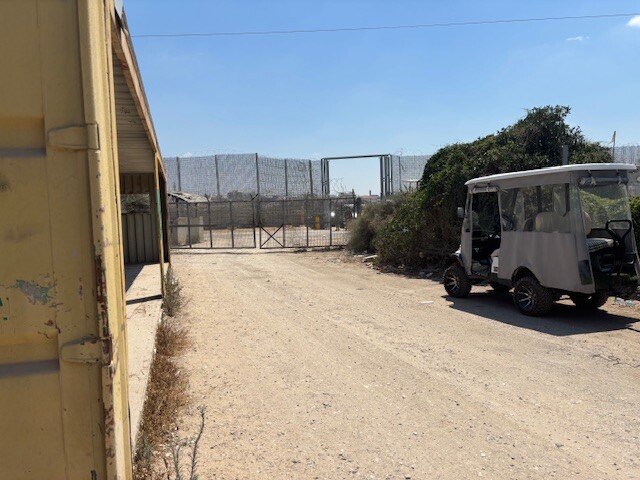 Nina SebaAug-18-2025Habla: The gate is in the process of closing
-
Te'enim Crossing
See all reports for this place-
Te'enim Crossing The Figs checkpoint, located on Road 557, east of the Green Line and the Ephraim Checkpoint (Road 444), is a vehicle crossing, open 24/7 all year round. It serves the Israeli population, including those authorized to enter the Palestinian Authority. The passage of foreigners holding international passports recognized by the State of Israel is approved. In exceptional cases will the passage of a Palestinian be allowed here.
-