
‘Anabta, Eyal, Irtah, Thu 23.4.09, Afternoon
Translation: Bracha B.A.
Today we wanted to see the checkpoints where workers cross from Israel to Palestine during the afternoon when they return home from work. People cross state borders between their workplace and their homes.
14:30: We entered Palestine at the Eliyahu Crossing.
15:15: Anabta
A traffic jam extends up to the junction with road 557 (towards the settlements of Einav and Avnei Hefetz). The reason – there is roadwork going on here to widen the checkpoint for additional passage lanes. We were told that a half hour ago the traffic jam was even worse. 15:30 We returned to Israel through the Te’enim Crossing.
15:40 Efraim Gate – Yirtach
This is a border crossing, but not like any other border crossing at all. Border crossings usually look different and are more orderly, and elegant. Here the background consists of electric fences 2.5 meters high. At the entrance there are concrete barriers piled up on top of each other. (Photographs are included with this report). Here we saw the wood-choppers and the water carriers of Israeli society, agricultural workers, and construction workers. Some wear ragged clothing. They come from the northern West Bank to work in Israel. They are the lucky ones. Others have not received entrance passes. A civilian security guard immediately came up to us to ask what we were doing. What are Israeli civilians doing here?
We first went to see the less crowded post at this time – the entrance point into Israel. At this hour there are families waiting here, most are apparently families of prisoners on their way to visit their relatives in Israeli prisons. They have already been waiting for an hour and a half and the gate is closed. One child is swinging on the huge yellow gate and then tries to climb the fence. He wants to move about a bit and ease the boredom of waiting. His family calls him back fearfully, since the fence is electrified. (See photographs). There is a large sign with a drawing of a pink flower that says “All of our hopes” in large letters in Arabic and smaller letters in Hebrew and English.
We then went to the entrance into the Palestinian side when we saw that large taxis were beginning to arrive in the parking lot. Israeli employers leave their workers here. At 16:00 there was already a line of about 200 people (Karin counted them). The line grows longer every minute. (See pictures). The turnstile at the front of the line begins to turn and people begin to go in. They know that the turnstile will stop and people push, everyone eager to get home. The crowd pushes ahead in a disorganized manner, and young single people are less in a hurry. Most are men, but there are also some women and families (apparently returning from visiting family members in Israeli prisons.) The turnstile stops, once for six minutes, once for two minutes, once for only a half a minute.
At each turn of the turnstile we counted the number of people who managed to get in: 30, 55, 27, 112, and this is only the entrance to the checkpoint. They still have to undergo a check inside.A 40-year-old man from Jenin who works laying floor tiles in Netanya tells us that he leaves at 3:00 AM, gets here at 4:20, and leaves the crossing at 5:30. He tells us that whoever doesn’t get to Yirtach between 5:00 and 6:00 in the morning does not get out of the border crossing in time and will miss his ride and lose the day’s work. This man is lucky: he has a car. He leaves it near the crossing. From him we learned that the crossing back into Palestine is relatively quick. He expects that he will already be home in another 50 minutes. He invited us to come visit and we said we would. Two other men told us that despite the fact that they have all the necessary permits, they are sometimes held up at the checkpoint in the morning. They have to wait inside the rooms in the crossing and are late for their rides to work.
Eyal Crossing – 16:50
Several men are kneeling on prayer rugs in the parking lot. Not all of them can pray at the designated place. At the checkpoint we hear about yesterday’s incidents (from many men, and all described similar details.) The line was very long; the entire path was filled up to the square. (In other words, there were about 500 people there.) They waited three hours, the sage was not opened. They tell us that there were several minutes when it seemed that the soldiers would beat some of them.
A young Palestinian-Israeli told us, “These are people that are going to earn a living for their children. They waited here until eight in the evening. I called Channel 10 IV to come photograph but they didn’t come. No one paid any attention.” How naïve. Today is calm (a term that has to be understood in a relative manner, of course). Every few minutes a taxi or two arrive. Ten or twenty workers get out. They enter the border crossing quickly and there is no waiting line. We see them going out within a few minutes after their documents are checked. One of the men told us that on Thursday (today) fewer people come here because some return to Ramallah by way of the Kalandia Checkpoint.
Photographs:1274: The entrance to the Yirtach Crossing1255-1258: A child trying to relieve the boredom of the long wait, Yirtach1281, 1303, 1289, 1297, 1296: The line at the entrance to the West Bank, Yirtach
'Anabta CP
See all reports for this place-
'Anabta CP
The checkpoint is located south of the village of 'Anabta, at the intersection of Road 60 (leading to Nablus at the entrance to Area A), with Road (57, 557, 5576) facing west towards the Einav settlement and the checkpoint at the exit from the West Bank - Figs checkpoint. Until 2010 we used to watch the intersection and report the long columns created due to a slow inspection of the vehicles in both directions.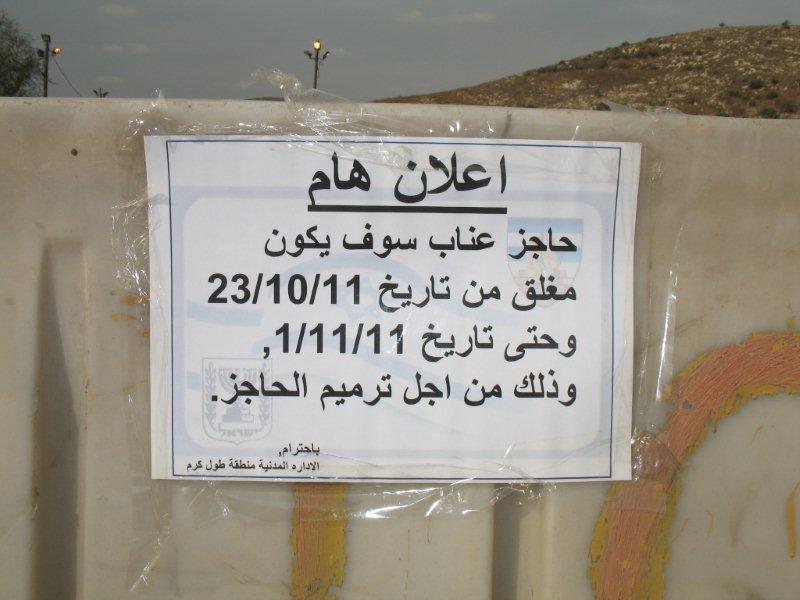 Oct-28-2011Anabta checkpoint 24.10.11
-
Eyal Checkpoint / Crossing
See all reports for this place-
Eyal Checkpoint is intended for pedestrians and Palestinians only. This is the main barrier for workers to cross from the center of the West Bank. Workers with a work permit to enter Israel can pass through it for trade, medicine, and visiting prisoners. The checkpoint was built on the Green Line north of Qalqilya in the separation barrier that surrounds the city. The checkpoint began operating in 2004 by the military. Opening hours on weekdays from 04:00 to 19:00. We started holding shifts there in 2007. We arrived at the checkpoint before it opened at 4 in the morning. We reported on the difficult conditions and the long and cramped queues of workers who must continue their journey by commuting to work throughout Israel. At the end of June 2009, the checkpoint was operated by a civil security company, The transit time has been gradually shortened, today it is faster, but the Palestinians still have to arrive very early to make it to the transportation. Usually, about 15,000 people pass through.
-
Irtah (Sha'ar Efrayim)
See all reports for this place-
The checkpoint is for Palestinians only. It is the main barrier to the passage of workers from the northern West Bank to Israel. Workers with a permit to work in Israel and also for trade (with appropriate permissions), medicine, and visiting prisoners. One can cross the checkpoint only on foot. The checkpoint is located north of Road 557 and south of Tulkarm. Operated by a civil security company, opening hours: between 4:00 and 19:00 on weekdays. As members of Machsom Watch, we began our shifts to this location in 2007. We arrived before it opened at 4 in the morning and report since, on the harsh conditions and the long and crowded queues of workers. The workers who pass by continue their journey by transportation to work throughout Israel. In the first period of its activity, about 3,000 and then 5,000 people passed through this checkpoint every day. Due to the small number of checking points and arbitrary delays for long periods of time in the "rooms", workers feared losing their transportation. Hence workers leave their homes at 2:30 at night to be among the first. Today, 15,000 pass and the transition is faster. Workers are still leaving their homes very early to get past the checkpoint at 7 p.m. In an adjacent compound, there is a terminal for the transfer of goods on a commercial scale, using the back-to-back method.
-