
‘Anabta, Eyal, Sun 24.2.08, Morning
Eyal 7.10
At the Ayal crossing the last of the people come out saying that there were delays at the exit. We tried to find out from the soldiers why this was so and they said that there is always pressure on a Sunday. We saw 4 checking post in spite of the pressure which was expected. At Irtach there had been no problem according to the workers and at Jubara there was no line . People from Jenin and Tulkarm between the ages of 16-35 could not exit. One detainee waited for his ID. He had been caught trying to bypass but the soldiers said that if it was found that he was not wanted he could pass.
Anabta 7.45
At the exit a line of which one could not see the end. Again the same limitations as at Jubara. Residents of Israel could enter as opposed to the situation last week. We asked Tammie to request reinforcements for the checking area
'Anabta CP
See all reports for this place-
'Anabta CP
The checkpoint is located south of the village of 'Anabta, at the intersection of Road 60 (leading to Nablus at the entrance to Area A), with Road (57, 557, 5576) facing west towards the Einav settlement and the checkpoint at the exit from the West Bank - Figs checkpoint. Until 2010 we used to watch the intersection and report the long columns created due to a slow inspection of the vehicles in both directions.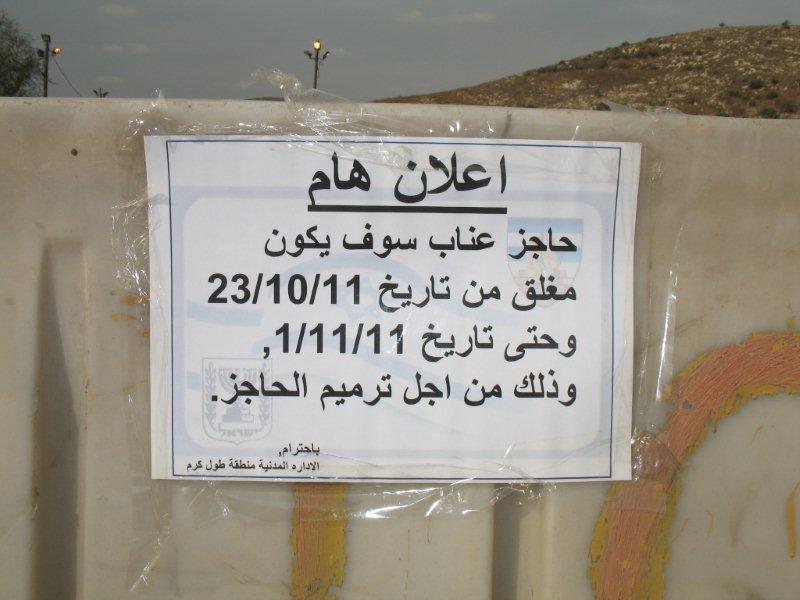 Oct-28-2011Anabta checkpoint 24.10.11
-
Eyal Checkpoint / Crossing
See all reports for this place-
Eyal Checkpoint is intended for pedestrians and Palestinians only. This is the main barrier for workers to cross from the center of the West Bank. Workers with a work permit to enter Israel can pass through it for trade, medicine, and visiting prisoners. The checkpoint was built on the Green Line north of Qalqilya in the separation barrier that surrounds the city. The checkpoint began operating in 2004 by the military. Opening hours on weekdays from 04:00 to 19:00. We started holding shifts there in 2007. We arrived at the checkpoint before it opened at 4 in the morning. We reported on the difficult conditions and the long and cramped queues of workers who must continue their journey by commuting to work throughout Israel. At the end of June 2009, the checkpoint was operated by a civil security company, The transit time has been gradually shortened, today it is faster, but the Palestinians still have to arrive very early to make it to the transportation. Usually, about 15,000 people pass through.
-