
‘Anabta, Falamiya, Kufr Jammal
Falamya CP, Kufr Jammal, Beit Lid, 'Anabta CP,
. At its side are some other buildings
with large glass windows in the front.under construction It will apparently become a
restaurant or a wedding hall.
09:45 Jayyus. The village is quiet, hardly anyone outside. Not even
the army. From there we go to Falamya CP. The gate is locked. Three soldiers
are inside; one approaches us and greets us
pleasantly. "The CP opens at 07:00 and stays open all day". So why
is it closed now? "They are throwing stones in Jayyus". "We were
just there", we say, "and it was quiet". Here the girl-soldier
intervenes, in a provoking tone we are familar with. "Where do you
live?", she asks. "In Tel Aviv. Where did you think?". "Over
there", she points to the Palestinian village. Ha ha
10:15 KufrJammal. A group of people are huddled in a small store. They say the
village is living its quiet life. Last night soldiers entered, but
then just left. They attribute the quiet to the neighboring
settlement, Sal'it, whose residents leave them alone. This kind of
reality, rare in the West Bank, also exists in Jurish. They too
enjoy relative quiet because their neighboring settlement, Migdalim,
do not harass them. It is sad to realize again how dependent the
Palestinians are on the good will (in these few cases) or bad (more
frequent) of their neighbors the occupiers. How do the villagers
make their living? Those with permits leave at 03:00 to Qalqilya,
hoping to pass Eyal CP in time for work. Others, with plots of
vegetables and herbs, have permits to reach their land daily through
Falamya CP. Olive harvesting, on the other hand, is limited to one
month a year.
As we exit Kufr Jammal, we see Sal'it on the neighboring hill. It
is expanding: we see 5 buildings under construction on the hillside.
Who, exactly, owns the land on which these nice and not harassing
neighbors are building?
11:00 Beit Lid. At this time of day the stores are closed, and no
people are outside. But there's a new school in town, in the center
of which is a fine basketball yard. Next to it there is a decorated
building for parties and weddings. Modest signs of relative
prosperity.
11:15 'Anabta (Einav) CP. Open. Cars go back and forth unhindered.
We do a u-turn, three miltary policewomen ignore us.
12:00 Back to Rosh Ha'Ayin
==============================
'Anabta CP
See all reports for this place-
'Anabta CP
The checkpoint is located south of the village of 'Anabta, at the intersection of Road 60 (leading to Nablus at the entrance to Area A), with Road (57, 557, 5576) facing west towards the Einav settlement and the checkpoint at the exit from the West Bank - Figs checkpoint. Until 2010 we used to watch the intersection and report the long columns created due to a slow inspection of the vehicles in both directions.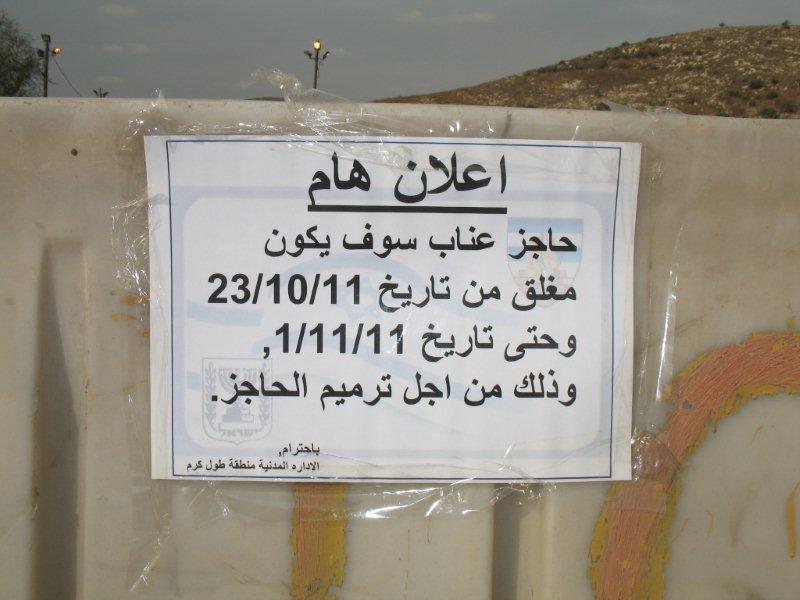 Oct-28-2011Anabta checkpoint 24.10.11
-
Falamiya
See all reports for this placeKufr Jammal
See all reports for this place-
Kufr Jammal This village, rising about 200 meters over sea level, is located about 14 kilometers south of Tul Karm town and about 17 kilometers from the Mediterranean Sea. The families living there since the mid-18th century number about 3,000 persons at present. The village has lost thousands of dunams of its northern and western lands due to the construction of the Separation Barrier, leaving the lands themselves behind the barrier. After the Israeli Supreme Court ruling in 2011, the barrier was moved to the west and many farmlands were returned to their owners. It is a quiet village, its relations with the nearby settler-colony of Sal’it are favorable, and many of the villagers work in the colony’s industrial plants. Farmers cross the agricultural checkpoint close to this settler-colony in order to tend their fields unhampered. However, there are numerous acts of harassment and disorder taking place when the village farmers cross the other agricultural checkpoints: gates do not open at hours suitable to the farmers’ needs, and for a short period of time only; the Civil Administration usually prevents all kinds of crops except olives; tractors and other farm equipment are forbidden entry; only a single permit is issued per family, and occasionally such permits are confiscated and their re-issue is delayed – the common excuse is usually “security reasons”. How do the villagers make their living? Holders of work permits inside Israel travel at 3 a.m. to Eyal Checkpoint near Qalqiliya town in order to make it on time to their workplace at Sal’it (close to their village) and elsewhere. Owners of vegetable patches who hold permits are allowed to reach their fields beyond the Separation Barrier through the distant Falamiya Checkpoint. Importantly, fields returned to the village show amazing improvement intending, irrigation and farming variety – and instead of the neglected olive tree groves that were accessible only to holders of transit permits through agricultural checkpoints usually closed, farming has now flourished. (updated Jan 2021)
-