
‘Anabta, Habla, Irtah (Sha’ar Efrayim), Mon 30.8.10, Afternoon
14:30 Habla
When we arrived we saw a group of five men entering to be inspected. They trickled out and crossed without delay. A truck carrying seedlings was also inspected and crossed without any unusual delay.
16:05 Southern Falamya gate
We entered Azzun through the main entrance, turned right under Route 55 and drove toward Jayyus. Instead of entering Jayyus we turned right toward the village of Jamal, and after driving for about 1 ½ kilometers turned left onto a dirt road that led us straight to Falamya gate, on which “Gate 927” is written in big letters. It’s not easy to find one’s way in the area, and we got lost a few times. We received directions by phone from Nina Seba, who’d already been there, and Na’im el-Bada, from Jayyus, whom we met on the way in Jayyus, also helped.
If you want to reach Falamya gate, don’t miss the turn onto the dirt road, which is located about 100 meters past a road that goes steeply uphill. At the turnoff to the dirt road are signs belonging to foreign organizations such as FUNDESOR, aecid, UAWC.
This is an agricultural gate, open from 05:00 until 17:00. Everything appears quiet and calm. It serves primarily villagers from Jayyus, Jamal and Falamya. The soldiers told us they don’t see any problems; they know all the local farmers who enter with their ID cards. Children younger than 16 wishing to help out, and are too young to have ID cards, are allowed to bring the ID card of one of their parents.
We continued to the Western Jayyus gate, that’s nearby. It was closed. It’s open between 18:00 – 18:30 in the afternoon.
17:50 Anav checkpoint, via the villages of Khaja and Al-Funduq
From Jayyus we drove back up to the nearby village of Jamal. We turned left at the central plaza. From the road down from the plaza you can see the security fence on the left. After about four kilometers there’s a junction at which we turned right toward Kur (if we’d gone straight we’d have reached Tulkarm). After turning right we drove straight for about seven kilometers to the village of Khaja, which adjoins Al-Funduq.
Driving through this region, you get the impression that it’s quiet and calm. No settlements are visible. The area is open and the minarets of the village mosques rise above the hills. We have to admit that the residents also seem calm and quiet. They’re more relaxed. People riding bicycles alongside others on donkeys. Something about their body language expresses greater self-confidence. Not like in Khaja and Al-Funduq that are right next to Qedumim, where the suspicious looks of people were allayed only by the flag on our car.
After driving through the villages we rode on Route 55 to Jit junction, and turned left onto Route 60, going north to the Anav checkpoint (Anabta), and from there via the Te’anim checkpoint to the Ephraim crossing.
18:20 Ephraim crossing
The crossing is almost empty, very few people going through. The checkpoint closes at 19:00, and given that daylight saving time ended early because of Ramadan it seems that most people are getting home by this hour.
'Anabta CP
See all reports for this place-
'Anabta CP
The checkpoint is located south of the village of 'Anabta, at the intersection of Road 60 (leading to Nablus at the entrance to Area A), with Road (57, 557, 5576) facing west towards the Einav settlement and the checkpoint at the exit from the West Bank - Figs checkpoint. Until 2010 we used to watch the intersection and report the long columns created due to a slow inspection of the vehicles in both directions.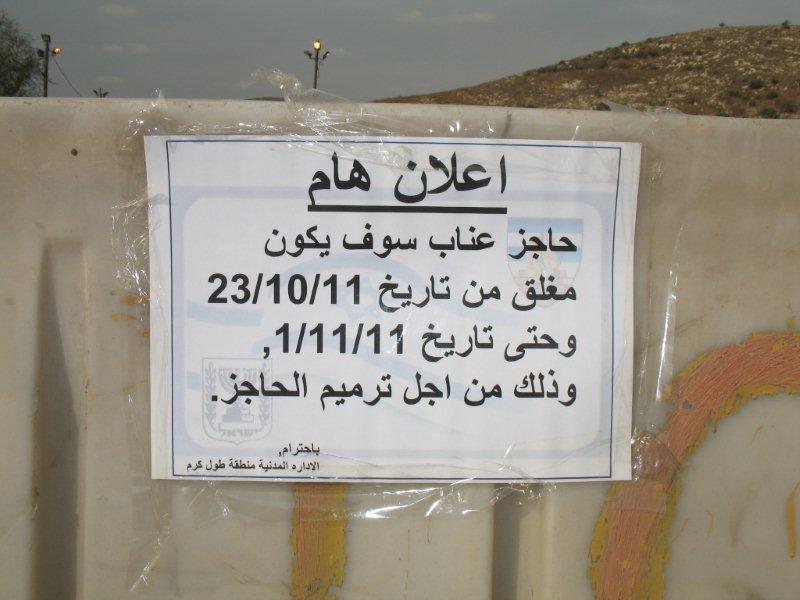 Oct-28-2011Anabta checkpoint 24.10.11
-
Habla
See all reports for this place-
Habla CP (1393)
The Habla checkpoint (1393) was established on the lands of the residents of Qalqilya, on the short road that
connected it for centuries to the nearby town of Habla. The separation barrier intersects this road twice and cut off the residents of Qalqilya from their lands in the seam zone.(between the fence and the green line).
There is a passage under Road 55 that connects Qalqilya to the sabotage This agricultural barrier is used by the farmers and nursery owners established along Road 55 from the Green Line and on both sides of the kurkar road leading to the checkpoint.
This agricultural checkpoint serves the residents of Arab a-Ramadin al-Janoubi (detached from the West Bank), who pass through it to the West Bank and back to their homes. The opening hours (3 times a day) of this agricultural checkpoint are longer than usual, about an hour (recently shortened to 45 minutes), and are coordinated with the transportation hours of a-Ramadin children studying in the occupied in the West Bank.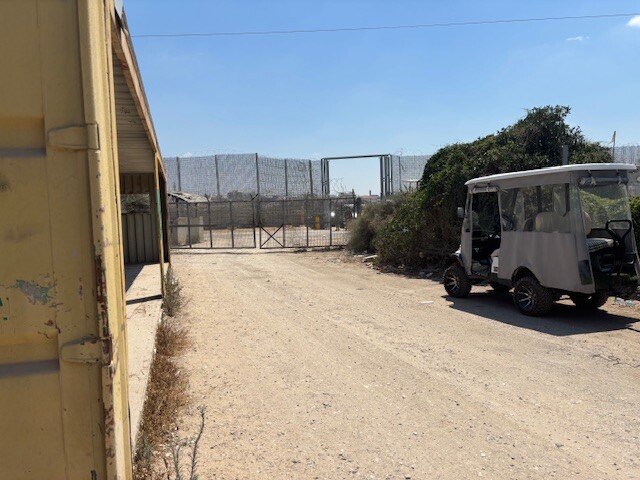 Nina SebaAug-18-2025Habla: The gate is in the process of closing
-
Irtah (Sha'ar Efrayim)
See all reports for this place-
The checkpoint is for Palestinians only. It is the main barrier to the passage of workers from the northern West Bank to Israel. Workers with a permit to work in Israel and also for trade (with appropriate permissions), medicine, and visiting prisoners. One can cross the checkpoint only on foot. The checkpoint is located north of Road 557 and south of Tulkarm. Operated by a civil security company, opening hours: between 4:00 and 19:00 on weekdays. As members of Machsom Watch, we began our shifts to this location in 2007. We arrived before it opened at 4 in the morning and report since, on the harsh conditions and the long and crowded queues of workers. The workers who pass by continue their journey by transportation to work throughout Israel. In the first period of its activity, about 3,000 and then 5,000 people passed through this checkpoint every day. Due to the small number of checking points and arbitrary delays for long periods of time in the "rooms", workers feared losing their transportation. Hence workers leave their homes at 2:30 at night to be among the first. Today, 15,000 pass and the transition is faster. Workers are still leaving their homes very early to get past the checkpoint at 7 p.m. In an adjacent compound, there is a terminal for the transfer of goods on a commercial scale, using the back-to-back method.
-