
‘Anabta, Irtah, Jubara (Kafriat), Qalqiliya, Thu 19.3.09, Morning
- The cargo terminal
at Irtach (Sha’ar Efrayim) – The parking lot is full with loaded
trucks. A private security company is operating the terminal. The moment
we arrive two security guards nervously demand that we leave at once.
They tell us that we are not permitted to be at the terminal, that it
is a closed military area (?) and on no condition are we permitted to
take pictures!
There is much traffic. Trucks
on their way in and out are waiting for their permits to load or unload
to be checked. A security guard losing his patience phones to report
that we are on the site. At the Irtach checkpoint
on the other side of the fence, next to the turnstile there are about
20 people, with permits ready to be checked, from different places in
the area: Haras, Jit, Kadum, Azun, Atma, Qalqiliya. They are waiting
for the District Coordination Administration (DCO) to open only between
8.30 to 9.00 in the morning. The roadblock itself is supposed to open
at 4.30 in the morning and, as we already know, at this hour there are
hundreds if not thousands of workers and families of prisoners waiting
to pass the checkpoint at the entrance to Israel.
It is important to remember
that the checkpoint itself is operated by a private security company
“Modi’in Ezrahi” which checks the entrance permits to Israel.
The DCO manned by the army (mainly the Shabak) is in charge of issuing
the permits.
A voice from the
loudspeakers: “Is there anybody entering Israel?” The waiting people
answer: “No, no!” They all have magnetic cards but no permits. They
want permits. The coffee vendor offers tea and coffee.
Lior, Yaron’s second (who
has not arrived yet) answers our questions patiently. On the parking
lot a few vans are waiting for their passengers. A bus, accompanied
by a police car, with a small number of relatives is leaving for the
Damun Jail. The soldiers serving
in the DCO arrive.
9.00 Jubara
– One cannot but feel terrible every time one sees Abu Hatam’s
house cut off from the road leading to the village by fences and gates
and two cement blocks having been placed there lately. As if all the
fences, the gate, the soldiers and the police were not enough to prevent
“intruders” to break through. Seeing the two big blocks I remember
the days when there were no fences and no gate but only two cement blocks.
A few soldiers would be posted there while a large number of people
would be waiting in line to pass through and go north to Jubara or east
to Nablus. It’s hard to remember how this house looked until not long
ago, when we stopped to talk with Abu Hatam and have a cup of coffee.
Does anybody know what has happened to him?
We ask to enter the village.
The commander at the roadblock enquires on the phone: “ Are we permitted
to open the southern gate?” “No, no!” is the loud answer.
A police car arrives at the entrance
to the territories. The roadblock itself is on Palestinian territory
close to Abu Hatam’s house and on the road leading to Avnei Hefetz
and Einav as well as to Shofa and Anabta and from there to road 60 to
Jerusalem.
A young woman working for the
security company “Modi’in Hefetz”, a law student, stops the entering
vehicles, mostly the trucks, checks the permits and examines the goods
carefully. “We only check the goods, to prevent stolen goods, God
forbid, to enter the territories. We make sure that the goods matches
the delivery note.” I remark that from here the cars drive only into
the territories, that only Israel is in the opposite direction. She
smiles trying to explain that “there are many Jewish settlements in
the area, Avnei Hefetz, Einav, Immanuel, Elkana, – those are Jewish,
they are not the territories, they are all Israeli!” She also tells
us that a truck driver who arrived in the area for the first time got
scared. Suddenly he understood that he was in the territories, so he
asked: “Is it the territories behind the yellow?” (the iron bar)
He was so afraid that he turned around and drove away. He didn’t agree
to drive on!
At Jubara there is a police checkpoint
at the entrance to the territories. At the exit there is an army checkpoint
where magnets, I.D. cards for Palestine Authority residents, goods etc.
are being checked.
The police checkpoint examines
fresh goods such as eggs, meat, vegetables etc. and makes sure there
is a permit for agricultural products. They also check gravel, stones,
sand, cement and iron. “For example, at Immanuel they are building
a sports hall, and this is the kind of goods needed. We have to make
sure that the goods reaches its destination.” She says that she knows
how to tell real delivery notes from fake ones. “We have to look out
for stolen goods that might be used in more than one way, that might
be used by enemy organizations for the production of weapons.”
Anabta –
It is unusually busy. There is a long line of cars as well as a line
of buses from the south all the way from the junction. It is impossible
to approach the roadblock to find out what is happening. The traffic
in the opposite direction is busy. The waiting drivers do not really
know what is going on. At our request a jeep driving in our direction
stops and the soldier says: “There are working on the road at the
checkpoint.”
Qalqiliya
– The roadblock is still a “traditional” one. There are a few
cement blocks, the Israeli flag, a number of red signs prohibiting entrance
into A territory (the letter is carefully erased), a number of soldiers
and the finger indicating if to keep driving or to stop. There is no
turnstile, there are no fences and gates and electronic eyes keeping
watch from afar. There is no private company operating the roadblock
and there are no loudspeakers. One can still see people stopping and
talking to each other. This does not mean that the place is idyllic.
This is the only roadblock through which one can enter and leave this
big town surrounded by a 9 meters high wall and with a population of
50,000 people. A man from Qalqiliya once said to me that his town is
like a pot with boiling water without a handle. Close by to the south
of the roadblock there is a large smoking garbage site.
Omri, the roadblock commander,
tells us to keep a distance because it is closed military area. We insist
and he lets us stay. There is little traffic. Cab drivers waiting for
passengers on the east side (“our”) come up to report and to find
out why the road towards Haji, Kadum is closed and why the road to Azzun
is completely blocked. Driving on highway 55 they did not notice anything
out of the ordinary. They also pointed out that every day between 3
–4 o’clock p.m. the roadblock is very busy and crowded with cars,
that the line reaches the far side of the junction, that everybody is
impatient and that it takes a long time to drive through. They tell
us we have to come and see for ourselves.
One of the drivers, a 28-year-old
man living in Qalqiliya, tells us that detaining him, handcuffing him,
covering his eyes, investigating him and releasing him has become a
routine. It happens a few times a month. “I haven’t done anything.
Why do they do it to me? I just want to work!”
'Anabta CP
See all reports for this place-
'Anabta CP
The checkpoint is located south of the village of 'Anabta, at the intersection of Road 60 (leading to Nablus at the entrance to Area A), with Road (57, 557, 5576) facing west towards the Einav settlement and the checkpoint at the exit from the West Bank - Figs checkpoint. Until 2010 we used to watch the intersection and report the long columns created due to a slow inspection of the vehicles in both directions.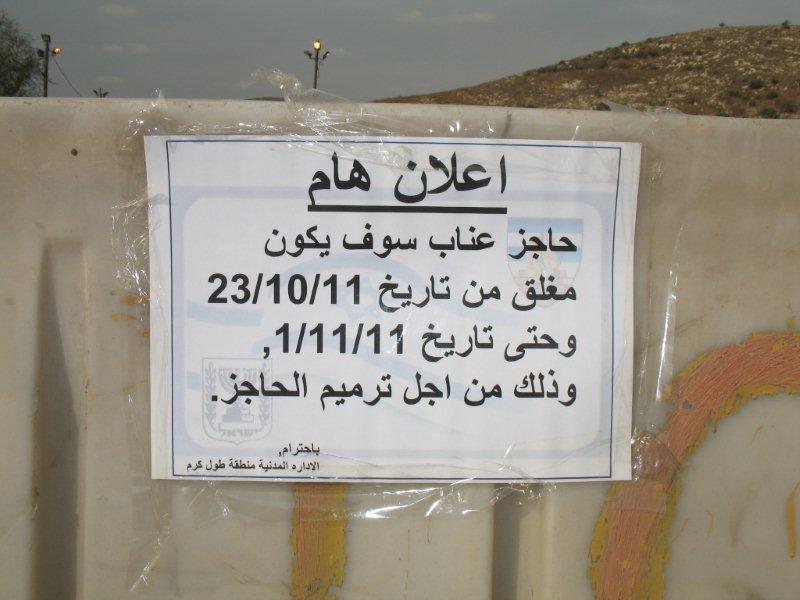 Oct-28-2011Anabta checkpoint 24.10.11
-
Irtah (Sha'ar Efrayim)
See all reports for this place-
The checkpoint is for Palestinians only. It is the main barrier to the passage of workers from the northern West Bank to Israel. Workers with a permit to work in Israel and also for trade (with appropriate permissions), medicine, and visiting prisoners. One can cross the checkpoint only on foot. The checkpoint is located north of Road 557 and south of Tulkarm. Operated by a civil security company, opening hours: between 4:00 and 19:00 on weekdays. As members of Machsom Watch, we began our shifts to this location in 2007. We arrived before it opened at 4 in the morning and report since, on the harsh conditions and the long and crowded queues of workers. The workers who pass by continue their journey by transportation to work throughout Israel. In the first period of its activity, about 3,000 and then 5,000 people passed through this checkpoint every day. Due to the small number of checking points and arbitrary delays for long periods of time in the "rooms", workers feared losing their transportation. Hence workers leave their homes at 2:30 at night to be among the first. Today, 15,000 pass and the transition is faster. Workers are still leaving their homes very early to get past the checkpoint at 7 p.m. In an adjacent compound, there is a terminal for the transfer of goods on a commercial scale, using the back-to-back method.
-
Jubara (Kafriat)
See all reports for this place-
The Jabra checkpoint was on Road 557, south of Tulkarm, on the side of the Figs Pass, which is located within the Palestinian Authority (a few kilometers east of the Green Line), and serves as an entry barrier from the territories to Israel. The checkpoint to the village of Jubara, which until 2013 was in the seam area, blocked and surrounded by a fence, was intended for the passage of the family members of the house next to the checkpoint, and also for the MachsomWatch volunteers (with special permission only), on their way to checkpoint 753. on the other side of the village. The soldiers supervising the "fig crossing" also supervised the crossing at this checkpoint, in our shifts we often waited a long time until the key was found and the gate opened. The checkpoint was abolished and became part of the separation fence that was moved west following the High Court.
-
Qalqiliya checkpoint
See all reports for this place-
Qalqilya is surrounded on all sides by the separation barrier. The only exit from the city is in the east of the city on the road that leaves the city in an easterly direction. This is where the checkpoint was located. When the checkpoint was active until 2009 our shifts watched long queues of cars being inspected at the only exit from the city to the West Bank. The checkpoint was canceled, but there is a military presence at the entrance to the city.
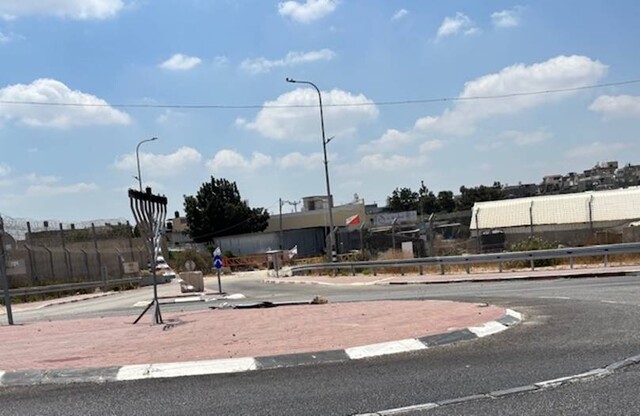 Nina SebaAug-18-2025Azzun: Enclosed by a high fence and the gate to the village is closed
-