
‘Anabta, Irtah (Sha’ar Efrayim), Mon 18.1.10, Afternoon
- The routine of the occupation and an obviously unpleasant event near Avnei Hefetz
- From the moment we entered Palestinian territory until we reached Huwara the car went from one target to another.
- It appears that all the facilities that the army has put up are used for posting signs with settler propaganda.
14:10 – We can see through the puddles that the entrance to Zita is still blocked, and there are cars standing on both sides of the checkpoint..
Zatra Checkpoint
There are about 20 vehicles waiting at the entrance to the junction from the direction of Huwara. Large signs are hanging on the fence surrounding the junction that read "Settle Nablus and Jacob's Tomb."
Huwara
15:00 – There is a new traffic island dividing the entrance road into Nablus. Two soldiers are standing in the southern position at the entrance, but all vehicles, even those with yellow license plates, are not being stopped. Most cars exiting the city are also not being stopped, but a minibus and taxi are stopped for passengers' documents to be checked.
Anabta
The checkpoint is open to traffic. There are no soldiers in the area and we drove up to the checkpoint. We made a U turn and headed towards Jubara.
Avnei Hefetz
Opposite the settlement an army jeep appeared and signaled for us to stop. There were three soldiers in it, one with long hair. They got out and pointed their weapons at us. It was a surrealistic and frightening sight. We felt just like the Palestinians frequently feel. We were convinced that they were settlers, since the person with long hair did not look like a soldier in active military service. They approached us, weapons still drawn, and asked us what we were doing. We identified ourseives as Machsom Watch and they asked to see our documents. One of them checked our documents, while the other continued to stand facing us, his rifle lowered to a 45 degree angle. We asked him if he was not ashamed to point his weapons at us, and he said that every soldier is issued a weapon. Pitchia called Ada Rabon and asked what to do and Ada also felt that they were settlers. We called the hotline and complained and a woman soldier registered our complaint. The episode ended with our documents being returned and we were told that the soldier at the checkpoint saw us and issued an alarm. We concluded that the soldier in the pillbox whom we had not seen had seen us approach and turn around and became alarmed.
Irtah
16:10 – There are two positions open. There are fewer people coming through than usual and they go through quickly.
'Anabta CP
See all reports for this place-
'Anabta CP
The checkpoint is located south of the village of 'Anabta, at the intersection of Road 60 (leading to Nablus at the entrance to Area A), with Road (57, 557, 5576) facing west towards the Einav settlement and the checkpoint at the exit from the West Bank - Figs checkpoint. Until 2010 we used to watch the intersection and report the long columns created due to a slow inspection of the vehicles in both directions.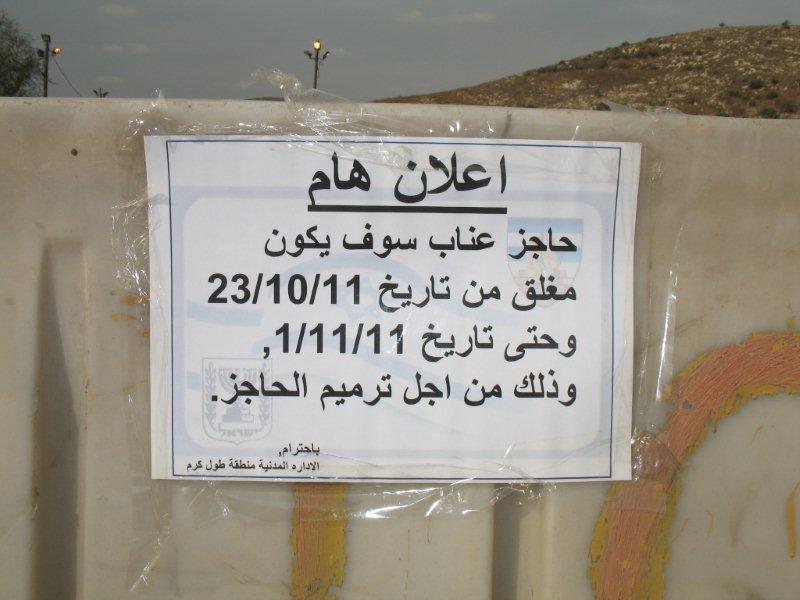 Oct-28-2011Anabta checkpoint 24.10.11
-
Irtah (Sha'ar Efrayim)
See all reports for this place-
The checkpoint is for Palestinians only. It is the main barrier to the passage of workers from the northern West Bank to Israel. Workers with a permit to work in Israel and also for trade (with appropriate permissions), medicine, and visiting prisoners. One can cross the checkpoint only on foot. The checkpoint is located north of Road 557 and south of Tulkarm. Operated by a civil security company, opening hours: between 4:00 and 19:00 on weekdays. As members of Machsom Watch, we began our shifts to this location in 2007. We arrived before it opened at 4 in the morning and report since, on the harsh conditions and the long and crowded queues of workers. The workers who pass by continue their journey by transportation to work throughout Israel. In the first period of its activity, about 3,000 and then 5,000 people passed through this checkpoint every day. Due to the small number of checking points and arbitrary delays for long periods of time in the "rooms", workers feared losing their transportation. Hence workers leave their homes at 2:30 at night to be among the first. Today, 15,000 pass and the transition is faster. Workers are still leaving their homes very early to get past the checkpoint at 7 p.m. In an adjacent compound, there is a terminal for the transfer of goods on a commercial scale, using the back-to-back method.
-