
‘Anabta, Irtah, Tue 4.3.08, Morning
Irtah
06:45-07:00 – A long time since our last visit, and nothing has changed. Workers are still coming out of the facility complaining about the long wait and the extra random check at what is called "the rooms".
Anabta
09:15-09:30 (back from Beit Iba) – Again, like last week, no vehicles queuing up. A soldier manning the checkpoint notifies us that taking photographs "is forbidden". We put him right, though Noga always consents not to photograph the faces of soldiers.
09:45-10:30 – The saga of the closed gate goes on. The key is there, but the checkpoint commander is unfamiliar with the permission granted to us to enter the village. We call Tammi, and eventually the gate is opened for us. The village is deserted as usual, and down in Ar-Ras hardly any vehicles pass.
'Anabta CP
See all reports for this place-
'Anabta CP
The checkpoint is located south of the village of 'Anabta, at the intersection of Road 60 (leading to Nablus at the entrance to Area A), with Road (57, 557, 5576) facing west towards the Einav settlement and the checkpoint at the exit from the West Bank - Figs checkpoint. Until 2010 we used to watch the intersection and report the long columns created due to a slow inspection of the vehicles in both directions.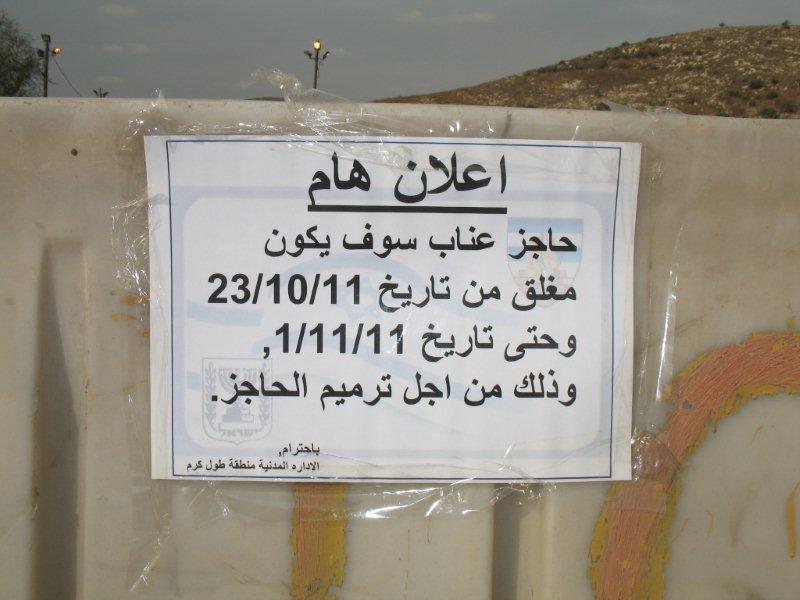 Oct-28-2011Anabta checkpoint 24.10.11
-
Irtah (Sha'ar Efrayim)
See all reports for this place-
The checkpoint is for Palestinians only. It is the main barrier to the passage of workers from the northern West Bank to Israel. Workers with a permit to work in Israel and also for trade (with appropriate permissions), medicine, and visiting prisoners. One can cross the checkpoint only on foot. The checkpoint is located north of Road 557 and south of Tulkarm. Operated by a civil security company, opening hours: between 4:00 and 19:00 on weekdays. As members of Machsom Watch, we began our shifts to this location in 2007. We arrived before it opened at 4 in the morning and report since, on the harsh conditions and the long and crowded queues of workers. The workers who pass by continue their journey by transportation to work throughout Israel. In the first period of its activity, about 3,000 and then 5,000 people passed through this checkpoint every day. Due to the small number of checking points and arbitrary delays for long periods of time in the "rooms", workers feared losing their transportation. Hence workers leave their homes at 2:30 at night to be among the first. Today, 15,000 pass and the transition is faster. Workers are still leaving their homes very early to get past the checkpoint at 7 p.m. In an adjacent compound, there is a terminal for the transfer of goods on a commercial scale, using the back-to-back method.
-