
'Anata-Shu'afat


Coming to the conclusion that it was no longer necessary to go to Qalandiya every week, we decided this time to see conditions at Shuafat refugee camp. We arrived at 6 a.m. and it took quite a while to find parking on the Israeli side, from where we walked to the Palestinian side.
The refugee camp itself is annexed to Jerusalem but remains beyond the separation wall. Therefore the inhabitants, although they hold blue residents’ documents, have to pass the checkpoint on their way to Jerusalem whether by transport or on foot. Today there are also residents who are not considered Jerusalem residents, and there are also residents of Anata who use the checkpoint – they all need permits.
Most school children are already on vacation, so there are very few buses in the parking lot intended for them. Traffic in the square in front of the checkpoint is dense, but gradually advances. Relative to the situation on previous visits a few years ago, one might call it clean. (But if the streets looked like this where we live, we would think it very dirty…)
Inside the camp, there seemed to be still lights left from Ramadan. There was also a poster with Ramadan greetings from Jerusalem municipality.
After waiting a while we went to the pedestrian checkpoint. This was small, but seemed adequate [at this time] for the needs. Two positions were active. One line was for people without packages; the other was open to all. Women seemed all to line up at the latter one, and this was slower. The turnstile allowed only one person to pass at a time (though sometimes a second one squeezed through). We stood in this longer line which soon stretched out of the building. From the other turnstile we suddenly heard shouting, apparently from someone who was being detained by a soldier who asked him to stand aside so that meanwhile other people could pass. People waiting in line began banging loudly on the metal door. Then when they finally let the people through, they asked a man if he was the one banging or, if not he, who was. The man answered “there are cameras. See who banged and let people pass.” In the end, passage resumed.
Meanwhile, our own line moved slowly. When our turn came, they were letting in more than one at a time, presumably to speed up passage. Altogether it took us 15 minutes to pass. At 7 o’clock we were already back in our car. There is definitely room for improvement at this checkpoint….
Checkpoint Shu'afat camp / Anata-Shu'afat (Jerusalem)
See all reports for this place-
The Shu’afat checkpoint is located in the northern part of East Jerusalem at the exit from the village of Anata and the Shu’afat refugee camp, which are located in the area annexed to Jerusalem in 1967. The refugee camp borders the Shu’afat neighborhood to the west, Pisgat Ze’ev to the north, the French Hill neighborhood to the south and the planned expansion of Ma’aleh Adumim to E-1 in the east. It was established in 1966 for 1948 refugees from the West Bank and was populated after the Six Day War by persons who had been expelled from the Jewish Quarter. Today its population comprises some 25,000 people holding blue ID cards and some 15,000 people with Palestinian ID cards. The camp lacks adequate infrastructure and services, and suffers from poverty, neglect and overcrowding. All its buildings are connected to the public electricity and water infrastructure, but not all are connected to the sewer system. The camp’s services are provided by UNRWA, except for those such as health clinics and transportation of pupils to schools in Jerusalem. In 2005, the Israeli High Court of Justice rejected a suit by the residents requesting that the route of the separation fence be drawn such that the camp would remain on the Israeli side, but conditioned its approval of the route on the establishment of a convenient and rapid crossing facility for the inhabitants of the neighborhood, most of whom are residents of Jerusalem.
A temporary checkpoint operated there until December, 2011. It was extremely congested during rush hours, and dangerous for pedestrians (especially children) because of inadequate safety provisions. The new checkpoint was inaugurated south of the old one, for public and private transportation and for pedestrians, intended solely for the residents of the camp – holders of blue ID cards, and those with Palestinian ID cards who possess appropriate permits. There are five vehicle inspection stations at the checkpoint, and two for pedestrians (one of which is currently closed) where scanners have been installed but are not yet operating. According to the army, representatives of government agencies will also be present to provide services to residents of the neighbourhood. The pedestrian lanes are very long, located far from the small parking lots, and accessible through only a single revolving gate.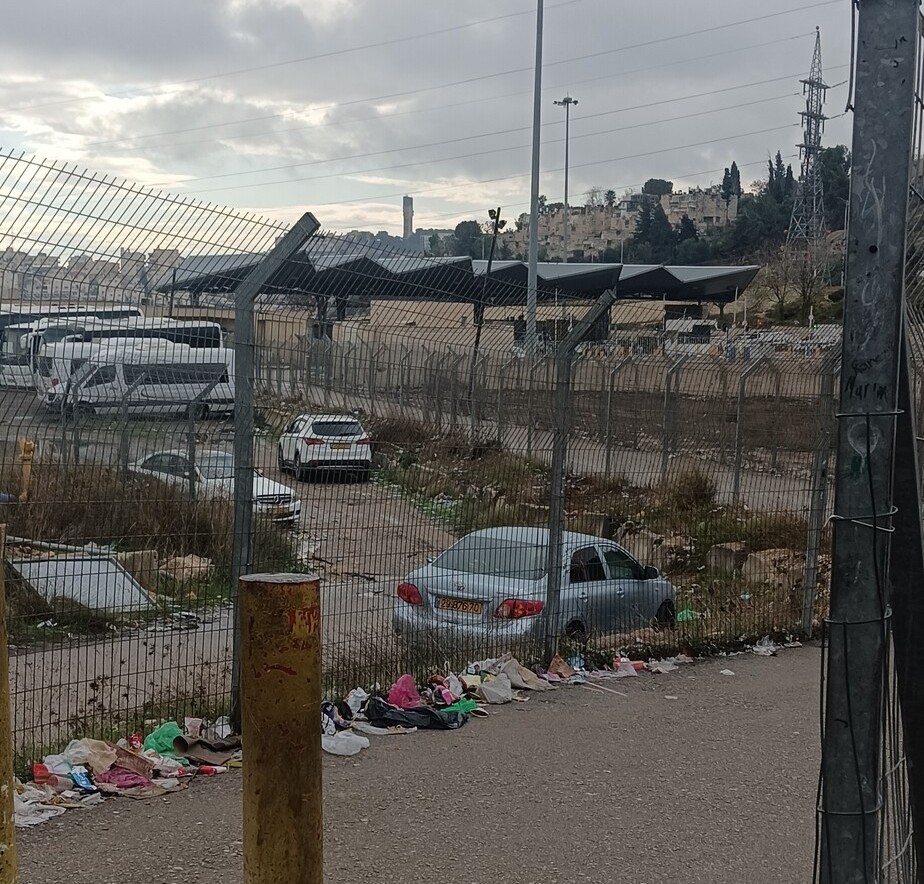 Ronny PerlmanDec-10-2025Anata Checkpoint: Neglect
-