
‘Anin, Barta’a-Reihan, Tura-Shaked, Sun 17.11.13, Afternoon
15:30 A’anin checkpoint
It’s raining. Men, women and children stand under the canopy, wet, some around fires of burning branches. A small child shivers with cold beside the fire and an old woman in a yellow dress, wet from the rain, tries to warm herself; sometimes, when more branches are added, the fire flares up impressively.
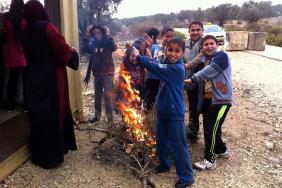
A military ambulance arrives about ten minutes later. A female soldier opens the gate; she’s a physician. Did something happen? To a soldier? She says they treat everyone who needs treatment, including Palestinians, but they’re now returning to the base. The gate is locked again and the ambulance drives off to its base.
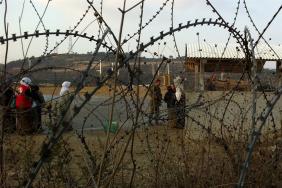
We began telephoning the DCO, to all the numbers we had, but no one answered or we were told we’d reached the wrong place. Finally I really got annoyed and told the soldier – people here are freezing, drenched, and you can’t walk to the next room to tell them the checkpoint is locked? The soldier acceded.
In any case, the gate opened at four; the soldiers were jumpy. Two female soldiers stationed themselves behind the concrete barriers and two male soldiers came toward the gate. The women and children went through first, as is usual among the Palestinians, in groups of five as instructed by the soldiers. The female soldiers detained the old woman in the wet yellow dress for a longer time. Another woman went through grandly after being inspected, a sack of olives upright on her head, down the path to the checkpoint’s exit to the village. After the women were inspected it was the men’s turn. They had to go through one by one.
Ruti began photographing and a female soldier was sent to stop her. She asked for the camera but Ruti told her it was her phone and she won’t hand it over. The soldier threatened to call the police and, as if by magic, a police jeep appeared from the fenced security road and disappeared. The men continued crossing slowly and we left.
We managed to see the sunset. Sunrises and sunsets at A’anin are always so lovely.
16:30 Tura checkpoint (Shaked)
The checkpoint is open. People dribble through in both directions. It’s funny to watch people getting out of cars and walking across the special pedestrian crossing to the fenced corridor. But perhaps it wasn’t exactly a case of obeying the law, but because the car came to a stop on the pedestrian crossing. The driver and passengers followed the usual procedure and went to the inspection room. Then the driver returned to the vehicle, the light turned green, he drove the car to be inspected and the passengers returned to the car on the other side of the third gate.
16:45 Barta’a checkpoint (Reihan)
An increasing flow of men through the fenced corridor to the terminal. All go through the revolving gate that doesn’t stop for a moment. Most are returning from work in Israel; they don’t delay and exit to the West Bank. The rest, who work in Barta’a, are quickly inspected at one of the windows or the biometric scanner and exit to the lower parking lot for their rides home. Those working in Israel continue to complain that, although their jobs are near this checkpoint, they have to cross via Irtach in the morning, near Kfar Saba, where it’s very congested, slow and difficult. What’s the magic secret that prevents someone living in Yabed, for example, who works in Hadera or in other nearby localities, from crossing here in the morning as well? Is the unstated reason to make it more difficult for those working in Israel?
'Anin checkpoint (214)
See all reports for this place-
'Anin checkpoint (214)
'Anin checkpoint is located on the Separation Fence east of the Israeli community Mei Ami and close to the village of Anin in the West Bank. It is opened twice a week, morning and afternoon, on days with shorter light time, for Anin farmers whose olive groves have been separated from the village by the fence it became difficult to cultivate their land. Transit permits are only issued to those who can produce ownership documents for their caged-in land, and sometimes only to the head of the family or his widow, eldest son, and children. Sometimes the inheritors lose their right to tend to the family’s land. The permits are eked out and are re-issued only with difficulty. 55-year-old persons may cross the checkpoint (into Israel) without special permits. During the olive harvest season (about one month around October) the checkpoint is open daily and more transit permits are issued. Names of persons eligible to cross are held in the soldiers’ computers. In July 2007, a sweeping instruction was issued, stating that whoever does not return to the village through this checkpoint in the afternoon will be stripped of his transit permit when he shows up there next time. Since 2019, the checkpoint has not been allways locked with the seam-line zone gate (1 of 3 gates), and the fence around it has been broken in several sites.
-
Barta’a-Reihan Checkpoint
See all reports for this place-
This checkpoint is located on the Separation Fence route, east of the Palestinian town of East Barta’a. The latter is the largest Palestinian community inside the seam-line zone (Barta’a Enclave) in the northern West Bank. Western Barta’a, inside Israel, is adjacent to it. The Checkpoint is open all week from 5 a.m. to 9 p.m. Since mid-May 2007, the checkpoint has been managed by a civilian security company subordinate to the Ministry of Defense. People permitted to cross through this checkpoint into and from the West Bank are residents of Palestinian communities inside the Barta’a Enclave as well as West Bank Palestinian residents holding transit permit. Jewish settlers from Hermesh and Mevo Dotan cross here without inspection. A large, modern terminal is active here with 8 windows for document inspection and biometric tests (eyes and fingerprints). Usually only one or two of the 8 windows are in operation. Goods, up to medium commercial size, may pass here from the West Bank into the Barta’a Enclave. A permanent registered group of drives who have been approved by the may pass with farm produce. When the administration of the checkpoint was turned over to a civilian security firm, the Ya’abad-Mevo Dotan Junction became a permanent checkpoint. . It is manned by soldiers who sit in the watchtower and come down at random to inspect vehicles and passengers (February 2020).
-
Tura-Shaked
See all reports for this place-
Tura-Shaked
This is a fabric of life* checkpoint through which pedestrians, cabs and private cars (since 2008) pass to and from the West Bank and the Seam-line Zone to and from the industrical zone near the settler-colony Shaked, schools and kindergartens, and Jenin university campuses. The checkpoint is located between Tura village inside the West Bank and the village of Dahar Al Malah inside the enclave of the Seam-line Zone. It is opened twice a day, between 7 a.m. and 10 a.m., and from 12 noon to 7 p.m. People crossing it (at times even kindergarten children) are inspected in a bungalow with a magnometer. Names of those allowed to cross it appear in a list held by the soldiers. Usually traffic here is scant.
- fabric of life roads and checkpoints, as defined by the Terminals Authority in the Ministry of Defense (fabric of life is a laundered name that does not actually describe any kind of humanitarian purpose) are intended for Palestinians only. These roads and checkpoints have been built on lands appropriated from their Palestinian owners, including tunnels, bypass roads, and tracks passing under bridges. Thus traffic can flow between the West Bank and its separated parts that are not in any kind of territorial contiguity with it. Mostly there are no permanent checkpoint on these roads but rather ‘flying’ checkpoints, check-posts or surprise barriers. At Toura, a small (less than one dunam) and sleepy checkpoint has been established, which has filled up with the years with nearly .every means of supervision and surveillance that the Israeli military occupation has produced. (February 2020)
 Mar-21-2022Anin Checkpoint: A magnificent breach in the center of the checkpoint
-