
‘Anin, Jalama, Reihan, Shaked, Thu 18.8.11, Morning
According to the rules, a Palestinian girl is not allowed to sleep at her grandmother's house, but the Reihan settlement wants 'social justice'.

6:10 A'anin CP
Only now, ten minutes late, are they opening the CP gates. Apparently they were simply waiting for us. About thirty people, a few tractors and a donkey arrive all together at the middle gate and are waiting to go through. Almost all those going through are men. Two young men are not allowed to go through. A few boys are waiting on the other side of the fence; they know that they will not be allowed to go through.
6:50. A family asks to go through. The mother shows the daughter's birth certificate; a girl aged 12. The girl is not allowed to go through. She is sent back with her brother. The girl does not want to leave her mother who has gone through the CP, and her brother holds her arm and pulls her in the direction of the village. We do not understand why the girl is not allowed to go through. At the DCO, they say that nothing is said in the mother's permit about her being 'accompanied by 12 year olds'. The woman soldier at the CP has another argument: She has discovered the plot! She found that the mother has a bag of clothes (belonging to the girl?), a sign that the child intends to sleep at her grandmother's house 'in Israel! And she will or will not come back. I'm well acquainted with the mess' (the grandmother apparently lives nearby in Umm-el-Reihan, and not in Tel Aviv, God forbid). What is the sin, we wonder and the soldier answers that she also likes to sleep at her grandmother's house, but this (pointing at them) is against the rules (rules that apply to the girl and not to the woman soldier).
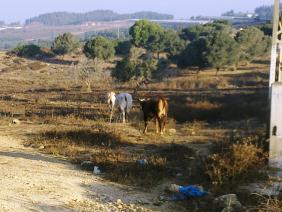
On our way to the Shaked-Tura CP, we met a farmer from A'anin on his plot of land. He points to the trees whose low branches have been licked and chewed by cows; the same cows of the resident of the Israeli Ein Sahala, that are doing damage to his land. (In the picture we can see the cows walking around in the olive groves, and none interfering with them.) He tells us that once he sowed onions in the shade of the trees, and put a fence around the plants. But that did not help. He says that the cows come by themselves without a herder and return to Ein Sahala in the evening. It has not helped to complain to the DCO and to the police. We saw the independent cows walking around in the area.
07:25 Shaked-Tura CP
Here, too, we are told that the CP was opened late. A herd of goats that we are acquainted with goes through to the seamline zone. A few people go through too. Only one woman goes through to the West Bank. The commander of the DCO, Kamil, arrives in a civilian vehicle. We ask to speak to him and we call him, but after looking in our direction he disappears. Three military jeeps arrive. In one of them, we see Menashe, the vice commander of the brigade; he stops and talks to us. We tell him about the girl from A'anin. He says that he will find out about it. He gives us a name and a telephone number because he is leaving in a week.
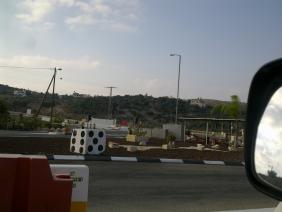
07:55 Reihan-Barta;a, Palestinian parking lot
(In the picture: a Shesh-Besh cube in the CP par, Occupation art)
The parking lot is not full. Perhaps because the Palestinian Authority has reinstated winter time, the tradesmen and workers of East Barta'a have not yet arrived. They are careful to let the few pedestrians go through in fives. A woman and her four children comes in together with five workers. The woman security guard in the hut immediately starts yelling: 'In fives, in fives! What has happened to you? You know this'.' They turned back and after a second, they entered again. Order must be preserved.
A driver complains about the difficulties of making a livelihood. The only alternative to work in transportation is in agriculture. An agricultural worker on the West Bank earns fifty shekels per day. He speaks a fluent Hebrew since for a long time he worked in Israel; he also learned the language from the book: 1000 WORDS. It turns out that he worked for years, for a family in Pardes Hannah, friends of Shula's. And he knows a surprising number of details about the history of this family.
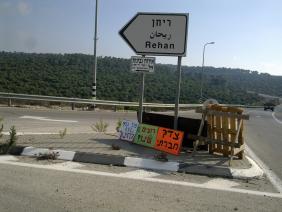
At the entrance to Reihan Settlement there are surprising and ridiculous signs: 'social justice', 'we want change', 'more money for education'. It seems that the Reihan settlers do not realize the injustice of their being there. Above the protest signs, there is a permanent sign inviting people to 'be guests of the Reihan Woods cheese' and behind them a sign announcing that 'a believer is not afraid'.
09:05 Jalameh CP
Many cars are parked at the opening of the terminal, something that is unusual. Among the vehicles in the vehicle CP, there are none that belong to Arab citizens of Israel. The passengers going to the Rambam Hospital are already waiting. No other people are going through at this time.
'Anin checkpoint (214)
See all reports for this place-
'Anin checkpoint (214)
'Anin checkpoint is located on the Separation Fence east of the Israeli community Mei Ami and close to the village of Anin in the West Bank. It is opened twice a week, morning and afternoon, on days with shorter light time, for Anin farmers whose olive groves have been separated from the village by the fence it became difficult to cultivate their land. Transit permits are only issued to those who can produce ownership documents for their caged-in land, and sometimes only to the head of the family or his widow, eldest son, and children. Sometimes the inheritors lose their right to tend to the family’s land. The permits are eked out and are re-issued only with difficulty. 55-year-old persons may cross the checkpoint (into Israel) without special permits. During the olive harvest season (about one month around October) the checkpoint is open daily and more transit permits are issued. Names of persons eligible to cross are held in the soldiers’ computers. In July 2007, a sweeping instruction was issued, stating that whoever does not return to the village through this checkpoint in the afternoon will be stripped of his transit permit when he shows up there next time. Since 2019, the checkpoint has not been allways locked with the seam-line zone gate (1 of 3 gates), and the fence around it has been broken in several sites.
-
Barta’a-Reihan Checkpoint
See all reports for this place-
This checkpoint is located on the Separation Fence route, east of the Palestinian town of East Barta’a. The latter is the largest Palestinian community inside the seam-line zone (Barta’a Enclave) in the northern West Bank. Western Barta’a, inside Israel, is adjacent to it. The Checkpoint is open all week from 5 a.m. to 9 p.m. Since mid-May 2007, the checkpoint has been managed by a civilian security company subordinate to the Ministry of Defense. People permitted to cross through this checkpoint into and from the West Bank are residents of Palestinian communities inside the Barta’a Enclave as well as West Bank Palestinian residents holding transit permit. Jewish settlers from Hermesh and Mevo Dotan cross here without inspection. A large, modern terminal is active here with 8 windows for document inspection and biometric tests (eyes and fingerprints). Usually only one or two of the 8 windows are in operation. Goods, up to medium commercial size, may pass here from the West Bank into the Barta’a Enclave. A permanent registered group of drives who have been approved by the may pass with farm produce. When the administration of the checkpoint was turned over to a civilian security firm, the Ya’abad-Mevo Dotan Junction became a permanent checkpoint. . It is manned by soldiers who sit in the watchtower and come down at random to inspect vehicles and passengers (February 2020).
-
Jalama
See all reports for this place-
North of Jenin, on the Green Line between Israel and the West Bank. A big terminal for the passage of Palestinians with permits allowing entrance into Israel and goods into Israel operates there. In the course of 2009 the terminal was opened for the passage of Israeli Arabic citizens into the West Bank. Since October 2009 they may pass in their cars.
-
Tura-Shaked
See all reports for this place-
Tura-Shaked
This is a fabric of life* checkpoint through which pedestrians, cabs and private cars (since 2008) pass to and from the West Bank and the Seam-line Zone to and from the industrical zone near the settler-colony Shaked, schools and kindergartens, and Jenin university campuses. The checkpoint is located between Tura village inside the West Bank and the village of Dahar Al Malah inside the enclave of the Seam-line Zone. It is opened twice a day, between 7 a.m. and 10 a.m., and from 12 noon to 7 p.m. People crossing it (at times even kindergarten children) are inspected in a bungalow with a magnometer. Names of those allowed to cross it appear in a list held by the soldiers. Usually traffic here is scant.
- fabric of life roads and checkpoints, as defined by the Terminals Authority in the Ministry of Defense (fabric of life is a laundered name that does not actually describe any kind of humanitarian purpose) are intended for Palestinians only. These roads and checkpoints have been built on lands appropriated from their Palestinian owners, including tunnels, bypass roads, and tracks passing under bridges. Thus traffic can flow between the West Bank and its separated parts that are not in any kind of territorial contiguity with it. Mostly there are no permanent checkpoint on these roads but rather ‘flying’ checkpoints, check-posts or surprise barriers. At Toura, a small (less than one dunam) and sleepy checkpoint has been established, which has filled up with the years with nearly .every means of supervision and surveillance that the Israeli military occupation has produced. (February 2020)
 Mar-21-2022Anin Checkpoint: A magnificent breach in the center of the checkpoint
-