
‘Anin, Reihan, Shaked, Thu 19.5.11, Morning
Translator: Charles K.
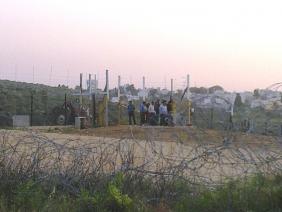 A’anin checkpoint 06:05
A small group of men and three tractors wait in the middle of the checkpoint. Opposite them, a few functionaries …sorry – I mean male and female soldiers – and who knows what they’ll tell (or lie to) their grandchildren one day about their military service in the shadow of the occupation? The number of people coming through this agricultural checkpoint, that serves the residents of A’anin who’ve been cut off from their lands by the separation fence, keeps declining. At the same time, the stories told by the few who’ve managed to get permits to reach their lands are heartbreaking, no matter how often we hear them. Their common theme – the complete indifference to the farmers’ need to work their lands every day of the year (and not only twice a week, only Tuesdays and Thursdays, from 07:00 to 15:30), as well as complete indifference to their traditions and culture. An old famer told Netta that after he had transferred ownership of his land to his sons he’s no longer permitted to reach them, even “just” to sit and rest in the shade of the ancient olive trees. “Just” isn’t enough of a reason for the occupier. The result is good for the occupier and, of course, makes the occupied population miserable: their lands and groves are neglected or abandoned, thereby making them even poorer, and certainly even more frustrated – which is excellent for Israel (that is, it must be excellent, for if it wasn’t, why do it?).
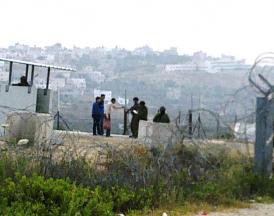 Go. Come back.
A father and son request something from the soldiers. It’s clear from their body language that they’re not exchanging Facebook addresses. It continues until we hear clicks and fragments of orders over the military walkie-talkies, and then the son is sent back to the village. The father (who always welcomes us) leaves crestfallen and angry, already exhausted from the struggle to survive. Last Monday they took the son’s ID card (he’s 25, studying computers at the Open University in Jenin), claiming that the photo isn’t of him. He went to the Salem DCO to speak with Captain Yosef or someone. There was no one to talk to. They didn’t return his ID, but told him to go to the checkpoint on Thursday. Today (Thursday) he came to the checkpoint, but today’s soldiers don’t know what he wants from them. They got rid of him, of course, sending him back to Salem. Captain Yosef, from the Salem DCO, says over the phone: “You don’t know the reason.”
The son’s ID will be returned to him only a week later, after being made to go back and forth pointlessly to the Salam DCO. Since we were in touch with him during that week, we can testify that the abuse was for the sake of abuse, nothing else. Only after we intervened with the humanitarian office, and reached the head of the Civil Administration, brigadier general Almoz, was the ID returned, but his crossing permit was confiscated and he has to arrange for a new one with the Palestinian DCO. That’s so he won’t feel too happy.
The father proudly tells us about his seven children (five sons and two daughters): a physician, a veterinarian, a teacher, the others still in school. Yes, he’s breaking his butt to insure they all have honorable professions. He’s not educated, he worked with his father since he was eight years old, he’s sold ice cream on the Tel Aviv beach and cleaned bus stations in Nahariyya and Akko.
07:00 Shaked-Tura checkpoint
Unlike the A’anin checkpoint, the one at Tura is a “Fabric-of-life checkpoint.” In other words, it’s intended to allow Palestinians separated by the fence from their neighbors to continue living as they did before (as if there were no fence…), but under the ongoing supervision of the occupier. Since the checkpoint again began to open at 7 AM, rather than at 6, the local residents are at wits’ end. It’s enough that the generator is out of order and the devices in the inspection booth aren’t working (like today), or the soldiers are new (like today), for the crossing to shut down (like today) so that everyone (workers in the industrial zone, teachers and others) is late for work, like today. The inhabitants again went to a lawyer to try and have the checkpoint remain open continuously, like the Reihan-Barta’a checkpoint, and also to remain open two hours longer at night, from ten to midnight, so that wedding guests from the West Bank can stay until the celebration has ended.
07:40 Until now, people have crossed in only one direction – from the seam zone to the West Bank (pupils, teachers and a bank employee). A large group from the West Bank waits to enter the seam zone, but no one crosses, except for a few teachers and the goats and goatherd who’ve been allowed to bypass the inspection building. A short line forms at the revolving gate to that building.
07:50 People begin crossing to the seam zone. One man coming out tells us: they admit five at a time, there’s no room to move, there’s confusion among those entering and those leaving, people hurry and leave without registering as they should, the soldiers can’t control the disorder, but when we come back they’ll say: You didn’t come through here this morning! and will confiscate our documents.
08:15 Reihan checkpoint
Five trucks carrying produce from the West Bank to the seam zone wait for inspection. Whoever arrives enters the terminal quickly. It takes about 15 minutes to get through.
The park at the Reihan checkpoint is blooming, flowerpots overflowing with blossoms, here a clay pot, there a well, huge backgammon dice made of concrete, shaded slides and seesaws, clean. Amazing. Lots of valuable water is poured out here. Lots of money. Are we the only ones aghast at the sight?
We pick up Ali’s father. Netta’s giving him a ride to Haifa to visit his son in Rambam Hospital.
'Anin checkpoint (214)
See all reports for this place-
'Anin checkpoint (214)
'Anin checkpoint is located on the Separation Fence east of the Israeli community Mei Ami and close to the village of Anin in the West Bank. It is opened twice a week, morning and afternoon, on days with shorter light time, for Anin farmers whose olive groves have been separated from the village by the fence it became difficult to cultivate their land. Transit permits are only issued to those who can produce ownership documents for their caged-in land, and sometimes only to the head of the family or his widow, eldest son, and children. Sometimes the inheritors lose their right to tend to the family’s land. The permits are eked out and are re-issued only with difficulty. 55-year-old persons may cross the checkpoint (into Israel) without special permits. During the olive harvest season (about one month around October) the checkpoint is open daily and more transit permits are issued. Names of persons eligible to cross are held in the soldiers’ computers. In July 2007, a sweeping instruction was issued, stating that whoever does not return to the village through this checkpoint in the afternoon will be stripped of his transit permit when he shows up there next time. Since 2019, the checkpoint has not been allways locked with the seam-line zone gate (1 of 3 gates), and the fence around it has been broken in several sites.
-
Barta’a-Reihan Checkpoint
See all reports for this place-
This checkpoint is located on the Separation Fence route, east of the Palestinian town of East Barta’a. The latter is the largest Palestinian community inside the seam-line zone (Barta’a Enclave) in the northern West Bank. Western Barta’a, inside Israel, is adjacent to it. The Checkpoint is open all week from 5 a.m. to 9 p.m. Since mid-May 2007, the checkpoint has been managed by a civilian security company subordinate to the Ministry of Defense. People permitted to cross through this checkpoint into and from the West Bank are residents of Palestinian communities inside the Barta’a Enclave as well as West Bank Palestinian residents holding transit permit. Jewish settlers from Hermesh and Mevo Dotan cross here without inspection. A large, modern terminal is active here with 8 windows for document inspection and biometric tests (eyes and fingerprints). Usually only one or two of the 8 windows are in operation. Goods, up to medium commercial size, may pass here from the West Bank into the Barta’a Enclave. A permanent registered group of drives who have been approved by the may pass with farm produce. When the administration of the checkpoint was turned over to a civilian security firm, the Ya’abad-Mevo Dotan Junction became a permanent checkpoint. . It is manned by soldiers who sit in the watchtower and come down at random to inspect vehicles and passengers (February 2020).
-
Tura-Shaked
See all reports for this place-
Tura-Shaked
This is a fabric of life* checkpoint through which pedestrians, cabs and private cars (since 2008) pass to and from the West Bank and the Seam-line Zone to and from the industrical zone near the settler-colony Shaked, schools and kindergartens, and Jenin university campuses. The checkpoint is located between Tura village inside the West Bank and the village of Dahar Al Malah inside the enclave of the Seam-line Zone. It is opened twice a day, between 7 a.m. and 10 a.m., and from 12 noon to 7 p.m. People crossing it (at times even kindergarten children) are inspected in a bungalow with a magnometer. Names of those allowed to cross it appear in a list held by the soldiers. Usually traffic here is scant.
- fabric of life roads and checkpoints, as defined by the Terminals Authority in the Ministry of Defense (fabric of life is a laundered name that does not actually describe any kind of humanitarian purpose) are intended for Palestinians only. These roads and checkpoints have been built on lands appropriated from their Palestinian owners, including tunnels, bypass roads, and tracks passing under bridges. Thus traffic can flow between the West Bank and its separated parts that are not in any kind of territorial contiguity with it. Mostly there are no permanent checkpoint on these roads but rather ‘flying’ checkpoints, check-posts or surprise barriers. At Toura, a small (less than one dunam) and sleepy checkpoint has been established, which has filled up with the years with nearly .every means of supervision and surveillance that the Israeli military occupation has produced. (February 2020)
 Mar-21-2022Anin Checkpoint: A magnificent breach in the center of the checkpoint
-