
Ar-Ram, Qalandiya, Sun 12.10.08, Afternoon
– We made our way through A-Ram checkpoint to Dahayat El Barid neighborhood. The way leading to the square was bad and narrower then it ever used to be. Construction work was being preformed at the metal gate that is to be closed soon and become a barrier between the two neighborhoods.
– We headed on along the Palestinian side of the wall, the main road that has seen better days. Along side the road and by the pave walk, sewage water ran like a small river- so it made the walk more present for the pedestrians.
Qalandia checkpoint:
We met the coffee salesman that a couple of months ago had his livelihood confiscated by the army when they took his cart from him in a violent raid. He is now trying to get things back to normal. He wouldn't dare now to place his chart in the same spot, where pedestrians can actually see his goods. He hides a little: slightly out side of the checkpoint area from the eastern side of the wall which closes the waiting zone. What will he do when winter comes and he has no roof over his head? The coffee salesman told us he had seven children, the two older ones study chemistry at Bir Zait university and his third son is soon to join his brothers. He said he doesn't want his children to work like him for their living and that even in during the holydays he won't allow them to work, he demands that they study and promise themselves a better future then the one their parents had.
Surprisingly he lately got a magnetic card and hopes they approve him a work permit in Israel, where he used to work a lot up until 2001.
- – There were two inspection lanes at the checkpoint. They soldier had no control over the sound system when they announced in a deafening volume: "Blue IDs at lane 1, green Ids at lane 3" (in Arabic).
At 16:00 both lanes suddenly closed. There was no explanation why this happened. After 15 minutes of pointless waiting, we started to hear sounds from the soldiers sterile rooms, a female soldier was yelling and some soldiers were banging on a door and shouting. I called the operation room to ask whether the checkpoint had been closed and whether something terrible had happened to one of the soldiers. They promised to find out what had happened and after several seconds the checkpoint opened: The speakers screamed, the soldiers gave out orders in their usual brutal tone, little girls escorted by their sisters were sent back since they weren't specified in the sister's ID… It's so good that things got back to normal.
Machson Watch at the soldiers' service:
- A soldier complained to Phyllis that the Palestinians cause many dysfunctions to the x-ray machine and asked that she help (they whole system) explain to the Palestinians that they should stop damaging the machine.
At 17:00 we meet in the parking lot a group of men from the village Mitlon in the vicinity of Jenin. They were caught around noon by some BP soldier near Atarot and their IDs were taken from them. They were 27 men who passed to Israel looking for work. They were kept for 4 hours in an installation that they said belonged to the Muhabarat (GSS): "They kept us there and all the time the called us son of bitchs and stuff like that…" said B, an elder man who spoke flowing Hebrew and was the group's leader. " I told them that this was our first and last time", he said and them added: "Really! I won't allow it any more". After four hours 26 of them were released, their IDs were handed back and they were sent back to the occupied territories. Every one but on 18 year old man, M', that wasn't released with everyone else. "He had disappeared", said B'.
-I called the company commander of the BP unit, Rami, to find out what happened to M', Rami said he was arrested but wouldn't say why.
– As usual in these cases you can make out most of what is not spoken from what is spoke, that they know what they are doing, that there was a good reason for arresting him and that we mustn't trying investigating what isn't for us to understand…
– I tried penetrating beyond Rami's friendliness, which is nothing more then a way to talk vaguely about the facts, buy speaking kindly to him.
-I said: "If that was my son I would be worried to death" and Rami said that M's mother must be worried, that why they are going to allow him to call home.
-"When will that happen?" I asked, "Very soon", he said.
-"Today?" I kept asking, "yes".
-"Do I have your word?"- "yes!"
-"If he doesn't call you will be hearing from me"- I threatened (yea right…).
I told the rest of the group that M was arrested.
Suddenly they were all relieved and so were we. As though now it was clear what was going on with him. We don't like in security! Now we all know what might happen to him, where he was, and who was holding him- apparently even the vaguest information can give us a feeling of relief, its' better then not knowing.
- – As though they (the Palestinians) and we (Machson Watch women) had become used to the reality in which the Palestinians freedom is to be taken from them and that the man in power can do as he likes with it. We don't insist on the reasons and details
What reasons or details can there be?
We told B' that we would try making calls on the next do and find out what happened to M.
Before departing B said we should call during the morning since it would be a Jewish holyday and they would close early.
Happy Sukkoth
A-Ram
See all reports for this place-
two kilometers south of Qalandiya and 300 metres north of Neve Yaacov Junction, in Dahiyat el-Barid Quarter. Checkpoint has operated since 1991, in a Palestinian area annexed to Jerusalem in 1967. The checkpoint has been inactive since the middle of 2009.
The wall was built on the road that led to Jerusalem. Since then the situation in the town has deteriorated. Houses are abandoned and half finished, most of the businesses have closed. Severe neglect around the fence and on the streets. Those who could left. Updated January 2024
-
Qalandiya Checkpoint / Atarot Pass (Jerusalem)
See all reports for this place-
Click here to watch a video from Qalandiya checkpoint up to mid 2019 Three kilometers south of Ramallah, in the heart of Palestinian population. Integrates into "Jerusalem Envelope" as part of Wall that separates between northern suburbs that were annexed to Jerusalem in 1967: Kafr Aqab, Semiramis and Qalandiya, and the villages of Ar-Ram and Bir Nabala, also north of Jerusalem, and the city itself. Some residents of Kafr Aqab, Semiramis and Qalandiya have Jerusalem ID cards. A terminal operated by Israel Police has functioned since early 2006. As of August 2006, northbound pedestrians are not checked. Southbound Palestinians must carry Jerusalem IDs; holders of Palestinian Authority IDs cannot pass without special permits. Vehicular traffic from Ramallah to other West Bank areas runs to the north of Qalandiya. In February 2019, the new facility of the checkpoint was inaugurated aiming to make it like a "border crossing". The bars and barbed wire fences were replaced with walls of perforated metal panels. The check is now performed at multiple stations for face recognition and the transfer of an e-card. The rate of passage has improved and its density has generally decreased, but lack of manpower and malfunctions cause periods of stress. The development and paving of the roads has not yet been completed, the traffic of cars and pedestrians is dangerous, and t the entire vicinity of the checkpoint is filthy. In 2020 a huge pedestrian bridge was built over the vehicle crossing with severe mobility restrictions (steep stairs, long and winding route). The pedestrian access from public transport to the checkpoint from the north (Ramallah direction) is unclear, and there have been cases of people, especially people with disabilities, who accidentally reached the vehicle crossing and were shot by the soldiers at the checkpoint. In the summer of 2021, work began on a new, sunken entrance road from Qalandiya that will lead directly to Road 443 towards Jerusalem and Tel Aviv. At the same time, the runways of the old Atarot airport were demolished and infrastructure was prepared for a large bus terminal. (updated October 2021)
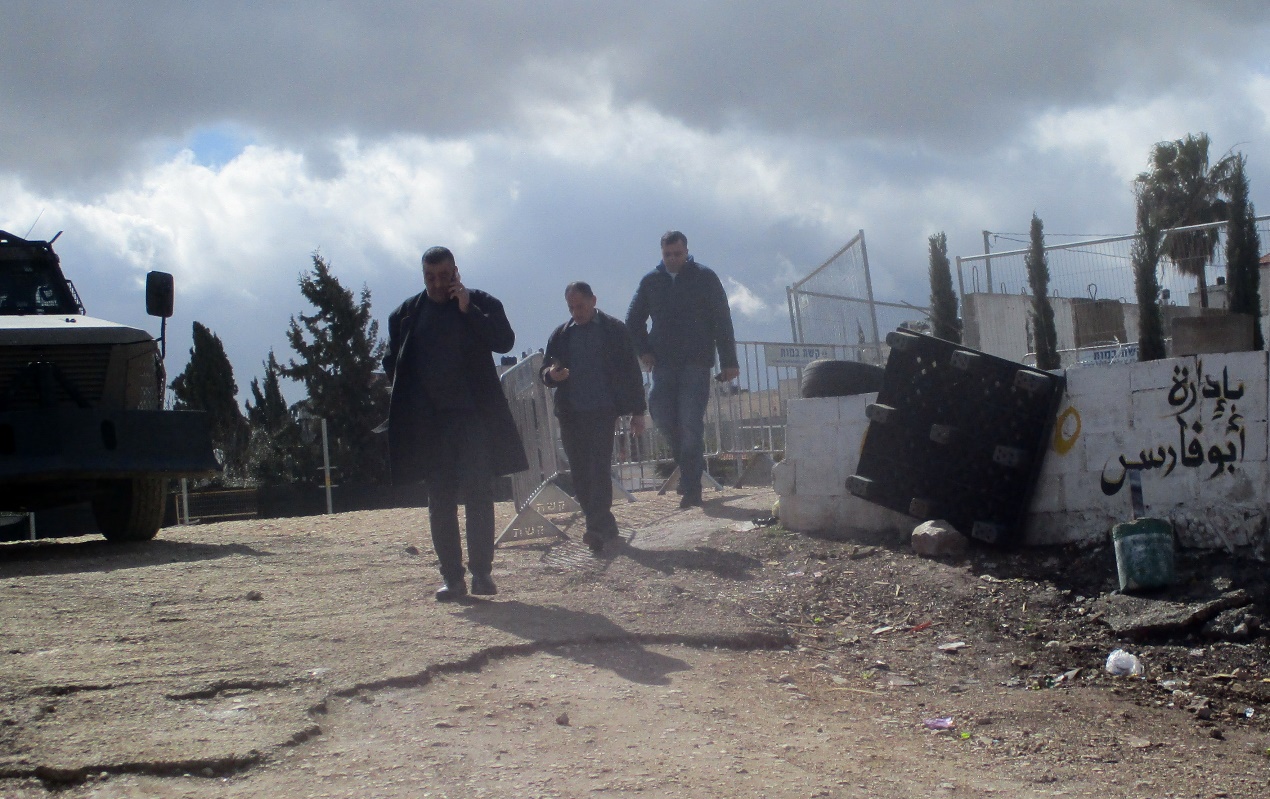 Tamar FleishmanFeb-27-2026Qalandiya: On the way to prayer
-