
‘Atara, Ar-Ram, Jaba (Lil), Qalandiya, Sun 8.3.09, Afternoon
Roni Hamerman, Ronit Bak, Tamar Fleishman (reporting and taking photos)
Bir Zait / Atara checkpoint
15:50- The Givati soldiers that had only recently come back from the battle field at Gaza, were once again running the checkpoint, but now they seemed to be calmer then ever before. They took less notice of the Palestinians and most of the time they were busy engaging in conversations amongst themselves. The result: traffic was flowing without any disturbance.
Gaba/ Leel checkpoint
16:50- A vehicle was parked inside the checkpoint and from it dressed-up girl came out, they were distributing holiday parcels to the soldiers at the post. They later crossed the road and went towards the pillbox, not forgetting the eyes and mouths of the soldiers that were observing from above.
The checkpoint commander came to us and said: "Do me a favor, I would be most grateful if you could get rid of this checkpoint"- we promised to try.
Before heading on our way a military vehicle stopped right beside us, in it were two soldiers in uniforms that were just ironed. One of them said to us in Hebrew and a small portion of English: "we will accompany you on your ride". We were puzzled so the soldier apologized and explained that they were waiting for some American donors how were supposed to visit their unit.
– Are they still (or perhaps again) collecting charity from the Jewish communities abroad, for the poor IDF?
Ar-Ram
17:00- We entered the town from the only side left open in the exclave. A perishing city, surrounded by a wall was revealed to our eyes.
We drove through Ar-Ram to the southern wall. We wanted to feel how it is to be on the dark side of the moon.
There was a melancholic atmosphere. We saw no anger, revolt or will for revenge. Only despair, a great and grim despair.
While we were standing in front of the locked mettle gate, by the wall that suffocates the lives of the thousands living in it, a dark and horrible silence had immerged from the gray reality like a muted scream, while twilight broke.
Qalandia:
17:40- Our friend, the coffee peddler, told us about the day to day reality during the mornings, ever since Ar-Ram checkpoint had been taken down. Hundreds of people had now joined on those thousands that had always been going there: some on their way to work and others (children) on their way to school. He said it is especially difficult on Sunday mornings, the pressure remains until 9:00 AM and sometimes even later.
– We wished him a happy holiday (the birth of the profit was due on the next day), but he informed us that many don't celebrate it any more. Those with a job wouldn't dream of taking a day off, from fear that they might get laid off.
We arrived at the checkpoint with a meter and decided to measure the sizes of the human cages. Here are the results from left to right:
Cage 1: 61 cm
Cage 2: 56 cm
Cage 3: 54 cm
– Each week it is more and more evident that the maintenance of the facilities isn't sufficient: the other turnstiles weren't working and they were connected to the main poll in a most improvised manner, the intercom buttons haven't been working for some time now so no one can use the "humanitarian" gates. A person carrying luggage will find it most difficult to pass through the cages, since they are so narrow, even a person who is a little over weight would find this to be a difficult task, but what about those on wheelchairs?
This is the real manifestation of idiocy
– When we were heading back from the checkpoint we met a man carrying a large TV set, with which he was hoping to pass. After the security forces noticed him with their plasma screens, they opened the first turnstile and he found himself caught between the first one and the next. He was stood there for 20 minutes. We joined him as he was waiting. A security man finally came to help him make way, but he didn't have a key to open the chain locking one of the gates (as I mentioned earlier they aren't working). He joined those waiting and got cross at us, in stead of being angry at the reality: "I'm not hear to play games…". After a while a colleague of his arrived with the magic key, but they couldn't let the Palestinian out through the straight way as they weren't able to open the exit gates, so they had to walk him through the curving path together with his TV set: the went to the inner lot of the Kiryat Ha'Memshala and from there to the back passage.
It must again be pointed out that they call this place a "border passage"
'Atara
See all reports for this place-
'Atara Checkpoint
Situated at the northern entrance to Ramallah from Route 465, called also Bir Zeit Checkpoint. Nowadays only remains of what used to be a busy checkpoint remain, a pillbox and concrete blocks.
-
A-Ram
See all reports for this place-
two kilometers south of Qalandiya and 300 metres north of Neve Yaacov Junction, in Dahiyat el-Barid Quarter. Checkpoint has operated since 1991, in a Palestinian area annexed to Jerusalem in 1967. The checkpoint has been inactive since the middle of 2009.
The wall was built on the road that led to Jerusalem. Since then the situation in the town has deteriorated. Houses are abandoned and half finished, most of the businesses have closed. Severe neglect around the fence and on the streets. Those who could left. Updated January 2024
-
Jaba' (Lil)
See all reports for this place-
Jaba' (Lil) In fact, the Jaba checkpoint is east of the Qalandiya checkpoint. Its declared purpose is the prevention of Israeli citizens from entering Area A. A road checkpoint for vehicles, located on Road 65, borders the southern fence of Kfar Jaba, about three kilometers east of the Qalandiya checkpoint, on the road leading to the settlement of Adam on Road 60. Archaeological excavations within the village found the remains of a cloth house from the First Temple period. The events that led to the construction of the checkpoint are precisely here: on the day of the abduction of Gilad Shalit and before the outbreak of the Second Lebanon War, a 17-year-old man from one of the settlements was abducted by a Palestinian cell. His body was found several days later at the entrances to Ramallah. A military investigation revealed that his abductors had taken him along this route. The checkpoint was set up to prevent future kidnappings and to warn settlers from traveling to Ramallah and entering Area A (which is forbidden for Israelis). The checkpoint that operates around the clock. Usually only vehicles traveling in the direction of Ramallah are inspected. (November 2016): Every morning, when the settlers en masse travel to Jerusalem on Route 60 and every afternoon they return from Jerusalem on Route 60, the army initiates a traffic jam at the entrance to the Jaba checkpoint and stops the movement of Palestinians traveling toward Route 60. (February 2020): In the last two years the checkpoint has not always been manned. Sometimes the soldiers come and just stand, sometimes they come and stop and check those who enter the village, sometimes they patrol the alleys of the village, sometimes they fire stun grenades and gas and sometimes they invade houses and stop young people, say those passing through the Hazma checkpoint. (Updated February 2020)
-
Qalandiya Checkpoint / Atarot Pass (Jerusalem)
See all reports for this place-
Click here to watch a video from Qalandiya checkpoint up to mid 2019 Three kilometers south of Ramallah, in the heart of Palestinian population. Integrates into "Jerusalem Envelope" as part of Wall that separates between northern suburbs that were annexed to Jerusalem in 1967: Kafr Aqab, Semiramis and Qalandiya, and the villages of Ar-Ram and Bir Nabala, also north of Jerusalem, and the city itself. Some residents of Kafr Aqab, Semiramis and Qalandiya have Jerusalem ID cards. A terminal operated by Israel Police has functioned since early 2006. As of August 2006, northbound pedestrians are not checked. Southbound Palestinians must carry Jerusalem IDs; holders of Palestinian Authority IDs cannot pass without special permits. Vehicular traffic from Ramallah to other West Bank areas runs to the north of Qalandiya. In February 2019, the new facility of the checkpoint was inaugurated aiming to make it like a "border crossing". The bars and barbed wire fences were replaced with walls of perforated metal panels. The check is now performed at multiple stations for face recognition and the transfer of an e-card. The rate of passage has improved and its density has generally decreased, but lack of manpower and malfunctions cause periods of stress. The development and paving of the roads has not yet been completed, the traffic of cars and pedestrians is dangerous, and t the entire vicinity of the checkpoint is filthy. In 2020 a huge pedestrian bridge was built over the vehicle crossing with severe mobility restrictions (steep stairs, long and winding route). The pedestrian access from public transport to the checkpoint from the north (Ramallah direction) is unclear, and there have been cases of people, especially people with disabilities, who accidentally reached the vehicle crossing and were shot by the soldiers at the checkpoint. In the summer of 2021, work began on a new, sunken entrance road from Qalandiya that will lead directly to Road 443 towards Jerusalem and Tel Aviv. At the same time, the runways of the old Atarot airport were demolished and infrastructure was prepared for a large bus terminal. (updated October 2021)
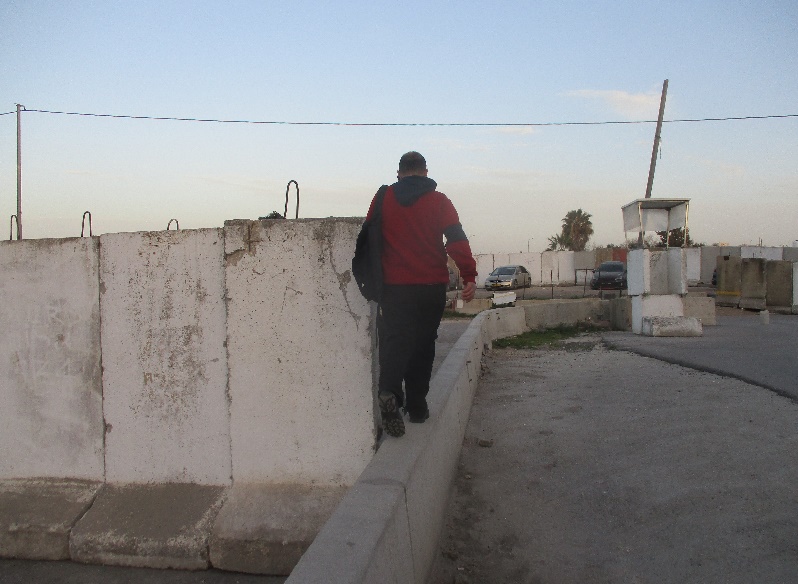 Tamar FleishmanFeb-16-2026Qalandiya CP: shortcut
-