
‘Atara, ‘Atarot, Qalandiya, Sun 18.4.10, Afternoon
Atarot Chekcpoint:
There was a long line of vehicles which continued to as far as the eye could see (at least 15 vehicles). While we were leaning on the balcony at the side of the road, watching the inspections (nothing special- usually a simple nod of the head towards the Jews and an ID inspection of those whose ethnic origin wasn't clear), the checkpoint commander approached us and informed us that we were disturbing him to "run the checkpoint". We told him that we were permitted to stand where ever we chose, so long as he didn't have a general-majors decree that stated the checkpoint was a closed military zone, adding that he was the one to start talking to us, so if anything he was the one that was distrusting the traffic at the checkpoint. After ten minutes we decided to leave.
Qalandiya checkpoint:
While we were crossing the checkpoint in our car towards the northern side, we noticed two ambulances. We parked our car at the lot on the side of the refugee camp, and hurried to the fence to see what was going on. One of the ambulances had already left and we understood that the patient (according to the paramedics it was two year old baby with a heart condition) was on his way to a hospital at Jerusalem. Right at that moment the megaphone that is attached to the pillbox started yelling, and with an incomprehensible mélange of languages, he probably asked us to stand back (according to Tamar's interpretation, the megaphone had already tried to engage in conversation with her a couple of times, so she is familiar with its secret language). However, due to the terrible racket we couldn't know for sure he was talking to us, so we continued to check on the ambulance through the fence.
As we decided to head off, a BP jeep arrived and from it two soldiers came out and started to drive off the cab drivers, who had been parked beside the exit from the checkpoint. The drivers were very upset, especially because it was obvious they weren't in the way and that it was merely a show of force. We started taking photos of the two in action, apparently they didn't appreciate it, so in return they approached an elder man who was sitting in the waiting shed with two of his friends, and asked to see his ID. They told him that since he had a green ID he wouldn't be able to pass, because of the closure. He informed them that he worked at Atarot industrial zone and therefore the closure didn't regard him, and that in any case he had already finished working for the day. The soldiers then replied "either you leave or you pass to the other side". The man was forced to stop his conversation and return home.
The person who sells coffee at the checkpoint told us that he saw policemen standing at Jaba checkpoint, that morning. They came to inspect the whether the traffic laws were being kept and impose on the residents of the West Bank the rule of the Israeli state. As a result, many refrained from passing through the checkpoint and decided to park their cars on the side of the road until the policemen left. The police car was there from 4 AM to 6.
In spite of the closure there was a long line at the pedestrian's checkpoint (and also at the vehicle checkpoint). A person we know told us that it was because the soldiers were performing their job in the slowest way possible. When we got in line, three lanes were open and it took us 20 minutes to pass. The soldier at the inspection post asked us whether we were against the Israeli soldiers, and I was asked whether or not I had even served in the army…
Bir Zait/ Atara checkpoint:
We headed off to this checkpoint knowing that although many think the army had left the place, in accordance with the orders of the Minister of Defense, there are always soldiers manning the pillbox. When we told some of our Palestinian acquaintances that this was our next stop, they promised us that we would find nothing there. As we were parking our car we noticed a soldier who was observing the checkpoint from above. When we pulled out our camera he yelled at us that we weren't allowed to take photos. While that same old routine argument was being held, he was more than happy to share with us his perception: "the Arabs are primitive and stupid". After a couple of minutes his colleagues arrived (they were all from the Nahal), two soldiers and the commander of the checkpoint, they came out form the gate the opens the fence around the pillbox and walked towards us. They wanted to know where we were from, that is, on whose behalf did we come there, and after a short conversation (during which the commander informed us that there are security cameras and that inside the tower they do have screens- but the cameras weren't working), the commander contacted his supervisors to ask whether or not it was "permitted" for us to be there. This took quite some time and we had already begun to get ready to leave- and as we were getting into the car we saw the three soldiers making their way towards the middle of the road, they looked as though they were getting ready to perform inspections on those passing through the checkpoint. We got out of the car and watched them for a while, they did nothing but the Palestinians who drove through the checkpoint did none the less slow down as though they feared one of the soldiers might pull them over. After ten minutes we decided to leave.
'Atara
See all reports for this place-
'Atara Checkpoint
Situated at the northern entrance to Ramallah from Route 465, called also Bir Zeit Checkpoint. Nowadays only remains of what used to be a busy checkpoint remain, a pillbox and concrete blocks.
-
'Atarot
See all reports for this place-
Atarot
Atarot was a workers' settlement destroyed during the War of Independence, where the Arab village of Qalandiya now stands, in the southwestern part of Atarot Airport, built by the British Mandate. After 1967, the Atarot industrial zone was established nearby, and until the completion of the wall from the Qalandiya checkpoint to Road 443, a checkpoint was in place. A new Jewish neighborhood is currently planned for the old airport area.
-
Qalandiya Checkpoint / Atarot Pass (Jerusalem)
See all reports for this place-
Click here to watch a video from Qalandiya checkpoint up to mid 2019 Three kilometers south of Ramallah, in the heart of Palestinian population. Integrates into "Jerusalem Envelope" as part of Wall that separates between northern suburbs that were annexed to Jerusalem in 1967: Kafr Aqab, Semiramis and Qalandiya, and the villages of Ar-Ram and Bir Nabala, also north of Jerusalem, and the city itself. Some residents of Kafr Aqab, Semiramis and Qalandiya have Jerusalem ID cards. A terminal operated by Israel Police has functioned since early 2006. As of August 2006, northbound pedestrians are not checked. Southbound Palestinians must carry Jerusalem IDs; holders of Palestinian Authority IDs cannot pass without special permits. Vehicular traffic from Ramallah to other West Bank areas runs to the north of Qalandiya. In February 2019, the new facility of the checkpoint was inaugurated aiming to make it like a "border crossing". The bars and barbed wire fences were replaced with walls of perforated metal panels. The check is now performed at multiple stations for face recognition and the transfer of an e-card. The rate of passage has improved and its density has generally decreased, but lack of manpower and malfunctions cause periods of stress. The development and paving of the roads has not yet been completed, the traffic of cars and pedestrians is dangerous, and t the entire vicinity of the checkpoint is filthy. In 2020 a huge pedestrian bridge was built over the vehicle crossing with severe mobility restrictions (steep stairs, long and winding route). The pedestrian access from public transport to the checkpoint from the north (Ramallah direction) is unclear, and there have been cases of people, especially people with disabilities, who accidentally reached the vehicle crossing and were shot by the soldiers at the checkpoint. In the summer of 2021, work began on a new, sunken entrance road from Qalandiya that will lead directly to Road 443 towards Jerusalem and Tel Aviv. At the same time, the runways of the old Atarot airport were demolished and infrastructure was prepared for a large bus terminal. (updated October 2021)
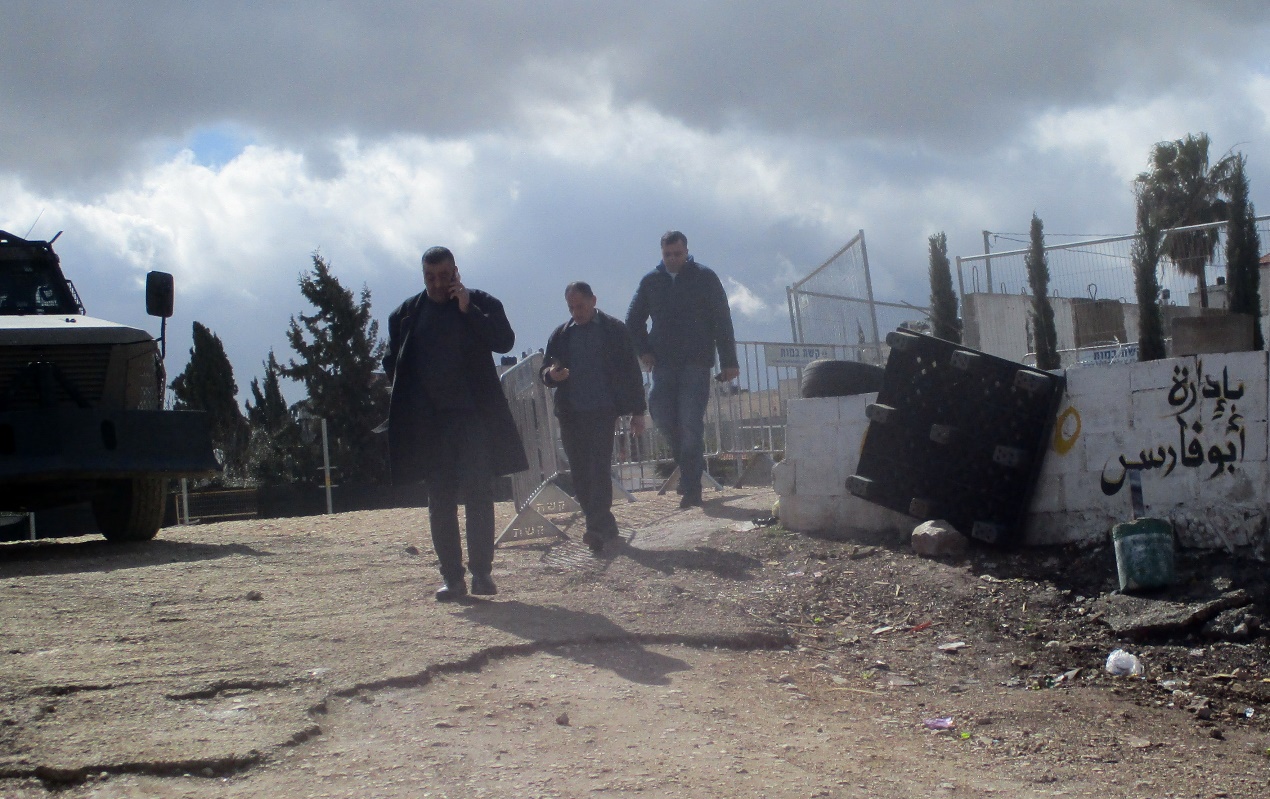 Tamar FleishmanFeb-27-2026Qalandiya: On the way to prayer
-