
‘Atara, Qalandiya, Sun 2.11.08, Afternoon
3:30 Atara
Givati soldiers carried out meticulous inspection of vehicles that arrived from all four directions — those coming from Ramallah and going to it, and all vehicles arriving from the village of Atara (from north of the checkpoint) and to travellers from the eastern sides at the end of the village of Bir Zeit. The check of one vehicle took about 7 minutes.
There were long lines of vehicles winding like a serpent around the area in front of the checkpoint. we counted 20 vehicles in the line leaving Ramallah and 70 going to the city. From the end of the line to the beginning took about 30 minutes.
The driver of a vehicle which belongs to the hospital in Ramallah was transporting an old man who was released from the hospital. He said, now the situation is quiet, not even a stone is being thrown. Rather than making things easier on us, they are making it harder. The old man added, "only after I die will things be better".
The commander of the checkpoint, and one of his soldiers, tried to restrict our movements by placing us in a restricted corner to stand in. We refused. He called the police. After a few minutes, we heard him angrily say that the police are not coming (how will they come?) He was also angry that we were speaking with the Palestinians and were causing delays in movement. We were causing the delays — not the checkpoints!) We pointed out to him the line of dozens of vehicles that were waiting and he blamed it on the instructions that he received regarding a suspect vehicle. Randomly, soldiers were stopping transits, making the passengers who were returning from a long day's work get out, and making them stand in a straight line to have their i.d.'s checked by a computer.
A Palestinian driver stopped and delivered blessings to Roni for peace. The commander was shocked and aroused his curiosity. "You two know each other?, as if Jews and Arabs are not meant to know each other. From that point on, he was interested in engaging us in conversation, and as his interest in us continued with us in friendly manner, the pace of passage sped up, the lines were shorter, vehicles that were stopped were sent to a special lane so as not to impede traffice. In contrast, his friend said that we were only interested in the good of the Arabs. "These are human beings. They blow up their bodies. They are animals". Thus the soldier summarized his view of the world. The commander contended that we do not provide the goods to those who benefit us. You have to come with cameras and video and photograph, he agreed. We agreed and explained that we don't have video cameras.

'Atara
See all reports for this place-
'Atara Checkpoint
Situated at the northern entrance to Ramallah from Route 465, called also Bir Zeit Checkpoint. Nowadays only remains of what used to be a busy checkpoint remain, a pillbox and concrete blocks.
-
Qalandiya Checkpoint / Atarot Pass (Jerusalem)
See all reports for this place-
Click here to watch a video from Qalandiya checkpoint up to mid 2019 Three kilometers south of Ramallah, in the heart of Palestinian population. Integrates into "Jerusalem Envelope" as part of Wall that separates between northern suburbs that were annexed to Jerusalem in 1967: Kafr Aqab, Semiramis and Qalandiya, and the villages of Ar-Ram and Bir Nabala, also north of Jerusalem, and the city itself. Some residents of Kafr Aqab, Semiramis and Qalandiya have Jerusalem ID cards. A terminal operated by Israel Police has functioned since early 2006. As of August 2006, northbound pedestrians are not checked. Southbound Palestinians must carry Jerusalem IDs; holders of Palestinian Authority IDs cannot pass without special permits. Vehicular traffic from Ramallah to other West Bank areas runs to the north of Qalandiya. In February 2019, the new facility of the checkpoint was inaugurated aiming to make it like a "border crossing". The bars and barbed wire fences were replaced with walls of perforated metal panels. The check is now performed at multiple stations for face recognition and the transfer of an e-card. The rate of passage has improved and its density has generally decreased, but lack of manpower and malfunctions cause periods of stress. The development and paving of the roads has not yet been completed, the traffic of cars and pedestrians is dangerous, and t the entire vicinity of the checkpoint is filthy. In 2020 a huge pedestrian bridge was built over the vehicle crossing with severe mobility restrictions (steep stairs, long and winding route). The pedestrian access from public transport to the checkpoint from the north (Ramallah direction) is unclear, and there have been cases of people, especially people with disabilities, who accidentally reached the vehicle crossing and were shot by the soldiers at the checkpoint. In the summer of 2021, work began on a new, sunken entrance road from Qalandiya that will lead directly to Road 443 towards Jerusalem and Tel Aviv. At the same time, the runways of the old Atarot airport were demolished and infrastructure was prepared for a large bus terminal. (updated October 2021)
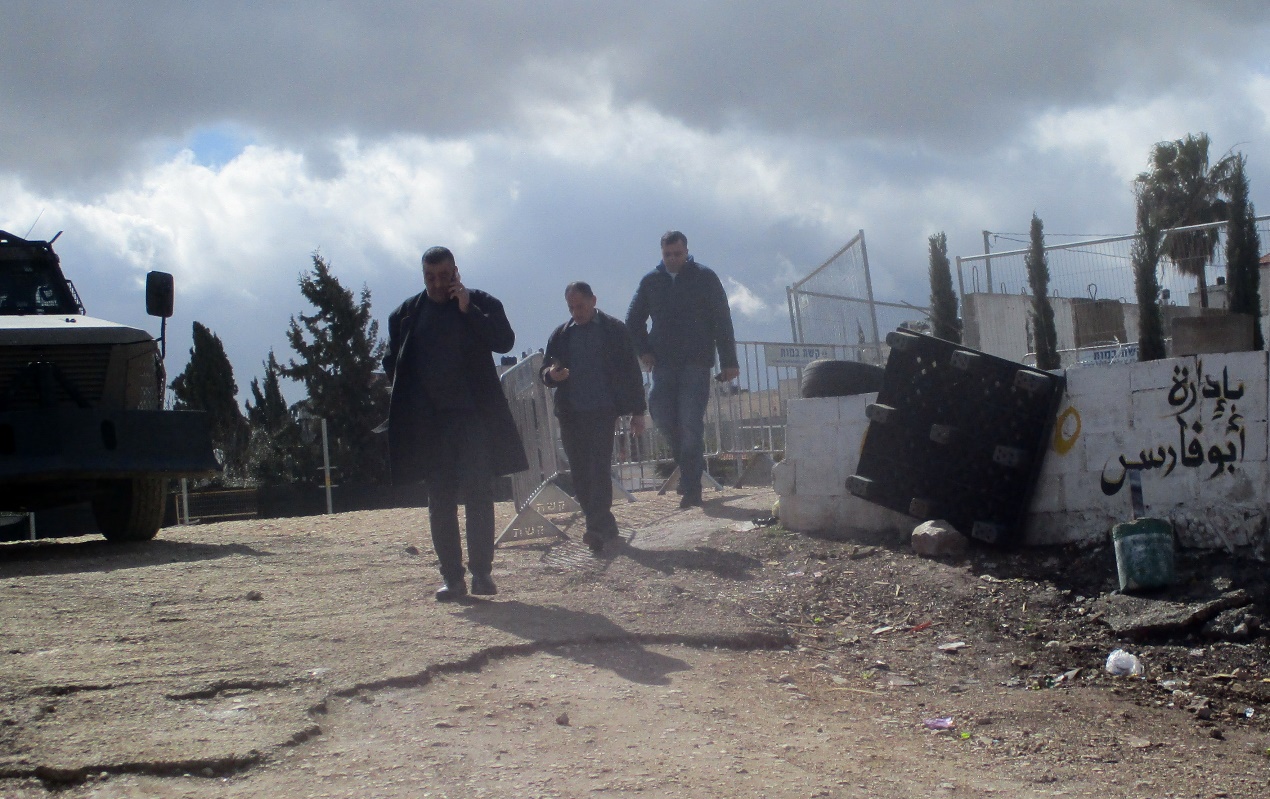 Tamar FleishmanFeb-27-2026Qalandiya: On the way to prayer
-