
‘Atara, Qalandiya, Sun 2.8.09, Afternoon
Qalandiya checkpoint:
New on the Wall: Hope Builds Bridges Fear Builds Walls 
A woman was being transferred from an ambulance that arrived from the occupied territories to a Red Crescent ambulance from East Jerusalem. This patient wasn't apparently a menace to the Israel's security, and the fractures in her ribs were in fact fracture. The proof: The whole process was preformed quickly. The two ambulances met and transferred the "merchandise" from on to the other, and them both of them turned around.
The four machines that inspect those heading from Israel back to the Occupied Territories were very efficient: a human voice instructed those using it in Arabic and at the end it used the traditional Arabic greeting to say goodbye.
- – To all those who believe that the occupation can and indeed should be run in a different way: here is a different and improved way of running it.
But the occupier is still an occupier, the repression of the other grows stronger even if "it is more comfortable" (to paraphrase on Hanoh Levin's song), it's still is oppression.
The checkpoints must be removed and not improved, and the occupation must be stopped and not made more comfortable.
Because, even if the soldiers were to smile from the other side of the dark and bullet proof glass, and say "please" instead of "get lost", the only ones to feel better would be the lords of this occupation, and not its victims.
While we stood amazed from the politeness of those machines and try helping a man who had lost his papers, a voice came through from the heavens: "Hi Tamar, welcome to Atarot Passage!" When we raised our eyes were saw only the bare ceiling of the checkpoint, spirits or angelic wings.
Was it the Big Brother? – And I don't even have an older brother. A bored soldier sitting in front of the plasma screen probably did it for the laughs.
Bir Zeit/ Atara checkpoint
"Rabbi Yehuda would assign them mnemonics…" – From the Passover Hagada. 
The assignment of the mnemonics makes it easier to remember the ten plagues.
We should also assign mnemonics as to mark the location of a checkpoint. For as we had already read from the armies publications: "the Palestinians' situation had been relieved", among these relieves was the removal of this checkpoint.
But all signs show that the army was lying.
A list of some of the signs: the light was on, the generators rattled, the spike chain was ready to be placed, the trash that was consisted from remains of the soldiers food from which we could learn about the IDF's menu, the ashes of a bonfire and beside it were potatoes that hadn't been cocked, a memorial candle that had faded out, an old cartridge of a smoke grenade, a loaf of bread that was only half eaten and a wide verity of empty cigarette boxes- apart of all of this, we couldn't help but notice that during the whole time there were soldiers hiding in the pillbox. Every couple of minutes one to two heads popped up and could be seen from the window of the high tower, but they got camera shy and immediately vanished.
Even if the camouflage dressing on the house near by was taken off, as long as the mnemonics are there, a checkpoint is a checkpoint.
'Atara
See all reports for this place-
'Atara Checkpoint
Situated at the northern entrance to Ramallah from Route 465, called also Bir Zeit Checkpoint. Nowadays only remains of what used to be a busy checkpoint remain, a pillbox and concrete blocks.
-
Qalandiya Checkpoint / Atarot Pass (Jerusalem)
See all reports for this place-
Click here to watch a video from Qalandiya checkpoint up to mid 2019 Three kilometers south of Ramallah, in the heart of Palestinian population. Integrates into "Jerusalem Envelope" as part of Wall that separates between northern suburbs that were annexed to Jerusalem in 1967: Kafr Aqab, Semiramis and Qalandiya, and the villages of Ar-Ram and Bir Nabala, also north of Jerusalem, and the city itself. Some residents of Kafr Aqab, Semiramis and Qalandiya have Jerusalem ID cards. A terminal operated by Israel Police has functioned since early 2006. As of August 2006, northbound pedestrians are not checked. Southbound Palestinians must carry Jerusalem IDs; holders of Palestinian Authority IDs cannot pass without special permits. Vehicular traffic from Ramallah to other West Bank areas runs to the north of Qalandiya. In February 2019, the new facility of the checkpoint was inaugurated aiming to make it like a "border crossing". The bars and barbed wire fences were replaced with walls of perforated metal panels. The check is now performed at multiple stations for face recognition and the transfer of an e-card. The rate of passage has improved and its density has generally decreased, but lack of manpower and malfunctions cause periods of stress. The development and paving of the roads has not yet been completed, the traffic of cars and pedestrians is dangerous, and t the entire vicinity of the checkpoint is filthy. In 2020 a huge pedestrian bridge was built over the vehicle crossing with severe mobility restrictions (steep stairs, long and winding route). The pedestrian access from public transport to the checkpoint from the north (Ramallah direction) is unclear, and there have been cases of people, especially people with disabilities, who accidentally reached the vehicle crossing and were shot by the soldiers at the checkpoint. In the summer of 2021, work began on a new, sunken entrance road from Qalandiya that will lead directly to Road 443 towards Jerusalem and Tel Aviv. At the same time, the runways of the old Atarot airport were demolished and infrastructure was prepared for a large bus terminal. (updated October 2021)
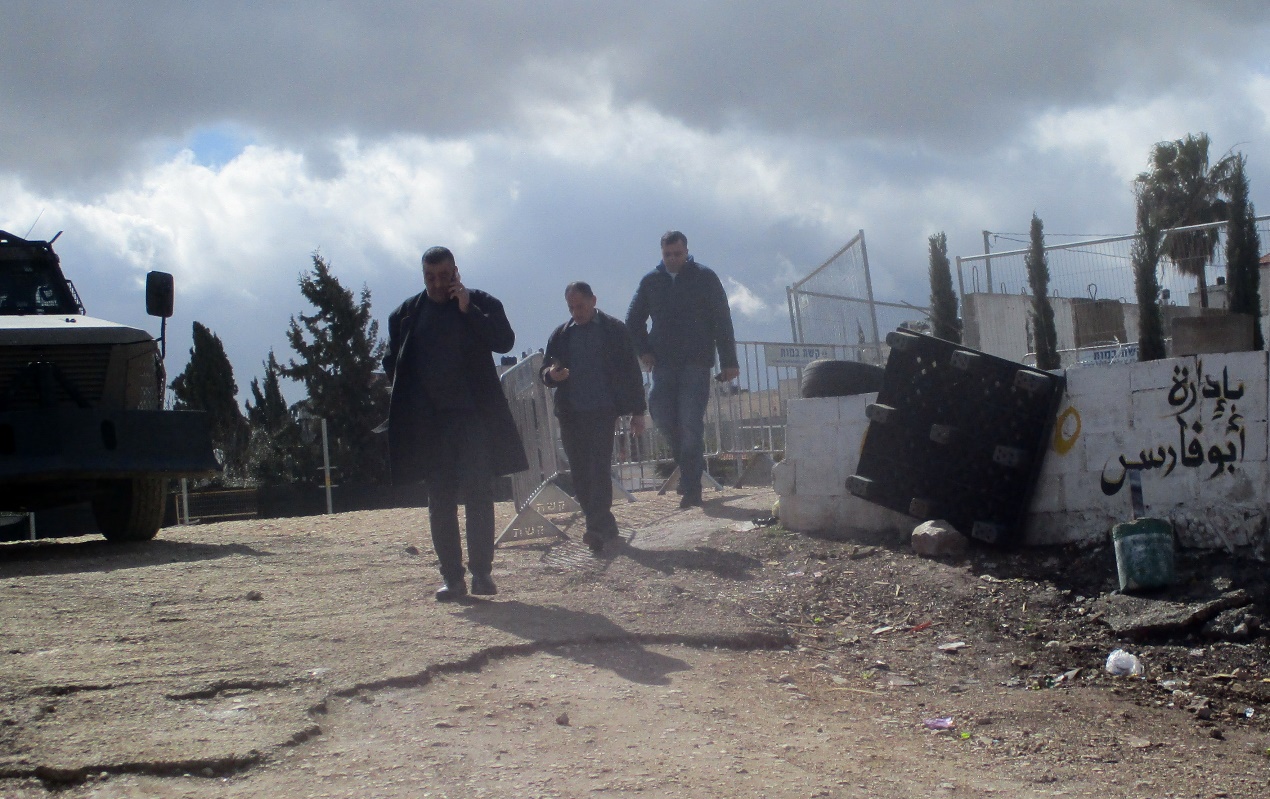 Tamar FleishmanFeb-27-2026Qalandiya: On the way to prayer
-