
‘Atarot, Hizma, Jaba (Lil), Qalandiya, Mon 22.2.10, Afternoon

.
15.20 Qalandiya – The traffic and that southern circle was again jammed because of disruption in the route of those driving to the north while the traffic in this route as to cross the route of the traffic from Ramallah – Ar-Ram at the northern exit. This leads to terrific traffic jams which go all the way back to the south of Jerusalem and north to Ramallah. Dafke at the southern circle there were reinforcements of police. A tour of captains.
At the pedestrian crossing three lanes were working. The first lane included both men and women while the 4th only men. This was announced over the loudspeaker. The third lane was only for women …no other choice. But all the lanes worked very slowly and especially number three which was for the women. We stood there to go through to Jerusalem but when we saw that the men's lane had ended in number 4 we went and stood there. In spite of the fact that there was no one else in the lane the soldiers again announced that the 4th lane was only for men (and only one woman who was very fast managed to go through). We phoned the Operations Room and were given a detailed explanation that the x-ray device at the 4th lane was very sensitive and caught the women who wore jewellery which slowed down the checking. And so instead of mending the machine they had decided to make the 4th lane only for men! Having no choice we returned to the third lane and again stood at the end of the line which in the meantime had not progressed at all. We came out to the southern circle at 3.50, after a wait of half an hour.
16.00 The line of cars at Atarot now reached the turning. The traffic at the southern circle was completely jammed. On our way back to the checkpoint we saw that the line of cars from Ramallah to Jerusalem stretched out for a kilometer.
16.10 At the checkpoint the soldiers kept announcing that the fourth lane was only for men. A group of about 10 tourists entered the checkpoint and stood at the first lane. Two small children selling chewing gum tried to persuade them to buy their wares and one tourist started to photograph them, Suddenly over the loudspeaker came the announcement that it was forbidden to photograph. The soldier making the announcement ( who was sitting the in the northern booth seemed to be enjoying himself as he hummed and made a whole musical production of "No Pictures" ( which we could follow by the rhythmic movement of his chair). Again and again the melody changed as if he were taking part in "A star is born" until eventually he calmed down. In the meantime the lines grew longer and nothing moved.
16. 35 The lines are still not moving. The inside lanes are full. In the northern shed 60 people wait. We phoned the Operations Room and they promised to see to an improvement of this situation. But when the 3rd and 4th lane emptied out the soldier in the booth was so busy listening to his music (as we again saw by the movement of his chair) that he did not pay attention and open the turnstiles.
16.45 The soldier lets through part of those waiting in the northern shed and now the inside lanes are full and about 40 people wait outside.
16.50 The tourists in the first lane are still waiting. It is already 40 minutes that nothing in the lane moved.
16.55 Suddenly the first lane become to move and within 5 minutes the last tourist is through.
17.00 We left Qalandiya for Jerusalem. On our way back we passed through Lil/Geva where there were 15 cars. At Hizma the traffic flowed.
'Atarot
See all reports for this place-
Atarot
Atarot was a workers' settlement destroyed during the War of Independence, where the Arab village of Qalandiya now stands, in the southwestern part of Atarot Airport, built by the British Mandate. After 1967, the Atarot industrial zone was established nearby, and until the completion of the wall from the Qalandiya checkpoint to Road 443, a checkpoint was in place. A new Jewish neighborhood is currently planned for the old airport area.
-
Hizma
See all reports for this place-
Hizma
A checkpoint at the north-eastern entrance to the Jerusalem area which was annexed in 1967, at Pisgat Zeev. The passage is allowed to bearers of blue IDs only. Open 24 hours a day.
-
Jaba' (Lil)
See all reports for this place-
Jaba' (Lil) In fact, the Jaba checkpoint is east of the Qalandiya checkpoint. Its declared purpose is the prevention of Israeli citizens from entering Area A. A road checkpoint for vehicles, located on Road 65, borders the southern fence of Kfar Jaba, about three kilometers east of the Qalandiya checkpoint, on the road leading to the settlement of Adam on Road 60. Archaeological excavations within the village found the remains of a cloth house from the First Temple period. The events that led to the construction of the checkpoint are precisely here: on the day of the abduction of Gilad Shalit and before the outbreak of the Second Lebanon War, a 17-year-old man from one of the settlements was abducted by a Palestinian cell. His body was found several days later at the entrances to Ramallah. A military investigation revealed that his abductors had taken him along this route. The checkpoint was set up to prevent future kidnappings and to warn settlers from traveling to Ramallah and entering Area A (which is forbidden for Israelis). The checkpoint that operates around the clock. Usually only vehicles traveling in the direction of Ramallah are inspected. (November 2016): Every morning, when the settlers en masse travel to Jerusalem on Route 60 and every afternoon they return from Jerusalem on Route 60, the army initiates a traffic jam at the entrance to the Jaba checkpoint and stops the movement of Palestinians traveling toward Route 60. (February 2020): In the last two years the checkpoint has not always been manned. Sometimes the soldiers come and just stand, sometimes they come and stop and check those who enter the village, sometimes they patrol the alleys of the village, sometimes they fire stun grenades and gas and sometimes they invade houses and stop young people, say those passing through the Hazma checkpoint. (Updated February 2020)
-
Qalandiya Checkpoint / Atarot Pass (Jerusalem)
See all reports for this place-
Click here to watch a video from Qalandiya checkpoint up to mid 2019 Three kilometers south of Ramallah, in the heart of Palestinian population. Integrates into "Jerusalem Envelope" as part of Wall that separates between northern suburbs that were annexed to Jerusalem in 1967: Kafr Aqab, Semiramis and Qalandiya, and the villages of Ar-Ram and Bir Nabala, also north of Jerusalem, and the city itself. Some residents of Kafr Aqab, Semiramis and Qalandiya have Jerusalem ID cards. A terminal operated by Israel Police has functioned since early 2006. As of August 2006, northbound pedestrians are not checked. Southbound Palestinians must carry Jerusalem IDs; holders of Palestinian Authority IDs cannot pass without special permits. Vehicular traffic from Ramallah to other West Bank areas runs to the north of Qalandiya. In February 2019, the new facility of the checkpoint was inaugurated aiming to make it like a "border crossing". The bars and barbed wire fences were replaced with walls of perforated metal panels. The check is now performed at multiple stations for face recognition and the transfer of an e-card. The rate of passage has improved and its density has generally decreased, but lack of manpower and malfunctions cause periods of stress. The development and paving of the roads has not yet been completed, the traffic of cars and pedestrians is dangerous, and t the entire vicinity of the checkpoint is filthy. In 2020 a huge pedestrian bridge was built over the vehicle crossing with severe mobility restrictions (steep stairs, long and winding route). The pedestrian access from public transport to the checkpoint from the north (Ramallah direction) is unclear, and there have been cases of people, especially people with disabilities, who accidentally reached the vehicle crossing and were shot by the soldiers at the checkpoint. In the summer of 2021, work began on a new, sunken entrance road from Qalandiya that will lead directly to Road 443 towards Jerusalem and Tel Aviv. At the same time, the runways of the old Atarot airport were demolished and infrastructure was prepared for a large bus terminal. (updated October 2021)
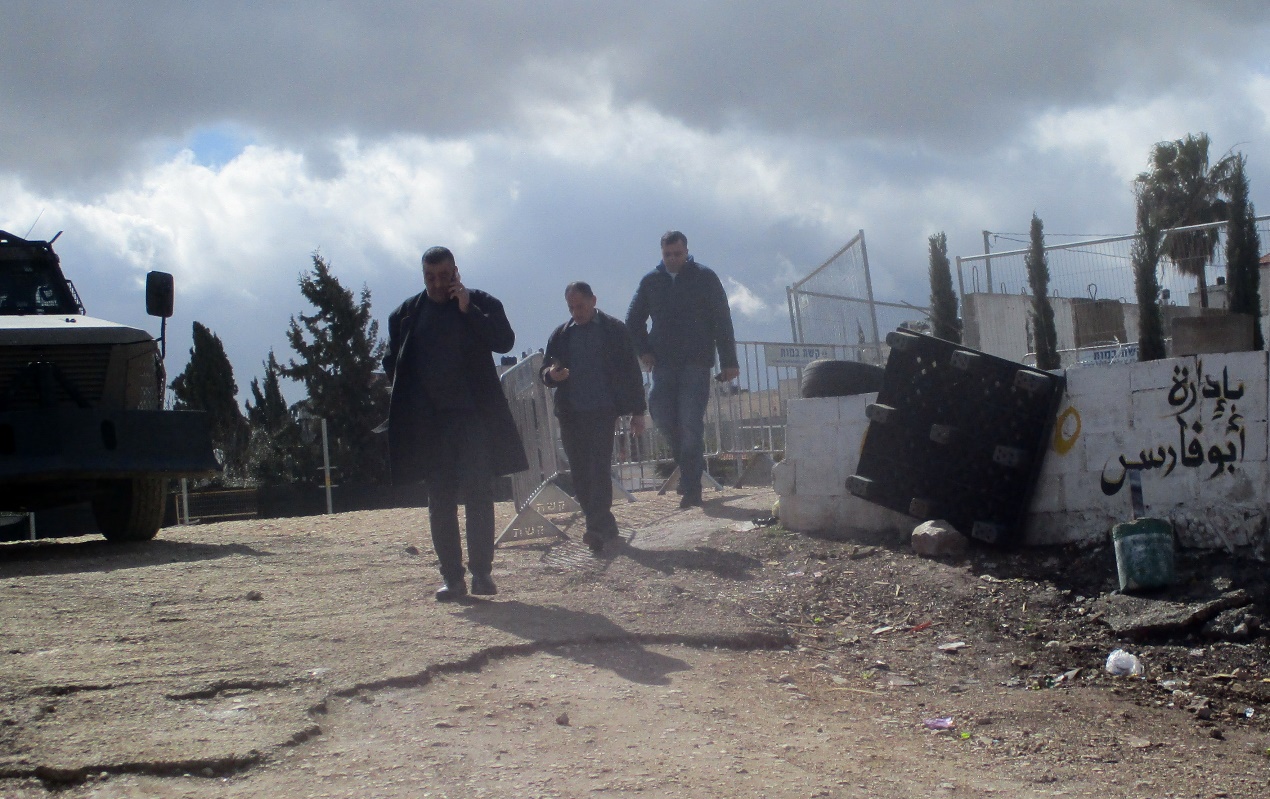 Tamar FleishmanFeb-27-2026Qalandiya: On the way to prayer
-