
‘Atarot, Qalandiya, Wed 30.9.09, Afternoon
From 1:30 till 4:00 PM
Atarot CP, Industrial Area and Vocational High School, Givat Zeev CP and Nebi Samuel
We drove along the Ramot Road and turned right at the Ofer Junction. The road there was (again) newly asphalted – shiny black with bright yellow markings. Two bored soldiers were hardly watching the traffic at the Atarot Checkpoint. On our way back, however, when the traffic had increased, we counted about thirty cars waiting amongst which even a police van.
Huge billboards and signs announce the ‘revival' of Atarot and in addition to the construction of more industrial buildings the roads are widened with lamp posts in the middle – the economic crisis has not struck the industries in the territories apparently. Two polite civilian Arab guards man the entrance and told us that they know most of the cars entering and otherwise they ask and investigate (we, of course, had not been questioned). They told us that not only Jewish enterprises construct new buildings and that the entrance in manned 24 hours a day.
We proceeded to the school where we saw the older students just leaving for the weekend and were welcomed by the guard with a broad smile. Two teachers also left, one addressing us in German and one in Hebrew. Mr. Wasfi Tamimi the acting Headmaster told us he is glad he has not been appointed Headmaster, since he has to answer Jordanian qualifications and claims they do not understand the needs of a school in Jerusalem.
He told us he now belongs to the Israeli school system and will have to meet with the Jerusalem Municipality's Education Dept. The decision was purely financial: Instead of 400 Sh. per student he now receives more than four times as much from the Israeli government, which of course was the incentive. He would like to have an administrator with experience as his boss and he himself would then concentrate on the educational aspects of the job. He is currently doing research for a Master's degree and investigates the detrimental influence of an illiterate background on the motivation of students. He told us that in East Jerusalem often twenty people live in one room where the father is a drug or alcohol addict and where incest is rampant. We asked him about dropouts and whether he is allowed to dismiss teachers and send students home. He told us with pride that he had added the tenth grade in order to instill in students even more of a desire to learn a trade. He was pleased to inform us that his students from Nablus and Hebron now received a three months' permit to remain in Jerusalem and sleep over. They can now return home for the weekend without fear and return on Saturday early in the morning. He has about forty students in the boarding school, but no one stays for the weekend, when the place becomes spooky and he is all alone with his wife and baby on the premises. He told us that students and teachers from Ramalla wait for more than an hour in Qalandia in the morning – although the hand-machines have been installed and notifications were handed out re checking on the way out, this is fortunately still not implemented. The most popular department is that of Hotel Management. They have the space to equip a proper hotel and look for a donor who would furnish the place, so they could host pilgrims on the way to Ben Gurion Airport (which is very close via Road 443). He wants to organize courses for girls in computer sciences and also have them participate in the Hotel School curriculum which includes amongst others cooking (the Deputy Chef of the Notre Dame restaurant teaches cooking).
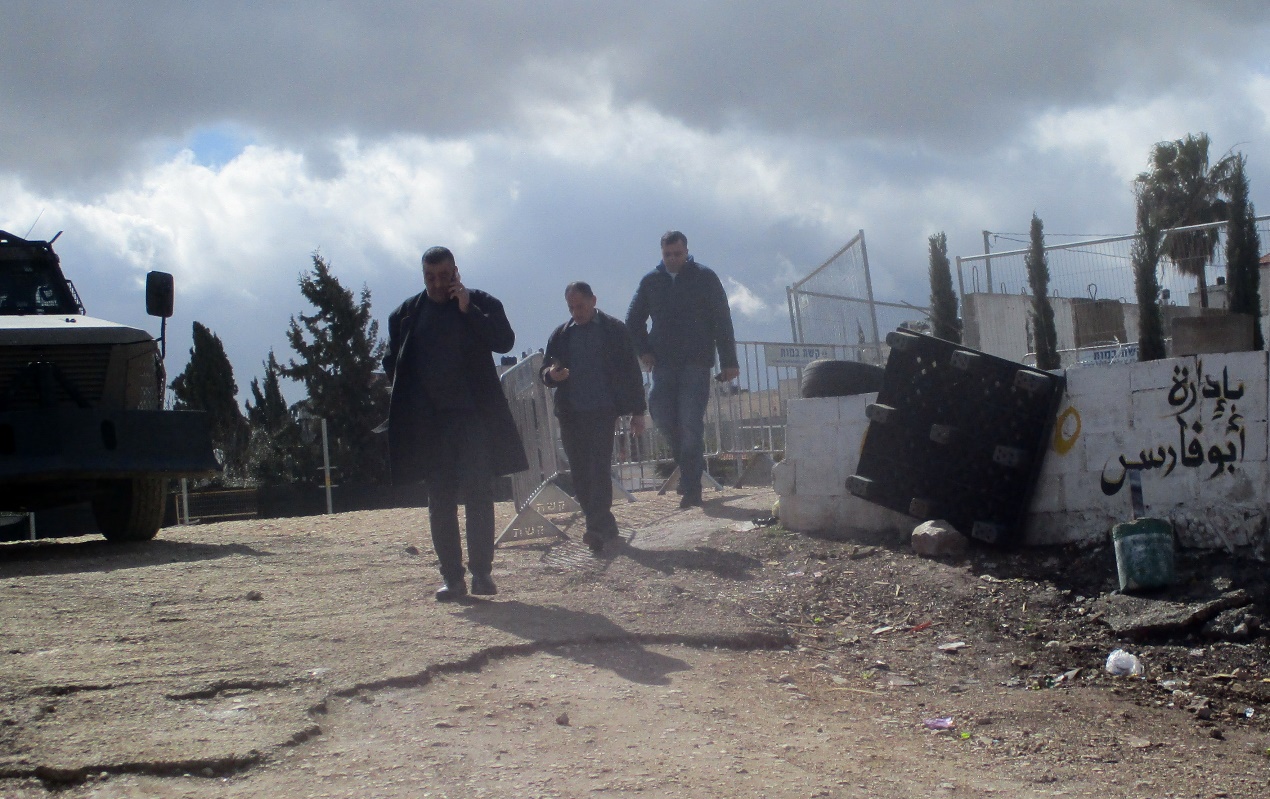
The Givat Zeev Checkpoint with its many fences, gates, sleeves, walls and security roads now appears almost finished and is an enormous complex for the few Palestinians who are allowed to use it, namely only those who work in the construction of the various suburbs of Givat Zeev. The civil security guards knew exactly who we were, one of them remembered ‘us' from Tarqumiya. However the commander, an elderly Border Policeman, had no idea and called his officer to ask whether we could go in. He was instructed to tell us to watch from far away. Since there were hardly any people passing, we didn't insist and left, deciding to return some other time at a later hour.
There were many cars parked and it looked like another busy day at the holy site of Nebi Samuel. Our friend, the owner of the grocery store, was trying to sell some fruit at the entrance. He told us that ‘they' come all the time to chase him away. We promised to come to take photo's next week. We continued into the village, which looked even sadder than before, if at all possible. A donkey was nibbling on dried thistles and a young man was galloping on a horse. We saw no sign of the settler.
'Atarot
See all reports for this place-
Atarot
Atarot was a workers' settlement destroyed during the War of Independence, where the Arab village of Qalandiya now stands, in the southwestern part of Atarot Airport, built by the British Mandate. After 1967, the Atarot industrial zone was established nearby, and until the completion of the wall from the Qalandiya checkpoint to Road 443, a checkpoint was in place. A new Jewish neighborhood is currently planned for the old airport area.
-
Qalandiya Checkpoint / Atarot Pass (Jerusalem)
See all reports for this place-
Click here to watch a video from Qalandiya checkpoint up to mid 2019 Three kilometers south of Ramallah, in the heart of Palestinian population. Integrates into "Jerusalem Envelope" as part of Wall that separates between northern suburbs that were annexed to Jerusalem in 1967: Kafr Aqab, Semiramis and Qalandiya, and the villages of Ar-Ram and Bir Nabala, also north of Jerusalem, and the city itself. Some residents of Kafr Aqab, Semiramis and Qalandiya have Jerusalem ID cards. A terminal operated by Israel Police has functioned since early 2006. As of August 2006, northbound pedestrians are not checked. Southbound Palestinians must carry Jerusalem IDs; holders of Palestinian Authority IDs cannot pass without special permits. Vehicular traffic from Ramallah to other West Bank areas runs to the north of Qalandiya. In February 2019, the new facility of the checkpoint was inaugurated aiming to make it like a "border crossing". The bars and barbed wire fences were replaced with walls of perforated metal panels. The check is now performed at multiple stations for face recognition and the transfer of an e-card. The rate of passage has improved and its density has generally decreased, but lack of manpower and malfunctions cause periods of stress. The development and paving of the roads has not yet been completed, the traffic of cars and pedestrians is dangerous, and t the entire vicinity of the checkpoint is filthy. In 2020 a huge pedestrian bridge was built over the vehicle crossing with severe mobility restrictions (steep stairs, long and winding route). The pedestrian access from public transport to the checkpoint from the north (Ramallah direction) is unclear, and there have been cases of people, especially people with disabilities, who accidentally reached the vehicle crossing and were shot by the soldiers at the checkpoint. In the summer of 2021, work began on a new, sunken entrance road from Qalandiya that will lead directly to Road 443 towards Jerusalem and Tel Aviv. At the same time, the runways of the old Atarot airport were demolished and infrastructure was prepared for a large bus terminal. (updated October 2021)
 Tamar FleishmanFeb-27-2026Qalandiya: On the way to prayer
-