
Awarta, Beit Furik, Huwwara, Za’tara (Tapuah), Sun 16.3.08, Afternoon
Translation: Tal H.
15:00 – very few vehicles, no waiting lines at the Tapuach-Zaatara Junction Checkpoint. The colonist snack truck at the CP parking area is expanding and gradually becoming a café. Many colonists at the hitchhiker station, and a policeman is busy handing out a traffic ticket to a bearded colonist who argues with him heatedly – a very rare sight in these parts where the lords of the land reign supreme.
Huwwara Checkpoint:
15:20 – there's no mistaking the familiar screeches of the Military Policewoman urging the next in line to approach "Ta'aal!!!!" (come here, in Arabic). She is counterbalanced with the securing soldier's barks and snarls "Irja lawara!!!" (Get back!), in charge both of state security and 'order' at the checkpoint. A man with a baby's pram wishes to proceed into Nablus but not through the difficult route of the pedestrian turnstile (narrow and barbed) but the soldiers including the checkpoint commander ignore his pleas until he turns back.
For a short while the side line for women becomes a men's checking post, complete with a woman soldier who instructs them to lift their shirt and pirouette. A young man tells us that today the checkpoint is good, especially because few people pass at this hour. At the metal detector young men are ordered to take off their shoes. What can they be smuggling in their shoes?? A 20-year old detainee in the concrete cubicle, already there for an hour and a half, came to the checkpoint without his ID that was accidentally ruined in the laundry, but with his birth certificate, lives in Kablan. The checkpoint commander says "Iam willing to let him go, but not without an ID. Let him find some place to stay overnight in Nablus and obtain a new ID in the morning."
And why is he locked up in the cubicle? "Because he is a troublemaker. I detained and locked him up because he refuses to go back into Nablus." Later he told us: "You know that they lie on principle. They lie to me all day long." When we involved the DCO representative in this episode, first he passed the responsibility to the commander, but after finding out that the Palestinian Ministry of Interior is closed after 3 p.m. in Nablus, he sent the young man home "for the last time!" at 4:20 p.m., requiring him to go to Nablus the following day and get his ID sorted out.
16:20: the 'Taal!!!" screeches are constant. The waiting shed fills up, lines stretch long and the checkpoint is no longer "good" today. It is hard to avoid the angry looks of men coming out with some of their garments and accessories in their hands. Waiting time is now two hours.
16:40 – a couple from Ramallah pace around the compound helplessly, looking for someone to talk to in order to get their IDs back. Coming out of the Awarta checkpoint, they naturally turned right and traveled the (apartheid) road with the 'Biblical' name of "Madison" (thus named by the army who forbids Palestinians any use of this road connecting Huwwara checkpoint junction and the colonies of Itamar and Alon More, and in the past, the natural travel artery for several villages and many thousands of Palestinians) to Huwwara CP Junction. There, the soldier took their IDs without explaining a thing. From their words it is obvious they knew nothing of the ban on Palestinian usage of this road. The maximal punishment is detention for three hours, but their age and respectable appearance produce a negotiation between us and the DCO, then between the DCO and the checkpoint commander, ending with the latter's agreement to detain them "only" for half an hour.
Another detainee is placed inside the cubicle. The sergeant doing the locking up signals him to shut up, seconds earlier shouts were heard from the waiting lines, and the DCO rep. says the man had tried to get through the special side line without a check. His ID proves to be "clean" so now he only has to do his "time" before going home.
17:05 – the sniffer-dog and its ladies arrive to make their contribution to our "security". The Ramallah couple are released, and we deliver Alex' photos from Deir Sharaf (where soldiers ran amok last week) to the head of the DCO.
at Awarta Checkpoint (goods crossing) we found 3 detainees in the cubicle, about whom the checkpoint commander (a sergeant) said he would let them go in three hours and not a second later. Thus he did, as well as another two private cars which we innocently thought were just waiting there for people but eventually discovered they had been detained for having traveled "Madison Road'. Details following.
Beit Furiq Checkpoint
15:20 – pedestrians coming rapidly out of Nablus but reporting a very long vehicle waiting line of over two hours. A car waits endlessly to enter Nablus, soldiers stand with their backs to it, ignoring it. Checks are conducted only in one vehicle lane (the second lane is barred with spikes), and very slow. We asked one of the people entering the area to report to us the number of cars waiting to come out of Nablus. He counted 45 cars! We placed a direct call to the DCO (Eyal), asking to send a representative to speed up the car checks. Within 3 minutes another checking lane was opened. The soldiers' checking pace remained low, but now it was done in two simultaneous lanes. The check requires the driver to stop far from the soldiers, get out of the car, lift his shirt and pirouette, approach the soldiers, hand them his and the passengers' IDs, get back to the car, wait to be signaled, drive up to the soldiers. Then the actual car inspection begins, opening doors, trunk and hood, everything very low gear, slow and chatty. A Hummer arrives with other soldiers – ample reason to stand around chatting and back-patting for ten minutes, then along comes another jeep and so on and so on.
18:45 – back to the Awarta Checkpoint, now closed down. The soldiers stay cozy in the watchtower, and a single car with four Palestinian men stands waiting. They tell us they were detained at 4:30 p.m. As we arrive, a blinding spotlight is switched on in our eyes, and then the soldiers approach us. The commander says the men are detained since 5:10 p.m. There is no meaning to these discrepancies – they were caught near Huwwara at 4:30 p.m. and brought to Awarta at 5:10 p.m., everyone's right… But from the moment the CP commander receives the 'delivery' he may hold on to it for three hours by the clock and that's exactly what he intends to do. These passengers, too, are from Ramallah and unfamiliar with the 'rules' and bans. First the commander tries to chase us away claiming we are breaking the law by not regarding the red sign at the entrance, and because "Jews are not allowed to be here". We explained that since there are no checkpoints inside Area A, the prohibition applies to the area beyond the Checkpoint towards Nablus, and not here. Then he threatened that as long as we stayed, he would not release the detainees.
We called the DCO about them, and asked the soldiers why no one puts up a road sign so Palestinians would know they are forbidden to travel this road, and thus spare the trouble to punish them for something they do not know. This idea produced an outraged response from the CP commnder: "That would be such a racist roadsign!!" He also claimed that "the Palestinians spin you like a corkscrew. They're not from Ramallah, they're from here, this village, I know him." And to show us how good he is, he said about the passengers, indeed from Ramallah, that "They were okay, they didn't make trouble for me so I let them sit in their car and not in the detention cubicle". Any one of those four detainees could easily have been father to these soldiers, age-wise.
Leaving Awarta at the "Madison" junction, soldiers are putting up a spike road barrier to catch the 'violators' that will be driving from Beit Furiq and Beit Dajam on this hallowed colonist road. Apparently the Palestinians do not accept this draconian rule, and neither do we.
Our calls to the DCO and the regional brigade shortened their detention time by half an hour.
And at Marda village on our way home:
a Hummer with four soldiers stop every car arriving at the village gate, get the passengers out, check their IDs and show them who's boss, and whether they have children the right age, warning them not to throw stones on Israeli cars driving along on road no. 5. They say that stones had been thrown earlier at a car (Tel Aviv family), no serious damage.
We thought that as long as the Occupation is there and the road is there, there will always be children "the right age" and wouldn't it be more effective to remove all the myriad stones from this area, who what do we know about security…
And at the "border crossing" into Israel? Yawning soldiers signal us through without even giving us a glance. Our yellow Israeli license plate is enough.
'Awarta
See all reports for this place-
Awarta, an internal checkpoint in the heart of the West Bank, is located east of the Hawara checkpoint, at the junction of Roads 555 (which was forbidden for Palestinian traffic in this area) and the entrance road to Nablus. It was one of the four checkpoints that surrounded Nablus until 2009. We used to watch it at Huwwara shifts because it was the only one where goods could be transferred to and from Nablus, using the back-to-back method. It was operated by the army, from 06:00 to 20:00. Until 2009.
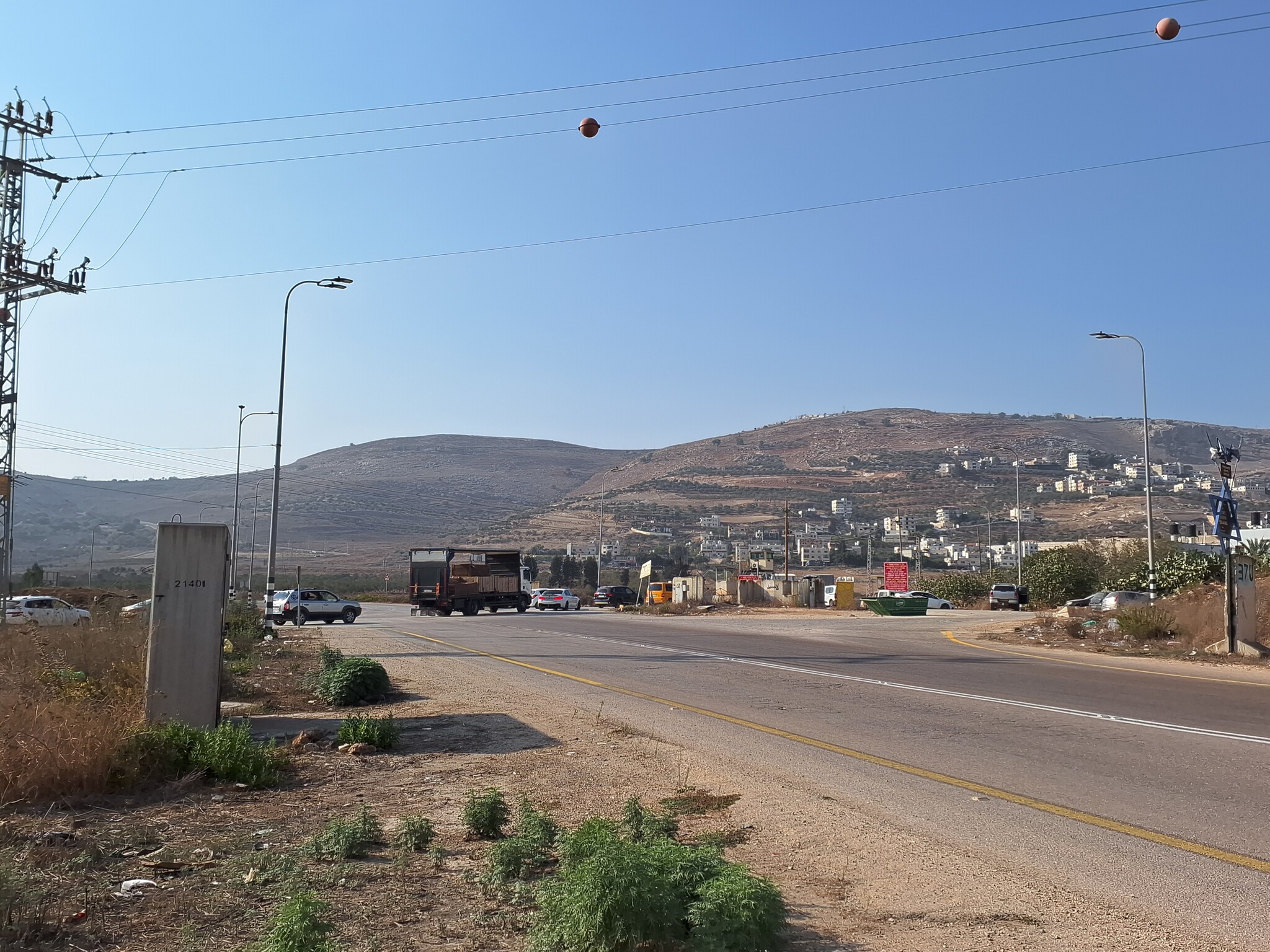 Ronit Dahan-RamatiNov-6-2025Awarta. Crossing the road towards the checkpoint
-
Beit Furik checkpoint
See all reports for this place-
One of the three internal checkpoints that closed on the city of Nablus - Beit Furik to the east, Hawara to the south, Beit Iba to the west. The checkpoint is located at the junction of Roads 557 (an apartheid road that was forbidden for Palestinians), leading to the Itamar and Alon Morea settlements and Road 5487. The checkpoint was established in 2001 for pedestrians and vehicles; The opening hours were short and the transition was slow and very problematic.Allegedly, the checkpoint is intended to monitor the movement to and from Nablus of the residents of Beit Furik and Beit Dajan, being the only opening outside their villages. Since May 2009 the checkpoint is open 24 hours a day, the military presence is limited, vehicles can pass through it without inspections, except for random inspections. (Updated April 2010)
-
Huwwara
See all reports for this place-
The Huwwara checkpoint is an internal checkpoint south of the city of Nablus, at the intersection of Roads 60 and 5077 (between the settlements of Bracha and Itamar). This checkpoint was one of the four permanent checkpoints that closed on Nablus (Beit Furik and Awarta checkpoints to the east and the Beit Iba checkpoint to the west). It was a pedestrian-only barrier. As MachsomWatch volunteers, we watched therre since 2001 two shifts a day - morning and noon, the thousands of Palestinians leaving Nablus and waiting for hours in queues to reach anywhere else in the West Bank, from the other side of the checkpoint the destination could only be reached by public transport. In early June 2009, as part of the easing of Palestinian traffic in the West Bank, the checkpoint was opened to vehicular traffic. The passage was free, with occasional military presence in the guard tower. Also, there were vehicle inspections from time to time. Since the massacre on 7.10.2023, the checkpoint has been closed to Palestinians.
On February 26, 2023, about 400 settlers attacked the town's residents for 5 hours and set fire to property, such as houses and cars. Disturbances occurred in response to a shooting of two Jewish residents of Har Bracha by a Palestinian Terrorist. The soldiers stationed in the town did not prevent the arson and rescued Palestinian families from their homes only after they were set on fire. No one was punished and Finance Minister Smotrich stated that "the State of Israel should wipe out Hawara." Left and center organizations organized solidarity demonstrations and support actions for the residents of Hawara.Hawara continued to be in the headlines in all the months that followed: more pogroms by the settlers, attacks by Palestinians and a massive presence of the army in the town. It amounted to a de facto curfew of commerce and life in the center of the city. On October 5, 2023, MK Zvi established a Sukkah in the center of Hawara and hundreds of settlers backed the army blocked the main road and held prayers in the heart of the town all night and the next day. On Saturday, October 7, 23 The "Swords of Iron" war began with an attack by Hamas on settlements surrounding Gaza in the face of a poor presence of the IDF. Much criticism has been made of the withdrawal of military forces from the area surrounding Gaza and their placement in the West Bank, and in the Hawara and Samaria region in particular, as a shield for the settlers who were taking over and rioting.
On November 12, 2023, the first section of the Hawara bypass road intended for Israeli traffic only was opened. In this way, the settlers can bypass the road that goes through the center of Hawara, which is the main artery for traffic from the Nablus area to Ramallah and the south of the West Bank. For the construction of the road, the Civil Administration expropriated 406 dunams of private land belonging to Palestinians from the nearby villages. The settlers are not satisfied with this at the moment, and demand to also travel through Hawara itself in order to demonstrate presence and control.(updated November 2023)
. Shoshi AnbarMay-18-2025Huwara: The old houses in Area C
-
Za'tara (Tapuah)
See all reports for this place-
Za'tara (Tapuah) Za'tara is an internal checkpoint in the heart of the West Bank, at the intersection of Road 60 and Road 505 (Trans-Samaria), east of the Tapuah settlement. This checkpoint is the "border" marked by the IDF between the north and south of the West Bank, in accordance with the policy of separation between the two parts of the West Bank that has been in place since December 2005. At the Za'tara checkpoint, there are separate routes for Israelis and Palestinians. In the route for Israelis, there are no inspections and the route for Palestinians inspects. The queue lengthens and shortens suits. The checkpoint is open 24 hours a day. The checkpoint is partially staffed and the people who pass through it are checked at random.
 Shoshi AnbarSep-27-2023Za'atra (Tapuah Intersection). Signs
-