
Awarta, Beit Furik, Huwwara, Za’tara (Tapuah), Tue 12.2.08, Morning
Translation: Rachel B.
At the order of the Regional Command there is a segregation (lwdyb) today pertaining to the checkpoints at Tul Karem, Jenin, and Za'tara (Tapu'ach Junction). Men ages 16-35 are not allowed to go through at all.
The weather is very stormy with a pouring rain. Along Road #5, where Palestinians are allowed to stand, workers are waiting for cars to pick them up to go to their daily jobs heading east into the West Bank. Across from it, on the same road at the Ariel Junction, there is a long line of cars. These are residents of Ariel heading in the opposite direction: west towards the center of Israel! There is a traffic jam at the junction. It is 6:30 AM . A policeman is energetically directing the heavy traffic. We await instructions from the policeman. Later, in the direction heading towards the Junction, there is an impromptu checkpoint manned by a Jeep, a Hummer and two soldiers, which stops the traffic.
Za'tara Junction (Tapu'ach): 6:45 AM
There is a Reserve unit stationed here. The junction is crowded with many cars coming from the north. A van full of passengers is checked and one of them, a 27 year old man who works for the UN, is asked to get out of the car. He doesn't understand why . Just a couple of minutes ago he passed through the checkpoint at Huwwara and everything was fine. The checkpoint commander tries to explain to him about the segregation but is unsuccessful. He has no choice and leaves. The commander calls him back and asks him to pay the van driver his fare. Very confused but restrained, the young man tries to find another way to get to his job in Ramallah. He asks if he may switch to a UN vehicle . The commander does not allow it. segregation is segregation!
I asked the Palestinian man if he understood why he was taken off the van and he said "no." I tried to explain it to him. He asks why there is a segregation and how will he know when and where he can get through, or if he won't. Who announces this? How do you know about it?
When he went through the checkpoint at Huwwara at 6:20 AM he wasn't told anything about this special situation, not even a hint. There was no warning that there was a segregation order in effect in Za'tara and that he won't be allowed to go through. The segregation order (evidently) starts in Za'tara and is no in effect at Huwwara! We were learning the same lesson… Since we were heading to Huwwara from there, we offered him a ride back with us, since the rain was not taking the travelers into consideration.
At the same spot (there was) a bus on its way to Ramallah. A quick check revealed that there were 8 passengers on the bus in the excluded age group (16-35). All 8 of them were asked to disembark from the bus into the pouring rain. Among them was a 30 year old lawyer who told us that he has a very important hearing at the court in Ramallah and that the judge will certainly not understand that he is stuck at the checkpoint! All his phone calls to various functionaries did not help, including calls to the District Coordinating Office. This is an order of the Regional Command and there is nothing to be done. Nevertheless, given the dire situation, we asked again and again and the checkpoint commander, who investigated this along his own channels of command, finally let him go through.
So, one person got through and all the others were left behind not knowing where to take cover from the heavy rain. The soldiers stood at the checkpoint under all kinds of ponchos, jackets and in rubber boots. The line of cars kept getting longer.
Across from the checkpoint in a cement building were two female settlers, taking cover from the rain. They were waiting for a ride. The scene was interesting. I went into the building, mostly in order to protect the camera from the rain, and following me – with my encouragement – the young men (who had been taken off the bus). The women settlers were beside themselves. So much so that they preferred to stand outside, exposed to the downpour, just so as not to come too close to the unfamiliar Palestinians. If it were not for our intervention, a Palestinian would never dare come into this place – it's the settlers' place. That's where they normally stand, well protected on their way back and forth between settlements – all across the West Bank.
A vegetable peddler from Salfit, whose ID card lists Beit Dajahn as his residence, gets stuck at Za'tara. He is not permitted to go through. At the District Coordination Office they promise to send someone over quickly (to investigate the problem).
8:15 AM. On the way to Beit Furik we stop at the Nablus District Coordination Office, but it was not open yet. It only opens at 8:30 AM. There are some people waiting under the overhang. On the side of the road there is a family – a young mother carrying a 4 month old baby girl well wrapped in a warm blanket. The baby has liver function problems and they have an appointment at Hadassah Hospital (in Jerusalem). The mother is accompanied by an older child and her worried parents. The whole entourage is waiting for a permit from the District Coordination Office, a permit that was arranged by the Peres Center. A phone call to the District Coordination Office brings Captain R.out of the building. He calls the family to go inside. Later, at 10:30, we meet them at the Huwwara checkpoint, smiling and continuing on their way to the hospital.
Awarta Junction: 830 AM
A Jeep and a Hummer at an impromptu checkpoint.
Beit Furik
There are a few people at the checkpoint. In the parking lot there is a line of 10 cars waiting with several passengers who occasionally cross the street and enter the checkpoint. They get checked and pass through (or not) to Nablus. The checkpoint commander approaches us and makes it clear that we are not to go past the white line. Again the white line. It was very important for him to demand that we not cross it.
It was not a simple matter. In response to my objection that the white line is so far from the turnstiles inside the checkpoint that you need binoculars to see what's going on, he pulled the usual trick: the threat of "collective punishment." – if we cross the white line they will completely stop checking people through. He declares the area a closed military zone and announces that he has summoned the police. The checkpoint starts to fill up with people. The soldiers gather at the corners of the checkpoint to pass the time. "You cross the line – we won't let anyone through." After a while we left the area and people started to go through.
At 9:30 AM on the way back we see a Hummer at the entrance to Itamar (a settlement).
Huwwara: 9:40 AM
The checkpoint is almost empty. The parking lot is totally full with taxis. There are many stalls with all kinds of goods – bagels, beverages, sweets, and hot food. A colorful display. Many drivers are calling out their destinations.
The detention holding pen is empty. There are very few people passing through. The X-ray machine position – the scanner – is locked up quickly on account of the rain.
There are two sanitation workers wearing yellow reflective vests marked with "Sanitation Worker." One of them, a resident of Huwwara, tells us that he is responsible for the cleanliness at the checkpoints for Huwwara and Beit Furik. Both of them (employed by???) walk around and collect trash which gathers around the paths of those walking through.
At Huwwara we reported about the segregation at Za'tara.
We left at 10:30 in a pouring rain.
'Awarta
See all reports for this place-
Awarta, an internal checkpoint in the heart of the West Bank, is located east of the Hawara checkpoint, at the junction of Roads 555 (which was forbidden for Palestinian traffic in this area) and the entrance road to Nablus. It was one of the four checkpoints that surrounded Nablus until 2009. We used to watch it at Huwwara shifts because it was the only one where goods could be transferred to and from Nablus, using the back-to-back method. It was operated by the army, from 06:00 to 20:00. Until 2009.
 Ronit Dahan-RamatiNov-6-2025Awarta. Crossing the road towards the checkpoint
-
Beit Furik checkpoint
See all reports for this place-
One of the three internal checkpoints that closed on the city of Nablus - Beit Furik to the east, Hawara to the south, Beit Iba to the west. The checkpoint is located at the junction of Roads 557 (an apartheid road that was forbidden for Palestinians), leading to the Itamar and Alon Morea settlements and Road 5487. The checkpoint was established in 2001 for pedestrians and vehicles; The opening hours were short and the transition was slow and very problematic.Allegedly, the checkpoint is intended to monitor the movement to and from Nablus of the residents of Beit Furik and Beit Dajan, being the only opening outside their villages. Since May 2009 the checkpoint is open 24 hours a day, the military presence is limited, vehicles can pass through it without inspections, except for random inspections. (Updated April 2010)
-
Huwwara
See all reports for this place-
The Huwwara checkpoint is an internal checkpoint south of the city of Nablus, at the intersection of Roads 60 and 5077 (between the settlements of Bracha and Itamar). This checkpoint was one of the four permanent checkpoints that closed on Nablus (Beit Furik and Awarta checkpoints to the east and the Beit Iba checkpoint to the west). It was a pedestrian-only barrier. As MachsomWatch volunteers, we watched therre since 2001 two shifts a day - morning and noon, the thousands of Palestinians leaving Nablus and waiting for hours in queues to reach anywhere else in the West Bank, from the other side of the checkpoint the destination could only be reached by public transport. In early June 2009, as part of the easing of Palestinian traffic in the West Bank, the checkpoint was opened to vehicular traffic. The passage was free, with occasional military presence in the guard tower. Also, there were vehicle inspections from time to time. Since the massacre on 7.10.2023, the checkpoint has been closed to Palestinians.
On February 26, 2023, about 400 settlers attacked the town's residents for 5 hours and set fire to property, such as houses and cars. Disturbances occurred in response to a shooting of two Jewish residents of Har Bracha by a Palestinian Terrorist. The soldiers stationed in the town did not prevent the arson and rescued Palestinian families from their homes only after they were set on fire. No one was punished and Finance Minister Smotrich stated that "the State of Israel should wipe out Hawara." Left and center organizations organized solidarity demonstrations and support actions for the residents of Hawara.Hawara continued to be in the headlines in all the months that followed: more pogroms by the settlers, attacks by Palestinians and a massive presence of the army in the town. It amounted to a de facto curfew of commerce and life in the center of the city. On October 5, 2023, MK Zvi established a Sukkah in the center of Hawara and hundreds of settlers backed the army blocked the main road and held prayers in the heart of the town all night and the next day. On Saturday, October 7, 23 The "Swords of Iron" war began with an attack by Hamas on settlements surrounding Gaza in the face of a poor presence of the IDF. Much criticism has been made of the withdrawal of military forces from the area surrounding Gaza and their placement in the West Bank, and in the Hawara and Samaria region in particular, as a shield for the settlers who were taking over and rioting.
On November 12, 2023, the first section of the Hawara bypass road intended for Israeli traffic only was opened. In this way, the settlers can bypass the road that goes through the center of Hawara, which is the main artery for traffic from the Nablus area to Ramallah and the south of the West Bank. For the construction of the road, the Civil Administration expropriated 406 dunams of private land belonging to Palestinians from the nearby villages. The settlers are not satisfied with this at the moment, and demand to also travel through Hawara itself in order to demonstrate presence and control.(updated November 2023)
. Shoshi AnbarMay-18-2025Huwara: The old houses in Area C
-
Za'tara (Tapuah)
See all reports for this place-
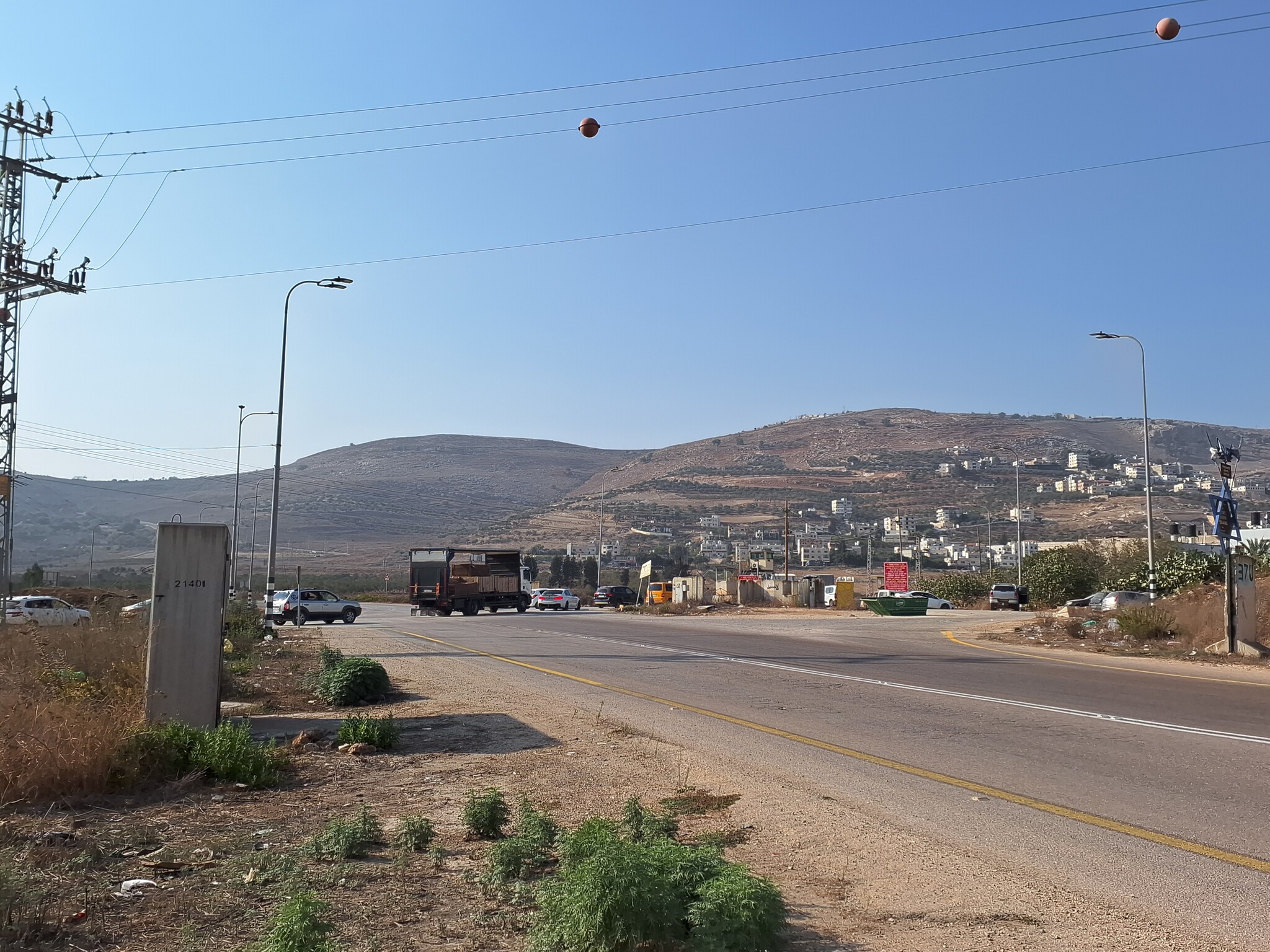
Za'tara (Tapuah) Za'tara is an internal checkpoint in the heart of the West Bank, at the intersection of Road 60 and Road 505 (Trans-Samaria), east of the Tapuah settlement. This checkpoint is the "border" marked by the IDF between the north and south of the West Bank, in accordance with the policy of separation between the two parts of the West Bank that has been in place since December 2005. At the Za'tara checkpoint, there are separate routes for Israelis and Palestinians. In the route for Israelis, there are no inspections and the route for Palestinians inspects. The queue lengthens and shortens suits. The checkpoint is open 24 hours a day. The checkpoint is partially staffed and the people who pass through it are checked at random.
 Shoshi AnbarSep-27-2023Za'atra (Tapuah Intersection). Signs
-