
‘Azzun ‘Atma, Eliyahu Crossing, Falamiya, Habla, Jubara (Kafriat), Mon 20.5.13, Morning
Palestinians go through holes in 'Azzun 'Atma’s security fence. The soldiers stationed at the checkpoint usually go out to search among those waiting outside for persons illegally in Israel. It isn’t clear why they don’t immediately repair the holes in the fence. Apparently the IDF doesn’t consider them very dangerous.
06:05 'Azzun 'Atma checkpoint
Many people have already come through; about 50 on line. The biometric fingerprint device is operating; each person going through must place a finger for identification. The ID is placed on a different device. That can take a long time, of course, if the identification isn’t successful due to erroneous placement of the finger, or it’s injured, or worn down from work. Personal belongings are left on a low, narrow concrete wall until their owner passes through the magnemometer; there’s no orderly procedure for leaving the belongings.
It took one man we timed from the moment he got on line 35 minutes to go through the checkpoint.
From time to time the soldiers go hunt for people who went through the holes in the fence and return those in Israel illegally to the West Bank. They pass among those waiting outside, question those waiting for their employers, send them back to the checkpoint to inspect their IDs. One man argued, insisting he’d come from the Eyal crossing and was unwilling to accompany the soldier to the checkpoint. There was a loud argument, until he relented and went with the soldiers so they could check his documents. After a discussion the soldiers are “right,” and they manage to convince him to go stand behind the checkpoint fence. It turned out that he had a crossing permit for Eyal that was valid from 7 AM; according to the soldier he couldn’t have already crossed. The procedure for those who went through the holes in the fence and were caught, and who had an Israeli work permit (there are such cases) is to be detained by the soldiers for three hours at the checkpoint and then allowed to go to work.
One of the soldiers (a reservist, of course) at the checkpoint talked to us and stressed repeatedly how he treats people going through with respect.
07:10 Habla checkpoint
No one is waiting on line.
A boys’ school bus goes through quickly after document inspection.
People keeping tricking in.
07:20 The girls’ bus crosses quickly after a fast document inspection.
One of the Palestinians tells us that a new DCO officer, Aliran, has replaced Tedesa, who completed his military service.
07:40 Eliyahu gate
Two cars are being inspected; no one is waiting on the pedestrian line.
08:00 Falamiya
Quiet and peaceful. They’re working on a new fence on the northern side, where people enter Israel, which will “enlarge” (after an appeal to the Supreme Court) the area “included” in Palestine, like at Jubara. Tractors arrive; their two drivers must open one of the closed gates on the road. The soldiers joke in the background. After the tractors cross the soldiers close the gate and again it’s quiet and peaceful. We stop at the beginning of the road to the checkpoint; it’s full of soldiers who don’t allow us to approach the checkpoint.
08:30 Jubara
Very quiet; almost no one is visible. All the asphalt has been taken up from the line of the fence that was removed; the land looks as if it had been plowed. (Perhaps they could plant olive trees? We doubt it, given the infrastructure that’s undoubtedly beneath the surface.) We went into the grocery to ask how they feel after the fence separating the village from the West Bank was removed (after the Supreme Court decision). The owner of the grocery is very pleased: We can visit people on the West Bank, they come to the village, there are no more problems obtaining merchandise, there’s freedom.
'Azzun 'Atma
See all reports for this place-
'Azzun 'Atma
A Palestinian village of about 1,800 residents. The settlement of Sha'arei Tikva was established on its land adjacent to it, and the settlement of Oranit was established on its agricultural lands. By 2013, the separation fence had passed through the village and a checkpoint staffed by the army allowed the residents to cross from side to side. After building a massive wall surrounding the village and some of its agricultural lands, the residents went daily for five years to their lands that remained in the Seam Zone through the Oranit agricultural checkpoint (4). Since 2018 it has only opened during the olive harvest and the farmers have to pass daily at the Beit Amin / Abu Salman checkpoint (1447), about 3 kilometers north.From a report from March 24, 2021: "The farmers from Beit Amin and Azon Atma are happy that since February 21 the Oranit checkpoint .is going to be open 3 times a day, The farmers are really developing the place."
Report from July 14, 2024: "Ornit checkpoint is closed . The Beit Amin/Abu Salman agricultural checkpoint is closed (there is no contact with the military to check if it opens rarely), the Ezbat Jaloud checkpoint was opened once a day before the war.
Updated for July 2024
 Apr-11-2019Azoun: The main entrance to village blocked now for several weeks
-
Eliyahu CP (109) / Crossing
See all reports for this place-
Eliyahu CP (109) / Crossing This checkpoint, also known as the Fruit Crossing, is one of the main checkpoints between Israel and the West Bank. It is located on Route 55 between Alfei Menashe and the turn to Qalqilya and Zufin, more than 4 km east of the Green Line, in the separation fence, which separates Qalqilya from its lands to the south, thus leaving Alfei Menashe West of the fence - the Seam Zone. This checkpoint, a few kilometers across the Green Line, is intended for "Israeli settlement in the West Bank and the population of the Seam Zone." It is managed by a civil company. Palestinians with a special permit for their lands in the seam area are also allowed to pass through it, on foot, and sometimes by car.
-
Falamiya
See all reports for this placeHabla
See all reports for this place-
Habla CP (1393)
The Habla checkpoint (1393) was established on the lands of the residents of Qalqilya, on the short road that
connected it for centuries to the nearby town of Habla. The separation barrier intersects this road twice and cut off the residents of Qalqilya from their lands in the seam zone.(between the fence and the green line).
There is a passage under Road 55 that connects Qalqilya to the sabotage This agricultural barrier is used by the farmers and nursery owners established along Road 55 from the Green Line and on both sides of the kurkar road leading to the checkpoint.
This agricultural checkpoint serves the residents of Arab a-Ramadin al-Janoubi (detached from the West Bank), who pass through it to the West Bank and back to their homes. The opening hours (3 times a day) of this agricultural checkpoint are longer than usual, about an hour (recently shortened to 45 minutes), and are coordinated with the transportation hours of a-Ramadin children studying in the occupied in the West Bank.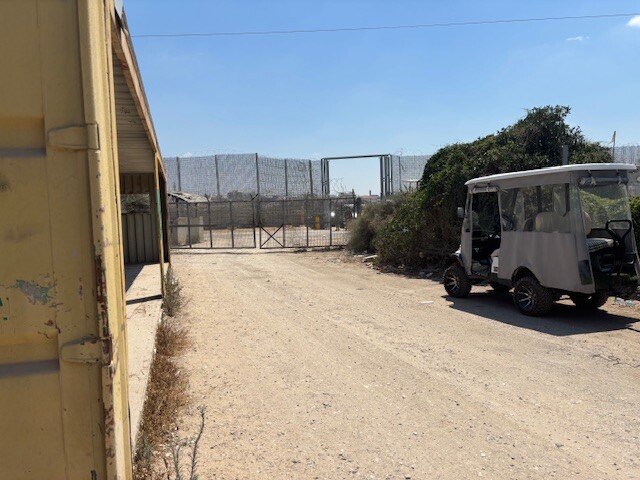 Nina SebaAug-18-2025Habla: The gate is in the process of closing
-
Jubara (Kafriat)
See all reports for this place-
The Jabra checkpoint was on Road 557, south of Tulkarm, on the side of the Figs Pass, which is located within the Palestinian Authority (a few kilometers east of the Green Line), and serves as an entry barrier from the territories to Israel. The checkpoint to the village of Jubara, which until 2013 was in the seam area, blocked and surrounded by a fence, was intended for the passage of the family members of the house next to the checkpoint, and also for the MachsomWatch volunteers (with special permission only), on their way to checkpoint 753. on the other side of the village. The soldiers supervising the "fig crossing" also supervised the crossing at this checkpoint, in our shifts we often waited a long time until the key was found and the gate opened. The checkpoint was abolished and became part of the separation fence that was moved west following the High Court.
-