
‘Azzun, ‘Azzun ‘Atma, Deir Ballut, Eliyahu Crossing, Mon 17.10.11, Morning
10:00 – Eliyahu crossing Not many vehicles or people in the new "installation". 'Azzun: We stopped to buy water and a number of people immediately approached us in order to tell us their problems. A father of a child receiving treatment in Tel Hashomer Hospital, who had undergone an operations on his hands, needed a permit for the next operation and ran into problems; a youth whose travel permit had expired in July, who is unemployed, while his elderly parents are still working their fields on the other side of the fence; a metal worker from a factory in Karnei Shomron who, along with many of his co-workers, is owed quite a bit of money for his work, and his Israeli employer forgets to pay them. We tried to help everyone by giving them the 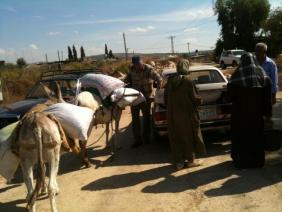 appropriate phone numbers and explanations, hoping they will find solutions to their problems. We continued on route #3, very well-described by Daliah, and arrived at the southern checkpoint of 'Azzun Atma, through which, of course, one cannot pass. Returned to 'Azzun Atma where we clarified, with the shop owner, if the army visits at night. The answer is yes. Sometimes they stop, sometimes just pass through. One of the residents told us that he has olive groves in Oranit and, until 2 years ago, they let him pass through and harvest them. Now, however, he has not been able to get there for two years. Once, as a boy, he worked in the shuk in Petah Tikva; today he is an infrastructure builder and has been building the new roads.
By way of Mascha we arrived at the southern checkpoint of Mascha (near the Hani Gate), at a time when the gate is open, at 12:30, for a couple of minutes. The 3 families who received permits to harvest the olives in the fields close to Elkana – opposite the gate – came back with their donkeys laden with olives. We spoke with Ayad, who didn't get a permit this year and was waiting in the car for his family. Opposite them, they are building 120 apartments. It will be interesting to see whether they receive permits for the harvest when these apartments are occupied… We continued to Bidia and crossed underneath road #5 to Dir Balut and from there back to Israeli at 13:00.
'Azzun
See all reports for this place-
Azoun (updated February 2019)
A Palestinian town situated in Area B (under civil Palestinian control and Israeli security control),
on road 5 between Nablus and Qalqiliya, east of Nabi Elias village. The inhabitants are allowed to construct and improve infrastructures. The Separation Fence has confiscated lands belonging to the town's people. In 2018 olive tree groves owned by one of its inhabitants were confiscated for the sake of paving a road to bypass Nabi Elias. Azoun population numbers 13,000, its economic state dire. Its infrastructures are poor, neglect and poverty rampant. In the meantime, the town council has completed paving an internal road for the inhabitants' welfare.
Because of its proximity to the Jewish settler-colony of Karnei Shomron and its outposts, the town suffers the intense presence of the Israeli army, especially at nighttime: soldiers enter homes, arrest suspects, trash the house and sometimes ruin it, as they do in numerous places in the West Bank. At times a checkpoint closes the entrance to the town, so no one can come in or get out.
-
'Azzun 'Atma
See all reports for this place-
'Azzun 'Atma
A Palestinian village of about 1,800 residents. The settlement of Sha'arei Tikva was established on its land adjacent to it, and the settlement of Oranit was established on its agricultural lands. By 2013, the separation fence had passed through the village and a checkpoint staffed by the army allowed the residents to cross from side to side. After building a massive wall surrounding the village and some of its agricultural lands, the residents went daily for five years to their lands that remained in the Seam Zone through the Oranit agricultural checkpoint (4). Since 2018 it has only opened during the olive harvest and the farmers have to pass daily at the Beit Amin / Abu Salman checkpoint (1447), about 3 kilometers north.From a report from March 24, 2021: "The farmers from Beit Amin and Azon Atma are happy that since February 21 the Oranit checkpoint .is going to be open 3 times a day, The farmers are really developing the place."
Report from July 14, 2024: "Ornit checkpoint is closed . The Beit Amin/Abu Salman agricultural checkpoint is closed (there is no contact with the military to check if it opens rarely), the Ezbat Jaloud checkpoint was opened once a day before the war.
Updated for July 2024
 Apr-11-2019Azoun: The main entrance to village blocked now for several weeks
-
Deir Ballut
See all reports for this place-
An internal checkpoint on Road 446 at the entrance to the village of Deir Ballut and near the settlements there, Alei Zahav and Peduel. Partially staffed, vehicles are inspected at random.
-
Eliyahu CP (109) / Crossing
See all reports for this place-
Eliyahu CP (109) / Crossing This checkpoint, also known as the Fruit Crossing, is one of the main checkpoints between Israel and the West Bank. It is located on Route 55 between Alfei Menashe and the turn to Qalqilya and Zufin, more than 4 km east of the Green Line, in the separation fence, which separates Qalqilya from its lands to the south, thus leaving Alfei Menashe West of the fence - the Seam Zone. This checkpoint, a few kilometers across the Green Line, is intended for "Israeli settlement in the West Bank and the population of the Seam Zone." It is managed by a civil company. Palestinians with a special permit for their lands in the seam area are also allowed to pass through it, on foot, and sometimes by car.
-