
‘Azzun, Beit Amin, Beit Amin Checkpoint (1447), Habla
Our second visit to the agricultural checkpoints and a meeting with two Palestinians who are forbidden to enter Israel.
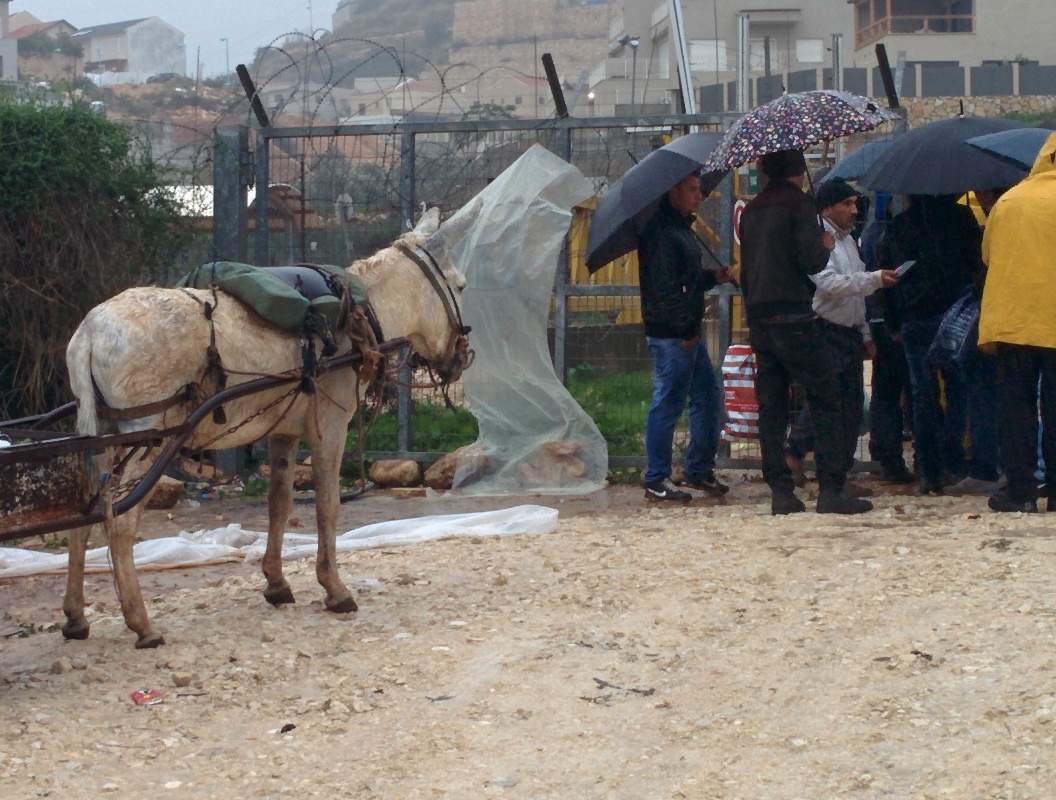
06:00 Habla 1391 For a change, the limited crew is already here and the gate is opened on time. From the direction of the village one can hear shouts. The soldiers do not intervene. We guess that the quarrel concerns placement in the queue, and indeed those who cross confirm our assumption. Such a depressing and humiliating situation every single morning provokes a frustration among the Palestinians that expresses itself in loud quarrels.
06:10 The first group of five exits after the inspection, and then another and another, one after the other.
06:25 A private car and five women come out.
06:30 A Palestinian on a donkey cart enters.
06:45 Up to now we have counted 110 people who came out of Habla.
Four private cars come out, then the plant-nursery truck laden with plants.
07:00 Our friend, the owner of the herd, comes out with a cart and a gorgeous horse.
Till now we have counted 130 people who passed through, but from afar one can still see the queue.
The minibus from Qalkiliya comes out, perhaps to bring the children to school. Two vans come out and a private car enters.
A total of 160 people came out, and from afar one can see another 20 people waiting to get out.
07:15 We leave in order to get to Beit Amin on time.
07:50 Beit Amin CP – 1447. The gate is already open. The same limited crew we met at Habla is present here too. The passage is quick and quiet. The soldier only registers the ID numbers that the Palestinians supply him with verbally. There is no checking of papers. There also is no reference to us on the part of the soldiers. Everybody smiles. The occupation is bad, the checkpoints are superfluous, but in this bad situation it is possible to behave toward the Palestinians like human beings without humiliating them. So why don't all the crews behave like this? Why is there sometimes a crew of 7 people who abuse the Palestinians and us?
30 people have come out. 2 private cars drive the farmers to their plots in shuttles and collect 10 shekels from each passenger. This very much facilitates matters for the farmers, who up until not long ago had to begin a march of 5-6 kms after passing through the checkpoints. At least this nightmare is over for them.
And again – If the army would open the gate opposite the square at the entrance to Oranit, much hardship could be avoided. But who cares?
Many people come up to us and tell us that they have received a prevention order without any explanation. We pass Sylvia's instructions on to them.
08:15 The CP is closed on time and the jeep leaves immediately.
08:45 Sha'ar Eliyahu CP – 4 cars at the checking posts
08:50 Nebi Ilyas – A meeting initiated by Ronit D. The young man tells us that he and his father are the owners of the restaurant where we and the participants in our tours eat falafel. He assumes that he has been prevented from entering Israel by the Shabak (General Security Service) because of a denouncement.
09:00 At the entrance to Azzun Three soldiers patrol on foot, but there is no Jeep. We meet a taxi driver who arrived on behalf of another person who has been prevented from entering Israel.
As usual we finish our tour at Z.'s shop. Z. smiles as usual.
'Azzun
See all reports for this place-
Azoun (updated February 2019)
A Palestinian town situated in Area B (under civil Palestinian control and Israeli security control),
on road 5 between Nablus and Qalqiliya, east of Nabi Elias village. The inhabitants are allowed to construct and improve infrastructures. The Separation Fence has confiscated lands belonging to the town's people. In 2018 olive tree groves owned by one of its inhabitants were confiscated for the sake of paving a road to bypass Nabi Elias. Azoun population numbers 13,000, its economic state dire. Its infrastructures are poor, neglect and poverty rampant. In the meantime, the town council has completed paving an internal road for the inhabitants' welfare.
Because of its proximity to the Jewish settler-colony of Karnei Shomron and its outposts, the town suffers the intense presence of the Israeli army, especially at nighttime: soldiers enter homes, arrest suspects, trash the house and sometimes ruin it, as they do in numerous places in the West Bank. At times a checkpoint closes the entrance to the town, so no one can come in or get out.
-
Beit Amin South / Abu Salman (1447)
See all reports for this place-
Beit Amin South / Abu Salman (1447) An agricultural checkpoint in the village of Abu Salman, which opens three times a day and is used by the farmers of Beit Amin and Abu Salman, and since the nearby gate has been inactive, also residents of 'Azzun' Atma, to reach their lands in the seamline zone adjacent to the settlement of Oranit.
-
Habla
See all reports for this place-
Habla CP (1393)
The Habla checkpoint (1393) was established on the lands of the residents of Qalqilya, on the short road that
connected it for centuries to the nearby town of Habla. The separation barrier intersects this road twice and cut off the residents of Qalqilya from their lands in the seam zone.(between the fence and the green line).
There is a passage under Road 55 that connects Qalqilya to the sabotage This agricultural barrier is used by the farmers and nursery owners established along Road 55 from the Green Line and on both sides of the kurkar road leading to the checkpoint.
This agricultural checkpoint serves the residents of Arab a-Ramadin al-Janoubi (detached from the West Bank), who pass through it to the West Bank and back to their homes. The opening hours (3 times a day) of this agricultural checkpoint are longer than usual, about an hour (recently shortened to 45 minutes), and are coordinated with the transportation hours of a-Ramadin children studying in the occupied in the West Bank.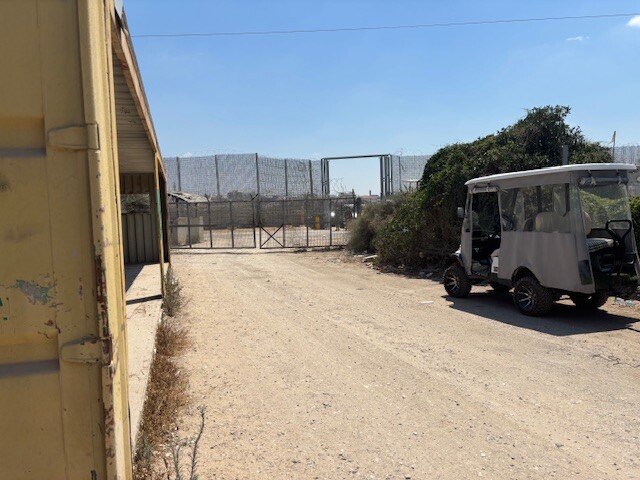 Nina SebaAug-18-2025Habla: The gate is in the process of closing
-