
'Azzun, Eliyahu Crossing, Habla Checkpoint (1393)

Owing to the Corona restrictions we do not visit faraway places which we used to visit in the past, but we did two good deeds and that’s a reason to set out on a shift.
At the Eliyahu Checkpoint there are three cars at the checking aread and two cars waiting to get in. At the exit from the checkpoint, direction east, there are 40 cars waiting for drivers to take them back home, probably to Qalqiliya.
Azzun – we visit Z.’s home to give him the pascels for the shop and to buy olive oil bottles. The whole family is at home. There are no studies owing to the Corona, although according to him there is no Corona at Azun but only at Kilkiliya. His three sons immediately volunteer to transfer the parcels, which we have brought. The eldest son stays in his room. Since that night, on which he has been taken for investigations by the General Security Service – the Shabak – he suffers from trauma.
The work permits for Z. who has been working at one of the Settlements and for his son are in the hands of the Sylvia team. In the meantime the family suffers from lack of income and from trauma.
At 12:30 we meet M. from Thulth at the center of the town. Since the last two years our members help him and buy olive oil from him. I approached Abed, the owner of a supermarket in Jaffa, and asked him to buy from our friend olive oil for his bakery. He has a lot of excuses to explain why he couldn’t drive to the West Bank and to make a big purchse. End of story – I bought from M. two jerrycans and brought them to Abed. I hope the quality of the oil is to his liking.
Habla CP 1392 – An agricultural gate as the army calls it.
We arrived at 13:20. There is nobody around , just a filthy container full of remnants of a meal that was eaten here. The opening in the fence has been repaired, but there is a new one on the left side.
Persons arriving on foot enter of course immediately. Also youngsters riding horses gallop in freely – a heartwarming sight. Who can tell them what to do on the territory belonging to their family?
At 13:40 an army vehicle arrives and the crew opens the gates at both sides. The soldiers are polite, as long as no problem arises. They offer us bottles of mineral water. They know Machsom Watch.
The vehicles which come out: 4 tenders, 3 all-terrain vehicles, 3 tractors, 7 private cars and bicycles drivers. 2 big trucks packed with equipment wrapped in nylon sheets (cabels?) are forced to wait on the side for approval of those in charge. The driver is enraged. According to him the matter had been coordinated yesterday. After a long wait and phone calls to the officers, they go on their way.
An elderly man who arrives on electrical bicycles is not allowed to enter. A heated argument ensues. The man was rightly furious. After a loud argument he was allowed to enter.
14:15 The soldiers close the checkpoint. Three pedestrians and a man on an all terrain vehicle arrive and are sent to the Eliyahu CP. This is what is written on their permit. What a nerve wracking bureaucracy. To what extent can one pester people. When will there be an end to these shameful procedures. At the end of the occupation.
'Azzun
See all reports for this place-
Azoun (updated February 2019)
A Palestinian town situated in Area B (under civil Palestinian control and Israeli security control),
on road 5 between Nablus and Qalqiliya, east of Nabi Elias village. The inhabitants are allowed to construct and improve infrastructures. The Separation Fence has confiscated lands belonging to the town's people. In 2018 olive tree groves owned by one of its inhabitants were confiscated for the sake of paving a road to bypass Nabi Elias. Azoun population numbers 13,000, its economic state dire. Its infrastructures are poor, neglect and poverty rampant. In the meantime, the town council has completed paving an internal road for the inhabitants' welfare.
Because of its proximity to the Jewish settler-colony of Karnei Shomron and its outposts, the town suffers the intense presence of the Israeli army, especially at nighttime: soldiers enter homes, arrest suspects, trash the house and sometimes ruin it, as they do in numerous places in the West Bank. At times a checkpoint closes the entrance to the town, so no one can come in or get out.
-
Eliyahu CP (109) / Crossing
See all reports for this place-
Eliyahu CP (109) / Crossing This checkpoint, also known as the Fruit Crossing, is one of the main checkpoints between Israel and the West Bank. It is located on Route 55 between Alfei Menashe and the turn to Qalqilya and Zufin, more than 4 km east of the Green Line, in the separation fence, which separates Qalqilya from its lands to the south, thus leaving Alfei Menashe West of the fence - the Seam Zone. This checkpoint, a few kilometers across the Green Line, is intended for "Israeli settlement in the West Bank and the population of the Seam Zone." It is managed by a civil company. Palestinians with a special permit for their lands in the seam area are also allowed to pass through it, on foot, and sometimes by car.
-
Habla CP (1393)
See all reports for this place-
Habla CP (1393)
The Habla checkpoint (1393) was established on the lands of the residents of Qalqilya, on the short road that
connected it for centuries to the nearby town of Habla. The separation barrier intersects this road twice and cut off the residents of Qalqilya from their lands in the seam zone.(between the fence and the green line).
There is a passage under Road 55 that connects Qalqilya to the sabotage This agricultural barrier is used by the farmers and nursery owners established along Road 55 from the Green Line and on both sides of the kurkar road leading to the checkpoint.
This agricultural checkpoint serves the residents of Arab a-Ramadin al-Janoubi (detached from the West Bank), who pass through it to the West Bank and back to their homes. The opening hours (3 times a day) of this agricultural checkpoint are longer than usual, about an hour (recently shortened to 45 minutes), and are coordinated with the transportation hours of a-Ramadin children studying in the occupied in the West Bank.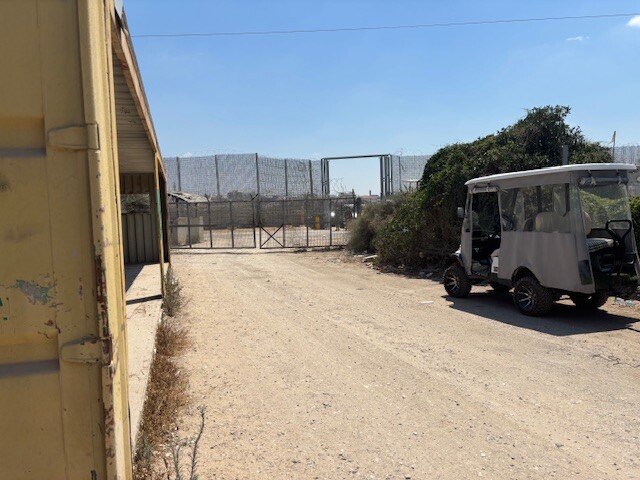 Nina SebaAug-18-2025Habla: The gate is in the process of closing
-