
‘Azzun, Eliyahu Crossing, Habla, Kufr Jammal
‘Azzun, Kufr Jammal, Habla,
Meetings with four Palestinians, old friends, who manage to describe the occupation’s injustices with commendable restraint.
10:30 Eliyahu checkpoint. Traffic flows. Many Palestinian cars are in the inspection area.
An army jeep is at the entrance to ‘Azzun, doors open, with soldiers inside.
We visit Z.’s store to unload packages we’ve brought and to shop in nearby stores. He accompanies us and says that this morning (November 11) the army inspected all cars entering and exiting, a line formed at the entrance to ‘Azzun which stretched to the center of town and many were late for work and for school.
We met with K. at the municipal building. He also described the very difficult morning. Every car entering or leaving was stopped for a slow, careful inspection.
One day during the olive harvest security personnel from Ma’aleh Shomron came to tell him he’s forbidden to remain on his land after 16:00, and showed him how far he could come with his car. Bravely he replied: “This is my land and I’ll come here whenever I wish.”
During the olive harvest they were helped by people from the International Solidarity Movement, a human rights organization. We asked about Israeli organizations. Our host said many people in ‘Azzun won’t accept help from Israelis!
Education – The extra curriculum program for pupils, of which they’re very proud, continues.
K. is polite but very busy and we had promised our visit would be brief. We left.
12:00 Kufr Jammal. We stop at Z’s shop. He tells us the village is quiet, people are focused on personal matters – making a living and family. Outside events don’t interest them. Some work in Israel (leaving at 02:30 to reach the Eyal checkpoint), farmers grow za’atar, and some work in one of the two local factories, Aqua Ice for mineral water, and Gappy for carbonated drinks. Z. sells those products. They see almost no soldiers – because there are no settlements near the village. He tells us his 17-year-old son hasn’t received a permit to work in their za’atar field. We mention Sylvia and his face lights up. He knows her, of course he does, she helped his oldest son very much. He admires her. He used to have 15 dunam. It was a long, narrow plot. The Israelis came and built fences and a road on it. Five dunam remained, where he grows olives, just for the family.
His family owned much land near Herzliya. They grew watermelons for export. Everything was taken in 1948. Many members of the family live in Tira. One of his cousins came to Kufr Jammal in 1948 on a visit, was shot by a border police soldier and killed.
A family account of land theft and killing.
Back via ‘Azzun. The army jeep is gone but a group of soldiers stands on guard in the shade.
13:00 Habla. The soldiers and MP’s are on site but they’re not hurrying to open the checkpoint.
People wait on both sides of the fence to return home and to leave the village. The gate finally opens and the first five people enter the inspection station. Three carts follow. The exit gate from Habla also opens and the first five advance toward the revolving gate. A number of vehicles go through in both directions.
We visit our friend A’s plant nursery. The cyclamen season has begun; he has an attractive assortment.
“If you start interfering with religion it’s a recipe for disaster. That’s what Israel doesn’t understand,” he says.
“Let people live. That’s all we want. Soon Abu Mazen won’t be able to control his people if you continue pouring fuel on the flames.” We’re on the verge of a holy war.
We left.
'Azzun
See all reports for this place-
Azoun (updated February 2019)
A Palestinian town situated in Area B (under civil Palestinian control and Israeli security control),
on road 5 between Nablus and Qalqiliya, east of Nabi Elias village. The inhabitants are allowed to construct and improve infrastructures. The Separation Fence has confiscated lands belonging to the town's people. In 2018 olive tree groves owned by one of its inhabitants were confiscated for the sake of paving a road to bypass Nabi Elias. Azoun population numbers 13,000, its economic state dire. Its infrastructures are poor, neglect and poverty rampant. In the meantime, the town council has completed paving an internal road for the inhabitants' welfare.
Because of its proximity to the Jewish settler-colony of Karnei Shomron and its outposts, the town suffers the intense presence of the Israeli army, especially at nighttime: soldiers enter homes, arrest suspects, trash the house and sometimes ruin it, as they do in numerous places in the West Bank. At times a checkpoint closes the entrance to the town, so no one can come in or get out.
-
Eliyahu CP (109) / Crossing
See all reports for this place-
Eliyahu CP (109) / Crossing This checkpoint, also known as the Fruit Crossing, is one of the main checkpoints between Israel and the West Bank. It is located on Route 55 between Alfei Menashe and the turn to Qalqilya and Zufin, more than 4 km east of the Green Line, in the separation fence, which separates Qalqilya from its lands to the south, thus leaving Alfei Menashe West of the fence - the Seam Zone. This checkpoint, a few kilometers across the Green Line, is intended for "Israeli settlement in the West Bank and the population of the Seam Zone." It is managed by a civil company. Palestinians with a special permit for their lands in the seam area are also allowed to pass through it, on foot, and sometimes by car.
-
Habla
See all reports for this place-
Habla CP (1393)
The Habla checkpoint (1393) was established on the lands of the residents of Qalqilya, on the short road that
connected it for centuries to the nearby town of Habla. The separation barrier intersects this road twice and cut off the residents of Qalqilya from their lands in the seam zone.(between the fence and the green line).
There is a passage under Road 55 that connects Qalqilya to the sabotage This agricultural barrier is used by the farmers and nursery owners established along Road 55 from the Green Line and on both sides of the kurkar road leading to the checkpoint.
This agricultural checkpoint serves the residents of Arab a-Ramadin al-Janoubi (detached from the West Bank), who pass through it to the West Bank and back to their homes. The opening hours (3 times a day) of this agricultural checkpoint are longer than usual, about an hour (recently shortened to 45 minutes), and are coordinated with the transportation hours of a-Ramadin children studying in the occupied in the West Bank.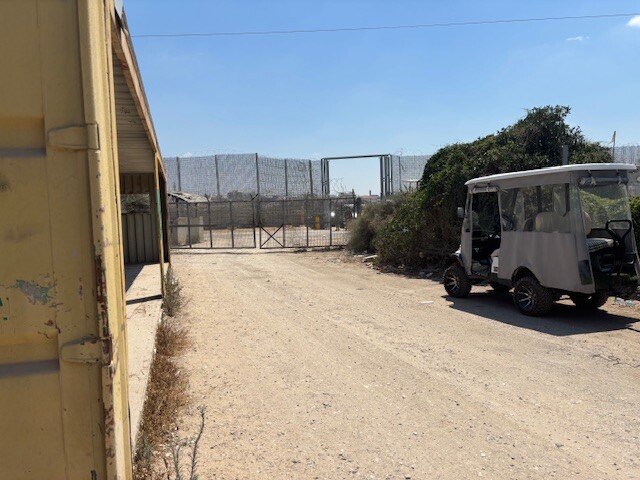 Nina SebaAug-18-2025Habla: The gate is in the process of closing
-
Kufr Jammal
See all reports for this place-
Kufr Jammal This village, rising about 200 meters over sea level, is located about 14 kilometers south of Tul Karm town and about 17 kilometers from the Mediterranean Sea. The families living there since the mid-18th century number about 3,000 persons at present. The village has lost thousands of dunams of its northern and western lands due to the construction of the Separation Barrier, leaving the lands themselves behind the barrier. After the Israeli Supreme Court ruling in 2011, the barrier was moved to the west and many farmlands were returned to their owners. It is a quiet village, its relations with the nearby settler-colony of Sal’it are favorable, and many of the villagers work in the colony’s industrial plants. Farmers cross the agricultural checkpoint close to this settler-colony in order to tend their fields unhampered. However, there are numerous acts of harassment and disorder taking place when the village farmers cross the other agricultural checkpoints: gates do not open at hours suitable to the farmers’ needs, and for a short period of time only; the Civil Administration usually prevents all kinds of crops except olives; tractors and other farm equipment are forbidden entry; only a single permit is issued per family, and occasionally such permits are confiscated and their re-issue is delayed – the common excuse is usually “security reasons”. How do the villagers make their living? Holders of work permits inside Israel travel at 3 a.m. to Eyal Checkpoint near Qalqiliya town in order to make it on time to their workplace at Sal’it (close to their village) and elsewhere. Owners of vegetable patches who hold permits are allowed to reach their fields beyond the Separation Barrier through the distant Falamiya Checkpoint. Importantly, fields returned to the village show amazing improvement intending, irrigation and farming variety – and instead of the neglected olive tree groves that were accessible only to holders of transit permits through agricultural checkpoints usually closed, farming has now flourished. (updated Jan 2021)
-