
‘Azzun, Eyal Crossing, Habla, Qalqiliya
The permanency of the Occupation: the non-stop development and landscaping of the Eyal Terminal.

4.48 No workers exited yet. The parking lot full with the usual white transits and on the side one bus of “Kavim” public transport company. On Fridays Eyal Terminal apparently only opens at 5.00 AM, not like Irtach at 4.45 AM.
5.00 We hear a voice via a loudspeaker: “work starting” and within 5 min the first worker exits. These are only men going to work though, as those people with a permit for going to Jerusalem’s Al Aksa for praying on the last Friday of Ramadan will be able to pass only at 8.00 AM. All  men and women seem in good spirits and greet us friendly . We meet Naim a Palestinian who is not just familiar with Machsom Watch but cooperates with us: he spoke at one of our meetings in the Cinemateque in Tel Aviv. He hurries off to his job but not before asking us if we need his help for anything and tells us passing the Terminal goes smoothly.
5.30 As we are not being allowed near the Terminal to observe near the fence of Kalkiliya where the workers enter the passsage, we pass the Terminal and walk towards the DCO-office behind it, to see if the road behind this office still gives access to the security road surrounding Kalkiliya from where we can observe the Kalkiliya’s fence with the workers-passage leading towards the Terminal; indeed it does.
We see that still not enough has been done to make the Occupation even more permanent: the non-stop development and landscaping continues here at Eyal. The very moment we took a picture of these developments we hear a warning voice, and from nowhere” comes a security-guard and some meters behind him the manager of the Terminal, with yet another guard, calling us and tells us ” like at Ben-Gurion Airport also here it is forbidden to take pictures, as is written at the entrance” . No sign to be seen, though, unless you walk where we are not permitted to go (the yellow board on the opened gate).
Enough watertaps are profided for, here at Eyal, but because of Ramadan few make use of it today.
5.45 We leave and drive eastwards direction Tsofim. On the road just before the Kalkiliya- crossing near Tsofim there are billboards, one with forbidding to “dump waste in Yehuda and Shomron” and one a “prohibition to give cars for repairs in the Palestinian Authority”.
This time we could pass the Kalkiliya crossing without being asked any questions and our stopping and taking pictures was not felt as suspect.
6.00 We drove to Azun to see if there was any IDF presence there but the yellow barrier was open and no soldiers were seen. The village seems still asleep at this early hour.
6.07 The girl-soldier at the Eliyahu-crossing started talking in English to us, maybe because of our MW-flag, thinking it was some international organization. Her Ethiopian colleague thought it hilarious she did not know what Machsom Watch was. With causing so much fun, they gave us no problems letting us pass.
6.10Habla-crossing still closed and deserted. “It opens usually on time, at 6.30, also Fridays, and no special problems either” we were told by a couple of men sitting in front of one of the several nurseries there. We took their word for it and did not wait for the arrival of the soldiers
'Azzun
See all reports for this place-
Azoun (updated February 2019)
A Palestinian town situated in Area B (under civil Palestinian control and Israeli security control),
on road 5 between Nablus and Qalqiliya, east of Nabi Elias village. The inhabitants are allowed to construct and improve infrastructures. The Separation Fence has confiscated lands belonging to the town's people. In 2018 olive tree groves owned by one of its inhabitants were confiscated for the sake of paving a road to bypass Nabi Elias. Azoun population numbers 13,000, its economic state dire. Its infrastructures are poor, neglect and poverty rampant. In the meantime, the town council has completed paving an internal road for the inhabitants' welfare.
Because of its proximity to the Jewish settler-colony of Karnei Shomron and its outposts, the town suffers the intense presence of the Israeli army, especially at nighttime: soldiers enter homes, arrest suspects, trash the house and sometimes ruin it, as they do in numerous places in the West Bank. At times a checkpoint closes the entrance to the town, so no one can come in or get out.
-
Eyal Checkpoint / Crossing
See all reports for this place-
Eyal Checkpoint is intended for pedestrians and Palestinians only. This is the main barrier for workers to cross from the center of the West Bank. Workers with a work permit to enter Israel can pass through it for trade, medicine, and visiting prisoners. The checkpoint was built on the Green Line north of Qalqilya in the separation barrier that surrounds the city. The checkpoint began operating in 2004 by the military. Opening hours on weekdays from 04:00 to 19:00. We started holding shifts there in 2007. We arrived at the checkpoint before it opened at 4 in the morning. We reported on the difficult conditions and the long and cramped queues of workers who must continue their journey by commuting to work throughout Israel. At the end of June 2009, the checkpoint was operated by a civil security company, The transit time has been gradually shortened, today it is faster, but the Palestinians still have to arrive very early to make it to the transportation. Usually, about 15,000 people pass through.
-
Habla
See all reports for this place-
Habla CP (1393)
The Habla checkpoint (1393) was established on the lands of the residents of Qalqilya, on the short road that
connected it for centuries to the nearby town of Habla. The separation barrier intersects this road twice and cut off the residents of Qalqilya from their lands in the seam zone.(between the fence and the green line).
There is a passage under Road 55 that connects Qalqilya to the sabotage This agricultural barrier is used by the farmers and nursery owners established along Road 55 from the Green Line and on both sides of the kurkar road leading to the checkpoint.
This agricultural checkpoint serves the residents of Arab a-Ramadin al-Janoubi (detached from the West Bank), who pass through it to the West Bank and back to their homes. The opening hours (3 times a day) of this agricultural checkpoint are longer than usual, about an hour (recently shortened to 45 minutes), and are coordinated with the transportation hours of a-Ramadin children studying in the occupied in the West Bank.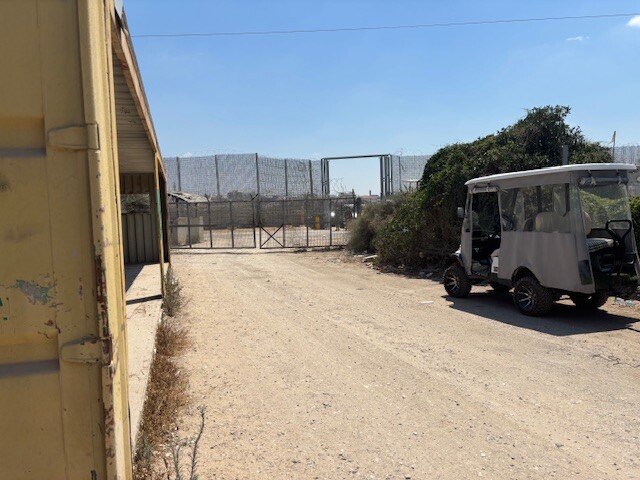 Nina SebaAug-18-2025Habla: The gate is in the process of closing
-
Qalqiliya checkpoint
See all reports for this place-
Qalqilya is surrounded on all sides by the separation barrier. The only exit from the city is in the east of the city on the road that leaves the city in an easterly direction. This is where the checkpoint was located. When the checkpoint was active until 2009 our shifts watched long queues of cars being inspected at the only exit from the city to the West Bank. The checkpoint was canceled, but there is a military presence at the entrance to the city.
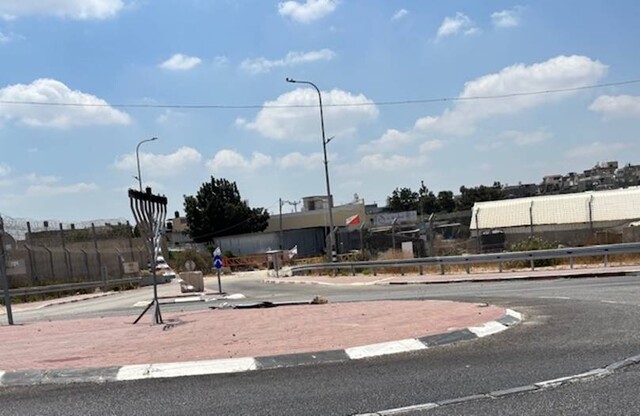 Nina SebaAug-18-2025Azzun: Enclosed by a high fence and the gate to the village is closed
-