
Azzun, Habla, Imatin
9.30 Azzun. Sarah gives a yoga lesson. 10 women take part. In spite of the difficulty of getting used to this activity they keep coming and are interested to continue. Others sat in the adjoining room with and the beadwork which they had brought from home, work and enjoy themselves chatting.
At the end of the hour Sarah goes with Nadim to Imatiin where she and Sarah give a Hebrew lesson to the women. Attractive yellow cards are used as an aid to the lesson. The subject: fruits and vegetables. Some women who are not interested in learning the language continue with the beadwork.
They were impressed at Ruthie’s work at previous visits and ask to learn how to crochet. Dafna and Sarah decide to take over this project, to learn this art on their own and with the help of Ruthie and then to teach the women. This idea inspires enthusiasm.
10.00 Imatin. 7 women are already waiting and 5 more arrived later. Some of the women are related. A daughter is studying at the Open University in Nablus her 12 sister comes to the lesson on her day off from school. Another girl comes for the first time with her mother. The father works in Israel and teaches them Israeli expressions. It seems that in this way he is encouraging them to learn the language. After an hour and a half Sarah arrives. I invite Nadim to come up. This time there will not be a yoga lesson.
10.00 We have to go back to Azzun. Sarah tries to decide with the women on another day for the activities. We hear that there are other women in the village who would like to join our group.
12.30 The Habla gate. We arrived before it is open. Quiet. A tractor with equipment is parking next to the gate. The water pump building next to the gate is open today. Nadim speaks with the guard. The water pump which was confiscated by the army has not been returned yet. They get a limited amount of water from Habla. They do not complain about a scarcity of water. In the afternoon there is to be a meeting of the various authorities, the Israeli DCO, the Palestinian DCO and the contributors from Europe about the pump.
12.45 We left.
'Azzun
See all reports for this place-
Azoun (updated February 2019)
A Palestinian town situated in Area B (under civil Palestinian control and Israeli security control),
on road 5 between Nablus and Qalqiliya, east of Nabi Elias village. The inhabitants are allowed to construct and improve infrastructures. The Separation Fence has confiscated lands belonging to the town's people. In 2018 olive tree groves owned by one of its inhabitants were confiscated for the sake of paving a road to bypass Nabi Elias. Azoun population numbers 13,000, its economic state dire. Its infrastructures are poor, neglect and poverty rampant. In the meantime, the town council has completed paving an internal road for the inhabitants' welfare.
Because of its proximity to the Jewish settler-colony of Karnei Shomron and its outposts, the town suffers the intense presence of the Israeli army, especially at nighttime: soldiers enter homes, arrest suspects, trash the house and sometimes ruin it, as they do in numerous places in the West Bank. At times a checkpoint closes the entrance to the town, so no one can come in or get out.
-
Habla
See all reports for this place-
Habla CP (1393)
The Habla checkpoint (1393) was established on the lands of the residents of Qalqilya, on the short road that
connected it for centuries to the nearby town of Habla. The separation barrier intersects this road twice and cut off the residents of Qalqilya from their lands in the seam zone.(between the fence and the green line).
There is a passage under Road 55 that connects Qalqilya to the sabotage This agricultural barrier is used by the farmers and nursery owners established along Road 55 from the Green Line and on both sides of the kurkar road leading to the checkpoint.
This agricultural checkpoint serves the residents of Arab a-Ramadin al-Janoubi (detached from the West Bank), who pass through it to the West Bank and back to their homes. The opening hours (3 times a day) of this agricultural checkpoint are longer than usual, about an hour (recently shortened to 45 minutes), and are coordinated with the transportation hours of a-Ramadin children studying in the occupied in the West Bank.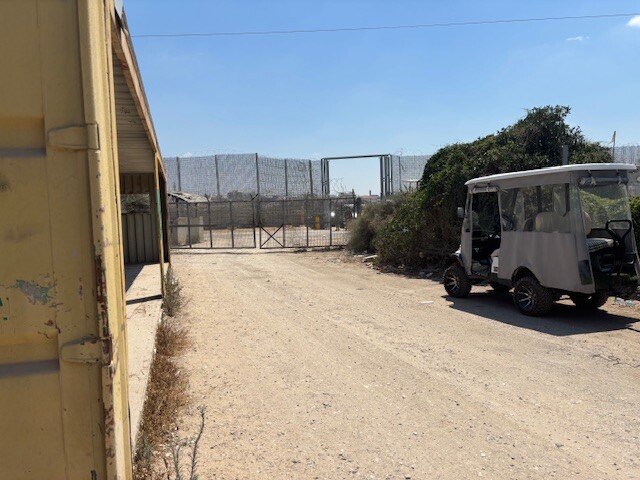 Nina SebaAug-18-2025Habla: The gate is in the process of closing
-
Imatin
See all reports for this place-
Imatin This village lies in the West Bank, 19 kilometers southwest of Nablus city and 23 kilometers east of the city of Qalqiliya. Its inhabitants' number 799, all members of four families from the neighboring village of Imatin. Far’ata is identified with the Biblical Far’atoun, and an archeological survey has identified findings on a timeline from the Second Iron Age until the days of the Ottoman Empire. After the Oslo Accords, the built-up area of the village was categorized as Area B, but 80% of its farmlands were classified as Area C. In 2002, settlers founded the outpost of Havat Gil’ad, which they claim is located on privately-owned land purchased by the Zar family. The Palestinians claim they own the land. The Civil Administration has issued demolition orders for all the structures in this outpost and they were declared illegal, but nothing was done about it. On February 4, 2018, the Israeli government unanimously ruled to regulate this outpost by defining it as a new settlement or by erecting a new settlement next to it. Beginning in 2012, the Palestinian Authority ruled to include Far’ata in the local council of Imatin, a larger community. For further information: http://vprofile.arij.org/qalqiliya/pdfs/vprofile/immatin_vp_en.pdf

 +-
+-
-