
‘Azzun, Habla, Qaddum
09.30: We set out in the direction of Kadum, to meet S. and hear from him about what has been going on recently in the village. According to him the army has increased the use of live bullets. The soldiers block the way of the demonstrators and do not allow them to advance in the direction of the spot where the road was blocked. The Kadum inhabitants continue to demonstrate on Fridays and Saturdays. There are many wounded among them, some of whom continue coming to the demonstrations despite their injury. S., who has always been optimistic, says that he sees no chance for peace.
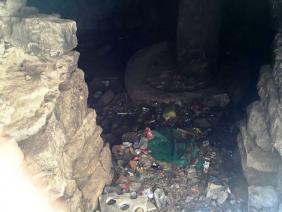
S. led us to the ancient part of the village. There are buildings that are over 400 years old. The buildings are not well maintained, but it is evident that they were imposing. There is also an old oil-press, where there is a big round stone. It is difficult to make it out in the dark, and with all the filth. The alleyways are narrow and picturesque. It is really beautiful to walk there, were it not that we know about the conditions of existence of the Kadum inhabitants. Everywhere the villagers stop us and invite us to their homes for coffee, tea, to be their guests. They are friendly and smiling. As always.
An elderly woman tells S. about her difficulties regarding the olive picking at her plot, which is situated exactly in the Kedumim settlement. Only her family members are allowed to accompany her, but her sons are not available for this. She only has a few days to enter with a permit. A difficult reality.
12.00: We drive to Azzun. We bring Z. clothes for his shop. At the entrance to the town there is a military vehicle, and a few soldiers around. Z. says that it is quiet at their place (a few days later this quiet was breached). In the town people are busy repairing the rain damage.
We continue to A.'s plant nursery. He is sad and angry. The soldiers at the Habla gate treat him rudely. He now prefers to cross in the morning by the Eliyahu checkpoint, and only in the evening by the Habla gate. It's a long time since I've seen this nice man so depressed. It seems that the burden of the occupation had begun to subdue him, too. He tells us that the soldiers made him enter the cabin for the security check and told him to undress. He refused. He said he told them that if they forced him to undress completely, he would go out naked in view of everybody. In the end they gave up.
He now has fewer buyers. Israelis are afraid to come. This too is a reason for his sadness. He tells us that one of his customers, an old woman, refused to leave her car. She asked him to load the flowers and drove away. This saddens him. He is known for his hospitality.
13.30: Habla gate.
A military vehicle arrives, in which there are two soldiers, not from the checkpoints unit. They stop next to us and ask what we are doing here. We explain. They have never heard about us. Novices. But nice ones. Still nice.
One of them asks me whether I am not afraid. Again the usual explanations. He says that if his mother or grandmother would wish to come here, he would worry about them. He tells us that at the gate before Habla, where they are coming from, there was an incident of stone throwing on soldiers. "I don't draw my weapon against them," he says, "not even in order to frighten them, but they do throw stones." He doesn't know the number of the gate or what it is called.
13.40: The soldiers open the gate. Within a short time all the people waiting, from both directions, go through. At noon there is no great pressure.
14.00 We part at the Rosh Ha'Ayin train station.
'Azzun
See all reports for this place-
Azoun (updated February 2019)
A Palestinian town situated in Area B (under civil Palestinian control and Israeli security control),
on road 5 between Nablus and Qalqiliya, east of Nabi Elias village. The inhabitants are allowed to construct and improve infrastructures. The Separation Fence has confiscated lands belonging to the town's people. In 2018 olive tree groves owned by one of its inhabitants were confiscated for the sake of paving a road to bypass Nabi Elias. Azoun population numbers 13,000, its economic state dire. Its infrastructures are poor, neglect and poverty rampant. In the meantime, the town council has completed paving an internal road for the inhabitants' welfare.
Because of its proximity to the Jewish settler-colony of Karnei Shomron and its outposts, the town suffers the intense presence of the Israeli army, especially at nighttime: soldiers enter homes, arrest suspects, trash the house and sometimes ruin it, as they do in numerous places in the West Bank. At times a checkpoint closes the entrance to the town, so no one can come in or get out.
-
Habla
See all reports for this place-
Habla CP (1393)
The Habla checkpoint (1393) was established on the lands of the residents of Qalqilya, on the short road that
connected it for centuries to the nearby town of Habla. The separation barrier intersects this road twice and cut off the residents of Qalqilya from their lands in the seam zone.(between the fence and the green line).
There is a passage under Road 55 that connects Qalqilya to the sabotage This agricultural barrier is used by the farmers and nursery owners established along Road 55 from the Green Line and on both sides of the kurkar road leading to the checkpoint.
This agricultural checkpoint serves the residents of Arab a-Ramadin al-Janoubi (detached from the West Bank), who pass through it to the West Bank and back to their homes. The opening hours (3 times a day) of this agricultural checkpoint are longer than usual, about an hour (recently shortened to 45 minutes), and are coordinated with the transportation hours of a-Ramadin children studying in the occupied in the West Bank.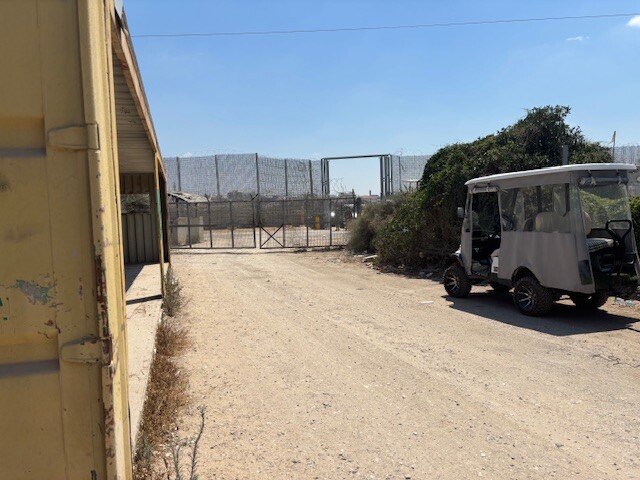 Nina SebaAug-18-2025Habla: The gate is in the process of closing
-
Qaddum
See all reports for this place-
Qaddum
The village of Qaddum dates back approximately 4,000 years. Today’s villagers mostly work in agriculture and cultivae olive groves. The hilly landscape is covered with olive trees and are dotted with patches of green fields.
Qaddum was attached to the district of Nablus until 1994 at which time it joined the Qalqiliya district. The village is home to 4,000 inhabitants (2013), with 22,000 dunams (5,400 acres) of which 11,000 dunam (2700 acres) are in Area C*. Access to Area C requires coordination with the Israeli army, which means that access is almost non-existent.
The settlement of Kedumim was founded in 1975 on lands belonging to the ancient the village of Qaddum. Since then, Kedumim has expanded to include 5 settlements. The Kedumim settlements separate Qaddum village from its lands and from access to the main road. The road connecting Qaddum village to Route 55 was closed to its residents in 2003. The short ride (1.5 km or less than a mile) between Qaddum and a neighboring village - Jit, turned into a 12 km (7.5 miles) bumpy ride on an unpaved gravely road. Since 2004, residents of the village of Qaddum have been submitting requests to the authorities to reopen the old road leading to Route 55.
On July 2011, the villagers began holding weekly demonstrations in protest of the road closure and of the theft of their lands. They march to the edge of the village and there they stop. There is a regular routine to the demonstration which always follows with a confrontation with the army when it enters the village at the end of the blocked road. The army reacts to the demonstrations with sharp weapons, rubber bullets, tear gas and lately also live ammunition. Villagers are injured and hurt each week and often, dozens are arrested by the army. Young people and children are intimidated by the army when they photos are posted in the village streets.
On 12/7/19 a 10 year old boy was criticaaly wounded after he was shot in the head by live ammunition while standing at the entrance to his home in Qaddum during a demonstration.*Area C is an administrative division of the West Bank established by the Oslo II Accords in 1995. The Palestinian Authority is responsible for medical and education services and Israel is responsible for infrastructure and administration.
-