
‘Azzun, Habla, Wed 20.10.10, Morning
Translator: Charles K.
Habla 7:25
“Fi mushkela” (there are problems today), a female farmer riding a donkey cart called to us…About a hundred people crowded around Habla’s wretched agricultural gate. Soldiers tried to push the gate closed, to control the crowd. They allowed two adult Palestinians to organize the angry line. They admitted men in groups of five for inspection in the checkpoint’s “rooms.”
It was like that until 8:15. The soldiers were late opening the gate today.
Angry men went through holding their belts. “Is there any point to all this?” they asked us.
Me, to a soldier: When did you open it today?
Soldier A: “What difference does it make?”
Soldier B: “What business is it of mine?”
When a donkey cart arrives, the donkey has priority. Some of the young people are on bicycles. They fly flags of “Real Madrid.”
8:20 Eliyahu crossing
Khirbet Nebi Elias, Azzun, Sir, Jayyus, Kafr Jamal
We drove through the villages. The olive harvest is at its peak. Families in the shade of ancient olive trees. Men shake the branches, the olives fall onto plastic sheets. Women collect the olives in sacks. A carriage with a baby. There weren’t any problems with settlers at the locations we passed. A man at the Jayyus gas station told us that yesterday they opened the gate to the harvesters at 18:00 instead of 17:00, so people had to wait after they’d finished their work day.
I was reminded of the soldiers at the Habla checkpoint: “What difference does it make? What business is it of mine?”
We drove to the Falamya agricultural gate.
Soldiers with nothing to do were happy to see us. Reservists, “pained to see the difficulties imposed on the farmers.” “But there were four attempts this week by Palestinians to go over the fence, and then the entire battalion is awakened, called out and has to pursue them. Maybe they’re planning an attack? By the way – two of them were children who were caught and turned over to the police.” “That’s why the gate opens late.” Revenge? Catching up on sleep?
We return via Azzun.
Today there’s a hamsin.
The high-rise buildings on the horizon along the coast are veiled in smog.
'Azzun
See all reports for this place-
Azoun (updated February 2019)
A Palestinian town situated in Area B (under civil Palestinian control and Israeli security control),
on road 5 between Nablus and Qalqiliya, east of Nabi Elias village. The inhabitants are allowed to construct and improve infrastructures. The Separation Fence has confiscated lands belonging to the town's people. In 2018 olive tree groves owned by one of its inhabitants were confiscated for the sake of paving a road to bypass Nabi Elias. Azoun population numbers 13,000, its economic state dire. Its infrastructures are poor, neglect and poverty rampant. In the meantime, the town council has completed paving an internal road for the inhabitants' welfare.
Because of its proximity to the Jewish settler-colony of Karnei Shomron and its outposts, the town suffers the intense presence of the Israeli army, especially at nighttime: soldiers enter homes, arrest suspects, trash the house and sometimes ruin it, as they do in numerous places in the West Bank. At times a checkpoint closes the entrance to the town, so no one can come in or get out.
-
Habla
See all reports for this place-
Habla CP (1393)
The Habla checkpoint (1393) was established on the lands of the residents of Qalqilya, on the short road that
connected it for centuries to the nearby town of Habla. The separation barrier intersects this road twice and cut off the residents of Qalqilya from their lands in the seam zone.(between the fence and the green line).
There is a passage under Road 55 that connects Qalqilya to the sabotage This agricultural barrier is used by the farmers and nursery owners established along Road 55 from the Green Line and on both sides of the kurkar road leading to the checkpoint.
This agricultural checkpoint serves the residents of Arab a-Ramadin al-Janoubi (detached from the West Bank), who pass through it to the West Bank and back to their homes. The opening hours (3 times a day) of this agricultural checkpoint are longer than usual, about an hour (recently shortened to 45 minutes), and are coordinated with the transportation hours of a-Ramadin children studying in the occupied in the West Bank.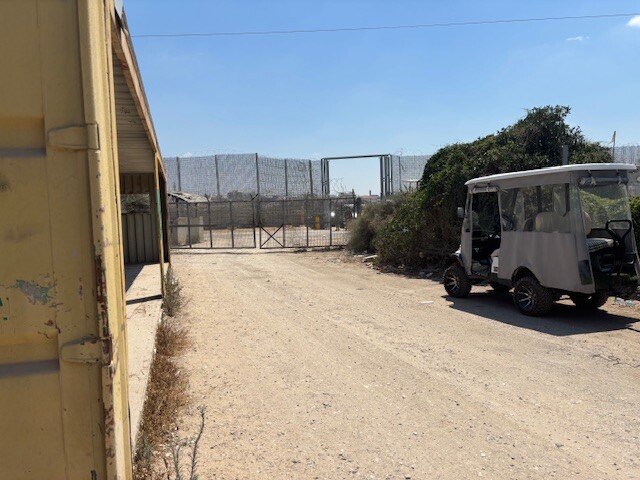 Nina SebaAug-18-2025Habla: The gate is in the process of closing
-