
‘Azzun, ‘Isla, Habla, Qaddum
|
Renewal of operation with a group of woman at Isla, visit to Kedum, Israeli evil at Habla.
10:00 Isla We met a group of about 8 Palestinian women at the womens' center; most of them were acquaintances of Nirit and Nurit from previous meetings with them a few months ago. The discussion is about teaching children and has been renewed after the war. By surprise the village head also joined. He came to take a look and understand and left as supportive and encouraging. Nadim, as usual, translated and already understands the fine nuances which Machsomwatch women want to communicate at such organizational meetings.
The discussion had been confirmed ahead of time, in order to find out what activities were appropriate for them, what we could do together and how to organize that. At their request, it was decided to dedicate the meetings to studying Hebrew (and not English, as we had suggested). It was also agreed that we would carry on the study in parallel with the study of Arabic. In addition, they asked to learn knitting, so they could make sweaters for their families. We decided on weekly meetings on Tuesdays and the Palestinian women would find other women from the village to take part. When we brought up the possibility of going together for a day of fun at the beach in the summer, there was great enthusiasm. Nirit, Nurit and Tikva will meet with the women weekly.
11:15 ‘Azzun The exit to the main road is open. Even the eternal jeep was not there. The new gate which the army constructed at the opening of the tunnel, at the exit to Tulkarm, is also open.
11:30 Kedum Last Friday, one of the organizers who heard about the activity of Nirit and Nurit with the children at Isla, suggested that we do something similar at Kedum. Now we entered the town hall (?) and met A., a music teacher by profession, who has also agreed to be on the town council. He told us that music as well as sports, exist in the Palestinian extra curriculum along with the formal educational curriculum. They try to find the talented children, both in music and other fields.
When we talked about the Friday demonstrations, they described for us the 3 strategies which it seems that the army uses in its struggle against Kedum demanding high fines when arrested; severe smoke attacks in the village; and, recently, wounding of the demonstrators with live fire. They told us that the condition of the youth who was wounded in his leg last Friday had improved.
A. thinks that the struggle of the residents of Kedum will be successful and, in the end, some solution will be found for the problem of the blocking of the road. He thinks that the fact that they suffer from the smoke at Kedumim as well will accelerate the finding of a solution. The last thing that the people of Kedum would consider would be ceasing the demonstrations!
Concerning the joint projects with the women of the village, A. will investigate with the woman responsible for organizing womens' activities and will tell us about the possibility of meeting with her.
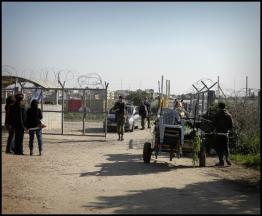
13:15 Habla There are only few people carts and vehicles at this hour. A young man who seemed worn out tried to cross in the direction of Habla with a horse and small wagon loaded with broken junk. The soldiers forbade him to enter because his permit was not appropriate, and anyway they asked him to unload the wagon. The final decision was that he was forbidden to cross.
The soldiers were not happy to see us and, when we tried to find out what was happening, they said it was none of our business and their female commander asked us to move away from the gate. We moved a bit, so as not to worsen the situation of the youth; that also did not help. We tried to check with Tammy C. if it was possible to help him. The soldiers also called zealously, not clear to whom or why. Meanwhile, the youth, who seemed to be in a panic from what the soldiers said to him, turned around with his wagon, said that he had to water the horse, and when the horse started to run, he disappeared in the direction of road #55. Before that, he also told us something not entirely clear; in the morning, he went out with his sick father and that now he was returning with the wagon. One of the soldiers said that he was afraid of the GSS. Another miserable incident that we didn't exactly understand.
Another Palestinian who was waiting at the crossing complained that the administration gives out permits stingily to farmers from Habla who need to work their land. In the best case, the permit is given to an older man and his wife, and they need younger people to help with the work and also for the carrying and operation of the agricultural equipment. And it is known in advance what happens to agricultural land whose owners don't work it for a period of 3 years…
|

'Azzun
See all reports for this place-
Azoun (updated February 2019)
A Palestinian town situated in Area B (under civil Palestinian control and Israeli security control),
on road 5 between Nablus and Qalqiliya, east of Nabi Elias village. The inhabitants are allowed to construct and improve infrastructures. The Separation Fence has confiscated lands belonging to the town's people. In 2018 olive tree groves owned by one of its inhabitants were confiscated for the sake of paving a road to bypass Nabi Elias. Azoun population numbers 13,000, its economic state dire. Its infrastructures are poor, neglect and poverty rampant. In the meantime, the town council has completed paving an internal road for the inhabitants' welfare.
Because of its proximity to the Jewish settler-colony of Karnei Shomron and its outposts, the town suffers the intense presence of the Israeli army, especially at nighttime: soldiers enter homes, arrest suspects, trash the house and sometimes ruin it, as they do in numerous places in the West Bank. At times a checkpoint closes the entrance to the town, so no one can come in or get out.
-
'Isla (1231)
See all reports for this place-
Isla - the village
This is a village whose lands were separated from their owners by the wall.
-
'Isla (1231)
Agricultural checkpoint,
Scheduled to be open 3 times per day.
-
Habla
See all reports for this place-
Habla CP (1393)
The Habla checkpoint (1393) was established on the lands of the residents of Qalqilya, on the short road that
connected it for centuries to the nearby town of Habla. The separation barrier intersects this road twice and cut off the residents of Qalqilya from their lands in the seam zone.(between the fence and the green line).
There is a passage under Road 55 that connects Qalqilya to the sabotage This agricultural barrier is used by the farmers and nursery owners established along Road 55 from the Green Line and on both sides of the kurkar road leading to the checkpoint.
This agricultural checkpoint serves the residents of Arab a-Ramadin al-Janoubi (detached from the West Bank), who pass through it to the West Bank and back to their homes. The opening hours (3 times a day) of this agricultural checkpoint are longer than usual, about an hour (recently shortened to 45 minutes), and are coordinated with the transportation hours of a-Ramadin children studying in the occupied in the West Bank.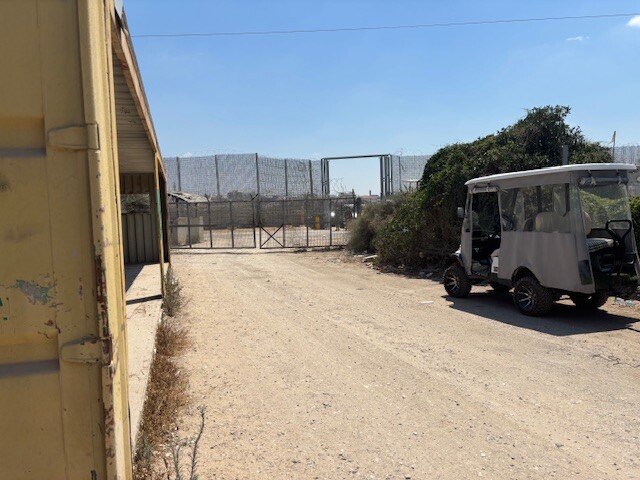 Nina SebaAug-18-2025Habla: The gate is in the process of closing
-
Qaddum
See all reports for this place-
Qaddum
The village of Qaddum dates back approximately 4,000 years. Today’s villagers mostly work in agriculture and cultivae olive groves. The hilly landscape is covered with olive trees and are dotted with patches of green fields.
Qaddum was attached to the district of Nablus until 1994 at which time it joined the Qalqiliya district. The village is home to 4,000 inhabitants (2013), with 22,000 dunams (5,400 acres) of which 11,000 dunam (2700 acres) are in Area C*. Access to Area C requires coordination with the Israeli army, which means that access is almost non-existent.
The settlement of Kedumim was founded in 1975 on lands belonging to the ancient the village of Qaddum. Since then, Kedumim has expanded to include 5 settlements. The Kedumim settlements separate Qaddum village from its lands and from access to the main road. The road connecting Qaddum village to Route 55 was closed to its residents in 2003. The short ride (1.5 km or less than a mile) between Qaddum and a neighboring village - Jit, turned into a 12 km (7.5 miles) bumpy ride on an unpaved gravely road. Since 2004, residents of the village of Qaddum have been submitting requests to the authorities to reopen the old road leading to Route 55.
On July 2011, the villagers began holding weekly demonstrations in protest of the road closure and of the theft of their lands. They march to the edge of the village and there they stop. There is a regular routine to the demonstration which always follows with a confrontation with the army when it enters the village at the end of the blocked road. The army reacts to the demonstrations with sharp weapons, rubber bullets, tear gas and lately also live ammunition. Villagers are injured and hurt each week and often, dozens are arrested by the army. Young people and children are intimidated by the army when they photos are posted in the village streets.
On 12/7/19 a 10 year old boy was criticaaly wounded after he was shot in the head by live ammunition while standing at the entrance to his home in Qaddum during a demonstration.*Area C is an administrative division of the West Bank established by the Oslo II Accords in 1995. The Palestinian Authority is responsible for medical and education services and Israel is responsible for infrastructure and administration.
-