
‘Azzun, ‘Izbet alTabib, Habla, Imatin
10:30 We left from the Rosh Ha’ayin train station.
Highway 55. Past Nabi Ilyas we saw two military armored vehicles heading in the opposite direction.
‘Izbet alTabib. It’s still blocked by an earthen berm and concrete barriers. Taxis park beyond the berm. On our way back we saw two soldiers standing at the blocked entrance.
‘Azzun. The entrance is blocked by a yellow gate & concrete barriers. Many minibuses and taxis at the gate.
11:00 Imatin. The women already await me in the classroom. Nine came. Some are accompanied by their small children. Schoolchildren and those in kindergarten are all on summer vacation. There’s a festive atmosphere. The women are particularly well-dressed. Two told us their delicately embroidered dresses were bought in Mecca. One of the children, around three years old, is dressed in festive white clothes and an embroidered white skullcap. They told me that’s what’s worn on the hajj. His mother’s three sisters are on their way to Mecca, which is why she and her son are dressed up. We discussed the trip and the experiences of the women who’d already fulfilled the hajj commandment.
Dafna and Saraleh are with me. I told the women both of them teach Hebrew in ‘Azzun. We had to cancel the class because of the closure so they came with me. We briefly discussed the situation. One woman, with relatives in Jinsafut, reported that soldiers suddenly appeared at night recently and took youths (shabab) from the village for interrogation. They were returned the next day. Imatin is relatively quiet. They said last night the army showed its presence; four Border Police soldiers appeared but didn’t enter homes.
Ramadan approaches; they aren’t letting this past week’s difficult events cloud the festive atmosphere. They’re cleaning, burnishing their homes; there’s great excitement. They told us how much they love this time of year. We discussed their holiday customs and activities. Next month they plan to visit Al Aqsa mosque in Jerusalem. The discussion flowed; Dafna and Saraleh also participated. We talked for almost two hours.
We finally left, parting warmly, in friendship. We plan to contact them again after the fast and the holiday that follows. As we left some of the women asked Nadim to help them arrange permits for a beach day. They still hope for a solution.
13:20 Habla gate. The vehicle gate is open wide. Trucks and carts with saplings went through unimpeded. We saw no one crossing on foot. They must have entered before we arrived.
The old, rusted water tank on the pump house was apparently full. There’s a serious leak; a great deal of water goes to waste.
13:40 Back to Rosh Ha’ayin.
'Azzun
See all reports for this place-
Azoun (updated February 2019)
A Palestinian town situated in Area B (under civil Palestinian control and Israeli security control),
on road 5 between Nablus and Qalqiliya, east of Nabi Elias village. The inhabitants are allowed to construct and improve infrastructures. The Separation Fence has confiscated lands belonging to the town's people. In 2018 olive tree groves owned by one of its inhabitants were confiscated for the sake of paving a road to bypass Nabi Elias. Azoun population numbers 13,000, its economic state dire. Its infrastructures are poor, neglect and poverty rampant. In the meantime, the town council has completed paving an internal road for the inhabitants' welfare.
Because of its proximity to the Jewish settler-colony of Karnei Shomron and its outposts, the town suffers the intense presence of the Israeli army, especially at nighttime: soldiers enter homes, arrest suspects, trash the house and sometimes ruin it, as they do in numerous places in the West Bank. At times a checkpoint closes the entrance to the town, so no one can come in or get out.
-
'Izbet a-Tabib
See all reports for this place-
'Izbet a-Tabib
-
Habla
See all reports for this place-
Habla CP (1393)
The Habla checkpoint (1393) was established on the lands of the residents of Qalqilya, on the short road that
connected it for centuries to the nearby town of Habla. The separation barrier intersects this road twice and cut off the residents of Qalqilya from their lands in the seam zone.(between the fence and the green line).
There is a passage under Road 55 that connects Qalqilya to the sabotage This agricultural barrier is used by the farmers and nursery owners established along Road 55 from the Green Line and on both sides of the kurkar road leading to the checkpoint.
This agricultural checkpoint serves the residents of Arab a-Ramadin al-Janoubi (detached from the West Bank), who pass through it to the West Bank and back to their homes. The opening hours (3 times a day) of this agricultural checkpoint are longer than usual, about an hour (recently shortened to 45 minutes), and are coordinated with the transportation hours of a-Ramadin children studying in the occupied in the West Bank.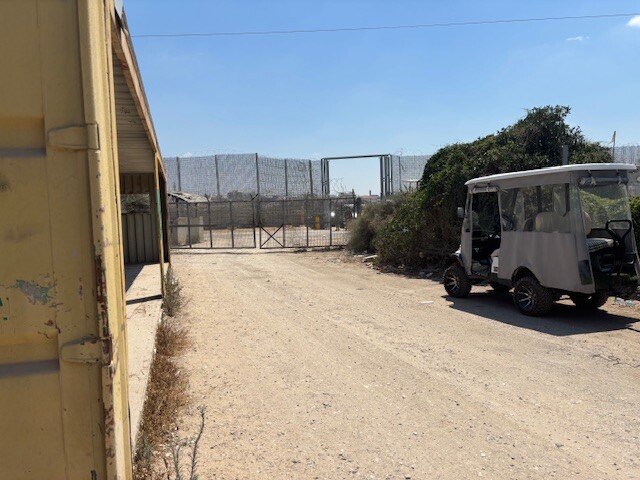 Nina SebaAug-18-2025Habla: The gate is in the process of closing
-
Imatin
See all reports for this place-
Imatin This village lies in the West Bank, 19 kilometers southwest of Nablus city and 23 kilometers east of the city of Qalqiliya. Its inhabitants' number 799, all members of four families from the neighboring village of Imatin. Far’ata is identified with the Biblical Far’atoun, and an archeological survey has identified findings on a timeline from the Second Iron Age until the days of the Ottoman Empire. After the Oslo Accords, the built-up area of the village was categorized as Area B, but 80% of its farmlands were classified as Area C. In 2002, settlers founded the outpost of Havat Gil’ad, which they claim is located on privately-owned land purchased by the Zar family. The Palestinians claim they own the land. The Civil Administration has issued demolition orders for all the structures in this outpost and they were declared illegal, but nothing was done about it. On February 4, 2018, the Israeli government unanimously ruled to regulate this outpost by defining it as a new settlement or by erecting a new settlement next to it. Beginning in 2012, the Palestinian Authority ruled to include Far’ata in the local council of Imatin, a larger community. For further information: http://vprofile.arij.org/qalqiliya/pdfs/vprofile/immatin_vp_en.pdf

 +-
+-
-