
Bardala: A settlers’ cattle herd tramples a Palestinian’s pepper field and damages irrigation pipes
On Saturday morning, two teams accompanied the shepherd’s flocks in Ein a-Sakut and in the eastern field opposite Ihmeir (al-Farisiyah), where the sheep grazed on the remains of barley and onion stubble.
Two other teams accompanied the cattle herds to the springs of Umm Jamal and Ein al-Hilweh. All these grazing sessions passed without incident in the morning.
Another team accompanied farmer M. from Bardala, who was checking the irrigation in his fields—mainly the hot and sweet pepper plots. These fields are near an outpost, reportedly built on land fraudulently purchased from a Palestinian by straw men. The settlers harass the workers, who refuse to harvest, leaving the ripe red fruit still on the bushes. The farmer showed us fresh droppings from the settlers’ cattle herd. They come and destroy everything, including the drip lines, causing water to burst out in various spots. The helpless Palestinian farmer walked around fixing the drippers, but it was clear this was Sisyphean work, since the settlers would return. He does not want to stop showing presence in the field, fearing that the land will be confiscated on the claim that he abandoned it.
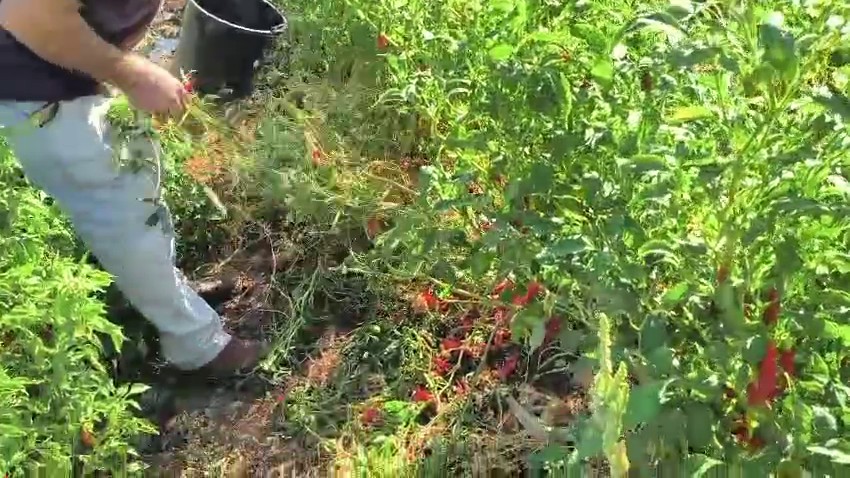
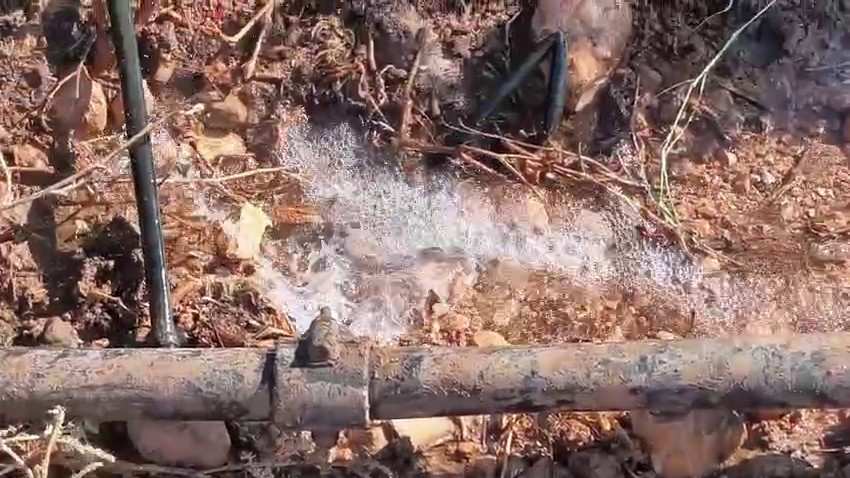
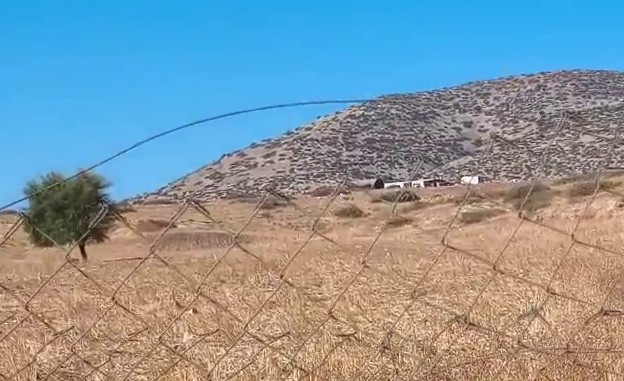
“I am a man of peace,” he said with pain. “All I want is to make an honest living. But will I be able to sow and plant for the coming year?” So far, he has lost large sums of money and fallen into debt. He is ashamed to be a simple laborer in Tubas for 100 shekels a day—after studying agronomy for years at university and purchasing land at great expense. Most likely, he will have no choice.
We stood before him, ashamed of the deeds of the so-called lords of the land, done in our name and in the name of Judaism—those who strive, and even succeed, in expelling anyone who is not of their religion.
The noon hours passed in great heat, but also in calm for all the teams.
In the afternoon, teams (those who arrived at noon and those who had stayed from the morning) went down to the different grazing areas. Everything passed almost peacefully.
Two hilltop youths, apparently about 16–17 years old, came down from the Maskiot outpost and passed through Sati’s encampment. They harassed the girls and their mother, opened the water tank tap, and washed their heads in it. Attempts to stop them did not help. Twice they washed and left—an ominous warning for the future.
The night passed in almost complete quiet, except for the security coordinator’s vehicle, seen at the entrance of the al-Farisiyah settlement. He made three rounds on the road and the path leading to it. The escorts checked that no one was left who could sabotage houses, solar panels, electricity, or water.
Such is life—even when nothing happens, or when provocations are minimal, fear and tension are always present. The Palestinians know that the settlers, the lords of the land, will not disappear anytime soon, unless there is global pressure or a change in Israeli policy. Israel’s annexation ambitions and its intent to concentrate the Palestinian population in certain towns are no secret.
Location Description
Bardala
See all reports for this place-
A relatively large township in Area B in the northern part of the Valley, home to about 300 families of farmers and other families. The villages of Bardala and Kardala, located nearby, sit on a very large reservoir of groundwater. In 1968, an "agreement" was signed between the occupier (represented by the Mekorot water company) and three villages (including Ein al-Bida), stipulating that in exchange for their agreement to stop pumping water their wells, Mekorot would establish its own pumping stations on their land and allocate them a "generous" quota of waterinfo-iconfor at the cost of pumping only (a few cents per cubic meter). Over the years, Mekorot violated the agreement, decreased the quotas drastically (from 240 cubic meters per hour to 100 and sometimes 40 cubic meters), and quadrupled the price. The residents refused to pay, and the PA paid for them. In late 2024, the army began paving a new road around Karbala and Bardala. According to the plan, the road will surround and Karbala from the south and Bardala from north and west, and finally turn east to Highway 90. The road will completely surround Bardala on all sides, cutting off the village from all its lands and imprisoning the village within its boundaries. The residents will no longer be able to come and work their lands freely. Our friends were unable to see the roadworks because the army had set up a checkpoint on the road to the new route.
 Sarah PostecDec-27-2026Hammam al-Malih: Border Guard and settlers in the compound
-
Jordan Valley
See all reports for this place-
Jordan Valley The Jordan Valley is the eastern strip of the West Bank. Its area consists of almost a third of the West Bank area. About 10,000 settlers live there, about 65,000 Palestinian residents in the villages and towns. In addition, about 15,000 are scattered in small shepherd communities. These communities are living in severe distress because of two types of harassment: the military declaring some of their living areas, as fire zones, evicting them for long hours from their residence to the scorching heat of the summer and the bitter cold of the winter. The other type is abuse by rioters who cling to the grazing areas of the shepherd communities, and the declared fire areas (without being deported). The many groundwaters in the Jordan Valley belong to Mekorot and are not available to Palestinians living in the Jordan Valley. The Palestinians bring water to their needs in high-cost followers.Sarah PostecDec-27-2026Hammam al-Malih: Border Guard and settlers in the compound
-