
Barta'a checkpoint: very crowded and stuck in the mornings


06.00 – 08.00
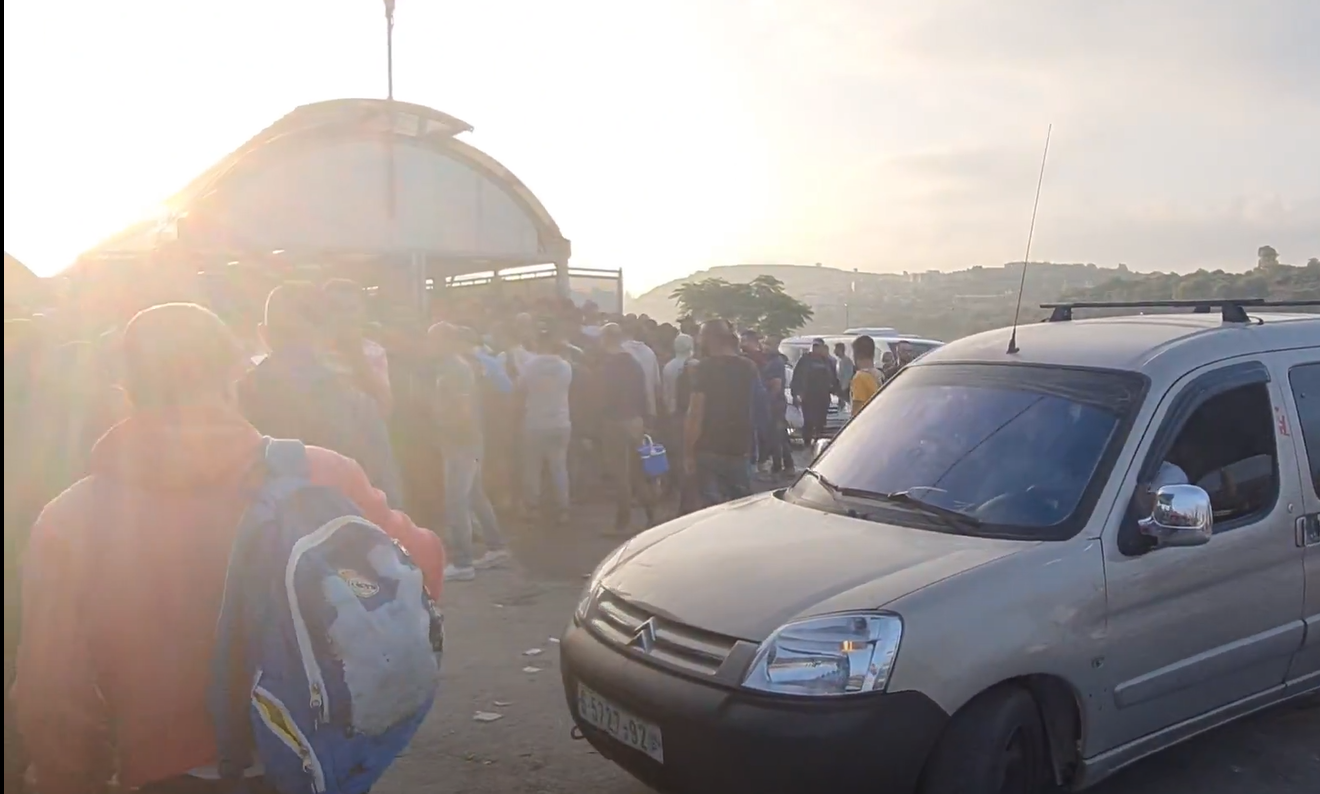
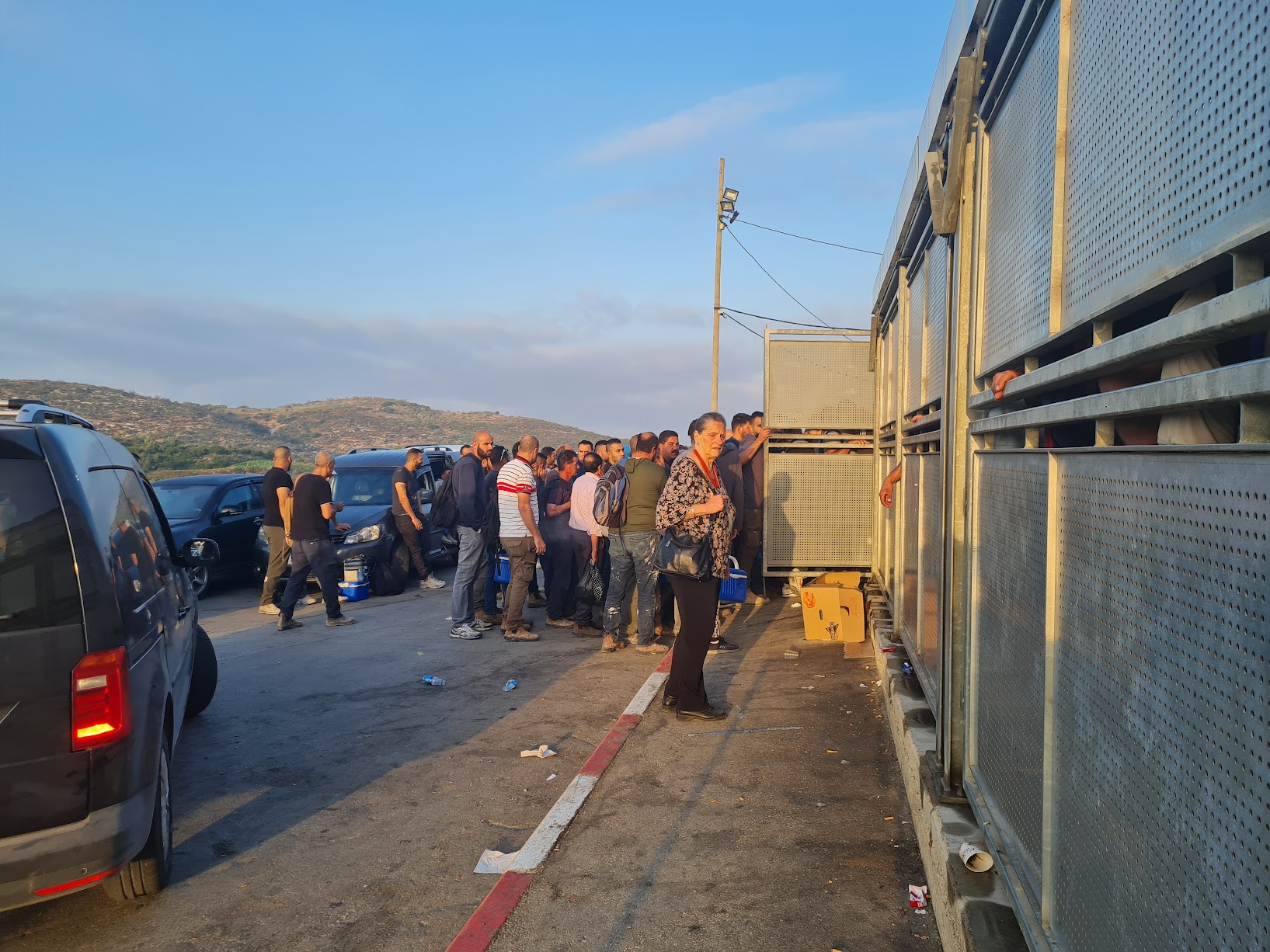
At the Barta’a-Reihan checkpoint on the seam zone side, lots of vehicles and people mingled with each other, all with the urgent goal of getting to work on time. At the checkpoint itself, masses of Palestinians crowded the passage shed to the terminal from the outside, and then got stuck and crammed inside it with no ability to move. The sight was terrifying and outrageous, we had never seen such a huge mass of people here including women. Occasionally the aisle opens, the queue moves a little and instantly closes. People told us – do something, it’s impossible – and we just stood by them helplessly. But there was no commotion. There was no shoving or shouting like there used to be in the past. In fact it was pretty quiet, with an atmosphere of “this is what it is”. We then passed next to the shed in the carousel area and measured time. Thus we found that the aisle opened every minute and a half for a minute and a half. Inside the shed people did not push, and when they left they did not rush to the terminal. Maybe fatigue? Maybe knowing that it does not matter? But within a quarter of an hour the density disappeared, the shed emptied and the rate of passage left the shed quite vacant.
6,000 men and women pass through here in the mornings, and despite its size the terminal is still limited in its absorption and transport capacity. It is impossible to flow people in non-stop in a situation of such a load (as the Palestinians requested) and the situation got better and stabilized in a fairly short time. We left the place when it calmed down and on the way to the car we told ourselves – at least they are moving to work, there is a livelihood and how important that is.
In the meantime, two guys approached us. One asked that we extract the identity card and magnetic card of a relative from Ya’abed, who was detained for two days in prison and released without these crucial certificates. Unfortunately we can only try to help him after the holiday. The other, a young man from the village of Ra’i in the Jenin sub-district, asked for help in cracking the riddle of why is he GSS prevented? At the Barta’a checkpoint, he was told that he had a “police ban” that he said he did not have, and at the DCO he was also told that he did not have one, but at Barta’a he was still barred from passing. He received Sylvia’s contact details from us.
After a very long break we drove to the Taibeh-Romana checkpoint, located east of Umm al-Fahm. The road leading down to the checkpoint was empty of rocks and obstacles, which young people from Umm al-Fahm placed there during the period of breaches in the fence, in order to prevent West Bank residents from entering the city (and to possibly extort transit fees). The checkpoint was empty, we were supposed to be on the early side but the drama at the Bartaa checkpoint delayed us. A tent of the fence guards, made of camouflage sheets, protruded above the checkpoint’s gate, and two sleepy soldiers, whose rest we’ve disturbed, came out to meet us with a cup of coffee in hand. We exchanged polite greetings and moved on.
We passed by the Anin checkpoint without entering because all the passers-by had already gathered outside the checkpoint, at the intersection, and were waiting for whom it wasn’t clear.
At the Tura Shaked checkpoint as usual, the soldiers worked slowly and were in no hurry to open at the appointed time. On Tura’s side waited a group of men and women and a number of vehicles. On the side of the seam zone a small number of shuttles were waiting. Students started arriving to move to the school in Tura. We greeted a boy with “good morning” in his mother tongue but he was careful not to look at us.
Barta’a-Reihan Checkpoint
See all reports for this place-
This checkpoint is located on the Separation Fence route, east of the Palestinian town of East Barta’a. The latter is the largest Palestinian community inside the seam-line zone (Barta’a Enclave) in the northern West Bank. Western Barta’a, inside Israel, is adjacent to it. The Checkpoint is open all week from 5 a.m. to 9 p.m. Since mid-May 2007, the checkpoint has been managed by a civilian security company subordinate to the Ministry of Defense. People permitted to cross through this checkpoint into and from the West Bank are residents of Palestinian communities inside the Barta’a Enclave as well as West Bank Palestinian residents holding transit permit. Jewish settlers from Hermesh and Mevo Dotan cross here without inspection. A large, modern terminal is active here with 8 windows for document inspection and biometric tests (eyes and fingerprints). Usually only one or two of the 8 windows are in operation. Goods, up to medium commercial size, may pass here from the West Bank into the Barta’a Enclave. A permanent registered group of drives who have been approved by the may pass with farm produce. When the administration of the checkpoint was turned over to a civilian security firm, the Ya’abad-Mevo Dotan Junction became a permanent checkpoint. . It is manned by soldiers who sit in the watchtower and come down at random to inspect vehicles and passengers (February 2020).
-
Tayba-Rummana
See all reports for this place-
Tayba-Rummana is an agricultural checkpoint. It is located in the separation fence in front of the eastern slopes of the Israeli city of Umm al-Fahm. The Palestinian villages next to the checkpoint are Khirbet Tayba and Rummana. Dozens of dunams of olive groves were removed from their owners, the residents of these villages on the western side of the separation fence. The Palestinian villages next to the checkpoint are Khirbet Tayba and Rumna. Dozens of olives dunams were removed from these villages' residents and swallowed up in a narrow strip of space, on the western side of the separation fence. The checkpoint allows the plantation owners who have permits to pass. Twice a week, the checkpoint opens for fifteen minutes in the morning and evening. During the harvest season, it opens every day for fifteen minutes in the morning (around 0630) and fifteen minutes in the afternoon (around 1530). (February 2020).
-
Tura-Shaked
See all reports for this place-
Tura-Shaked
This is a fabric of life* checkpoint through which pedestrians, cabs and private cars (since 2008) pass to and from the West Bank and the Seam-line Zone to and from the industrical zone near the settler-colony Shaked, schools and kindergartens, and Jenin university campuses. The checkpoint is located between Tura village inside the West Bank and the village of Dahar Al Malah inside the enclave of the Seam-line Zone. It is opened twice a day, between 7 a.m. and 10 a.m., and from 12 noon to 7 p.m. People crossing it (at times even kindergarten children) are inspected in a bungalow with a magnometer. Names of those allowed to cross it appear in a list held by the soldiers. Usually traffic here is scant.
- fabric of life roads and checkpoints, as defined by the Terminals Authority in the Ministry of Defense (fabric of life is a laundered name that does not actually describe any kind of humanitarian purpose) are intended for Palestinians only. These roads and checkpoints have been built on lands appropriated from their Palestinian owners, including tunnels, bypass roads, and tracks passing under bridges. Thus traffic can flow between the West Bank and its separated parts that are not in any kind of territorial contiguity with it. Mostly there are no permanent checkpoint on these roads but rather ‘flying’ checkpoints, check-posts or surprise barriers. At Toura, a small (less than one dunam) and sleepy checkpoint has been established, which has filled up with the years with nearly .every means of supervision and surveillance that the Israeli military occupation has produced. (February 2020)
 Mar-21-2022Anin Checkpoint: A magnificent breach in the center of the checkpoint
-