
Barta'a-Reihan, Tura-Shaked
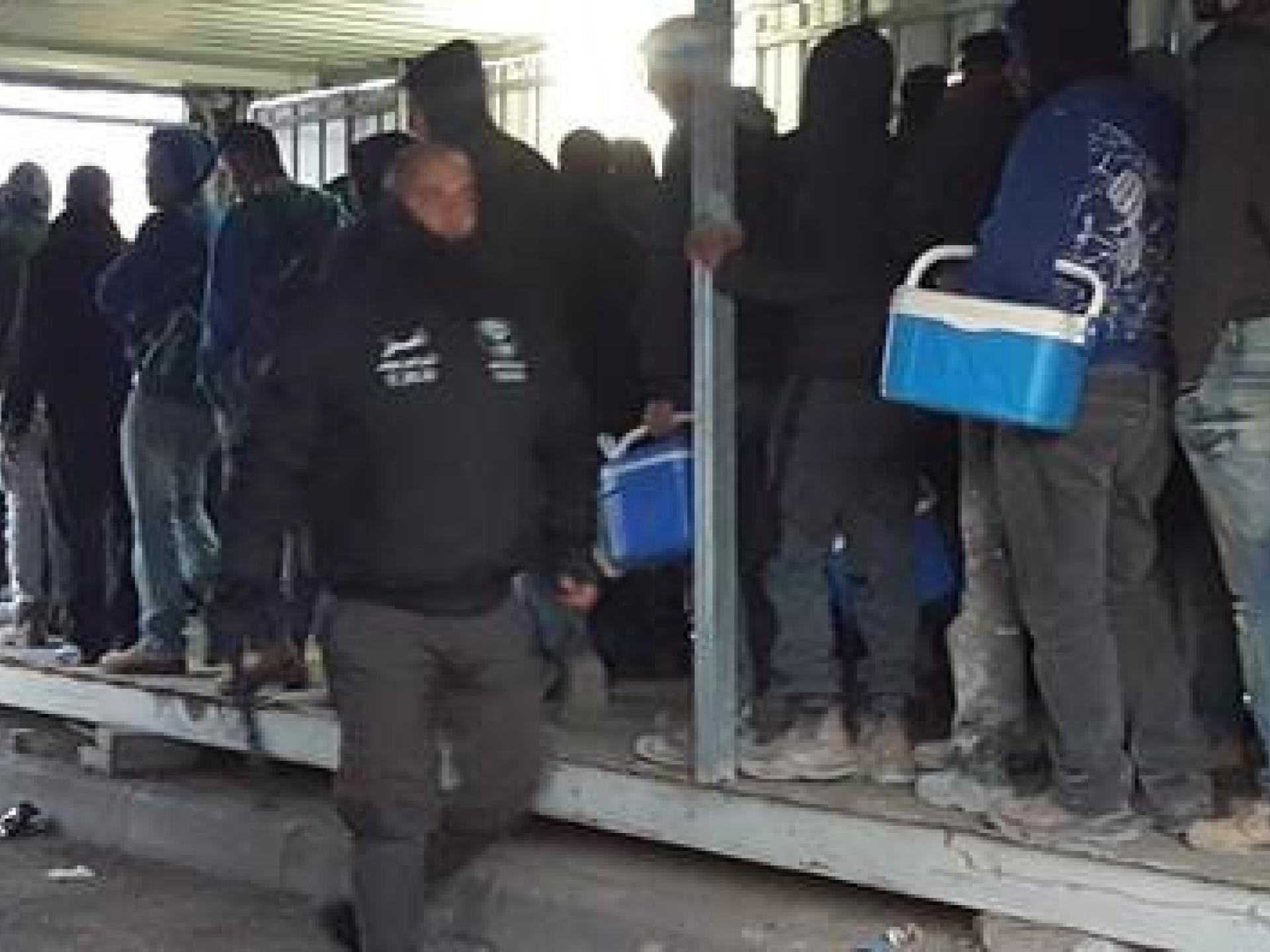
Barta`a Checkpoint 06:15 – A very long waiting line of younger and older men, heads hooded, holding a small blue lunch pail. These are the builders of Israeli Hareesh City, that started out as a Hashomer H-Tza’ir kibbutz, then became a haven town for the Karaje clan of Ramla (town inside Israel), and after an attempt to turn it into a haven for needy Haredi (Ultra-orthodox) Jews, it is now finally becoming an open community to all sectors. Its planners are aiming for an eventual population of 100,000 residents on an area of 13,000 dunams. So waiting lines at Barta’a Checkpoint are not expected to dwindle anytime soon.
About a year ago, following riots that broke out every morning when this “terminal” could not contain the pressure, the directors of the checkpoint along with the Barta’a local council came up with the idea of placing Palestinian security guards armed with teargas grenades (which they no longer carry now) and clubs (with they still do) to make sure no more riots break out, and on the other hand – more checking posts would be opened. The quiet is indeed being kept. The parking fees paid by drivers at the car park are shared by the land owners (from Jenin or Ya’abad), the occupiers (checkpoint directors) and the Barta’a local council. Crazy.
We offered two notes with Sylvia’s number to two people whose permits to enter Israel have been canceled. One told us that his brother or cousin is in jail, and consequently all the men of their extended family have been blacklisted en masse.
Toura-Shaked Checkpoint 7:00 – This small checkpoint is replete with various types of occupation, supervision and transit equipment. Both pedestrians and vehicles cross here from the Seamline Zone into the West Bank and back, with stiff permit considerations. A fellow from Toura village arrives in a car, with a small child seated next to him. He complains that the soldier at the checkpoint forced another child off the vehicle (both children are his nephews) and said he would not let him through until his father came to pick him up. The Palestinian was angry. He said the soldier spoke Hebrew to the child who did not understand him. He asked him how old he was, and repeated with his fingers – whether he was three or four? “What does he want, that #$% soldier,” said the uncle. “How should he know Hebrew?” At first his anger was obviously understood. And continued to be. But in between I wondered if the soldier had perhaps turned to the child in a friendly manner and tried to make conversation… Within minutes the father of the detained child arrived, probably displaying his registration in his ID or birth certificate, and they all drove home to Daher Al Malek, the small nearby community.
Barta’a-Reihan Checkpoint
See all reports for this place-
This checkpoint is located on the Separation Fence route, east of the Palestinian town of East Barta’a. The latter is the largest Palestinian community inside the seam-line zone (Barta’a Enclave) in the northern West Bank. Western Barta’a, inside Israel, is adjacent to it. The Checkpoint is open all week from 5 a.m. to 9 p.m. Since mid-May 2007, the checkpoint has been managed by a civilian security company subordinate to the Ministry of Defense. People permitted to cross through this checkpoint into and from the West Bank are residents of Palestinian communities inside the Barta’a Enclave as well as West Bank Palestinian residents holding transit permit. Jewish settlers from Hermesh and Mevo Dotan cross here without inspection. A large, modern terminal is active here with 8 windows for document inspection and biometric tests (eyes and fingerprints). Usually only one or two of the 8 windows are in operation. Goods, up to medium commercial size, may pass here from the West Bank into the Barta’a Enclave. A permanent registered group of drives who have been approved by the may pass with farm produce. When the administration of the checkpoint was turned over to a civilian security firm, the Ya’abad-Mevo Dotan Junction became a permanent checkpoint. . It is manned by soldiers who sit in the watchtower and come down at random to inspect vehicles and passengers (February 2020).
-
Tura-Shaked
See all reports for this place-
Tura-Shaked
This is a fabric of life* checkpoint through which pedestrians, cabs and private cars (since 2008) pass to and from the West Bank and the Seam-line Zone to and from the industrical zone near the settler-colony Shaked, schools and kindergartens, and Jenin university campuses. The checkpoint is located between Tura village inside the West Bank and the village of Dahar Al Malah inside the enclave of the Seam-line Zone. It is opened twice a day, between 7 a.m. and 10 a.m., and from 12 noon to 7 p.m. People crossing it (at times even kindergarten children) are inspected in a bungalow with a magnometer. Names of those allowed to cross it appear in a list held by the soldiers. Usually traffic here is scant.
- fabric of life roads and checkpoints, as defined by the Terminals Authority in the Ministry of Defense (fabric of life is a laundered name that does not actually describe any kind of humanitarian purpose) are intended for Palestinians only. These roads and checkpoints have been built on lands appropriated from their Palestinian owners, including tunnels, bypass roads, and tracks passing under bridges. Thus traffic can flow between the West Bank and its separated parts that are not in any kind of territorial contiguity with it. Mostly there are no permanent checkpoint on these roads but rather ‘flying’ checkpoints, check-posts or surprise barriers. At Toura, a small (less than one dunam) and sleepy checkpoint has been established, which has filled up with the years with nearly .every means of supervision and surveillance that the Israeli military occupation has produced. (February 2020)
 Mar-21-2022Anin Checkpoint: A magnificent breach in the center of the checkpoint
-