
Beit Amin Checkpoint (1447), Habla Checkpoint (1393), Nabi Ilyas
Our first stop is Nebi Elias. Leora, as an emissary of Silvia’s crew, meets a Palestinians who is barred from entering Israel. In the meantime, we go shopping in the neighborhood and peep into the nearby butcher shop. Its owner tells us that for the sake of the people of Alfey Menashe a rabbi arrives on holidays to check the “kashrut” of the meats.
Four Israeli men enter the falafel restaurant and I ask them where they come from and what they are doing at Nebi Samuel. Their reply: They came to take care of the olive trees which hinder the construction of the new settler road. Are you uprooting olive trees? I ask. No, we prune them and prepare them to be transferred to a new site. (where exactly?) Who sent you? We are sub-contractors of a sub-contractor. And who pays you, who ordered the work? We have no idea who ordered the work . Again land robbery and again uprooting of olive trees.
From here to Azun to deliver parcels. We meet Z. in his shop, and his eyes are red. He hasn’t slept since Rahel told him yesterday about Zvia’s accident. I tell him: Zvia is like a mother for you. And he replies much much more than a mother.
From Azun we turn southward to locate checkpoints that are less known to us. By way of El-Modwar we arrive at a closed gate. Is this the reverse side of the Beit Amin South no. 1447 gate? If so it should be opened at 12:45 and we find it closed. It probably is not this one. But how can one check if there is neither name nor number on it?
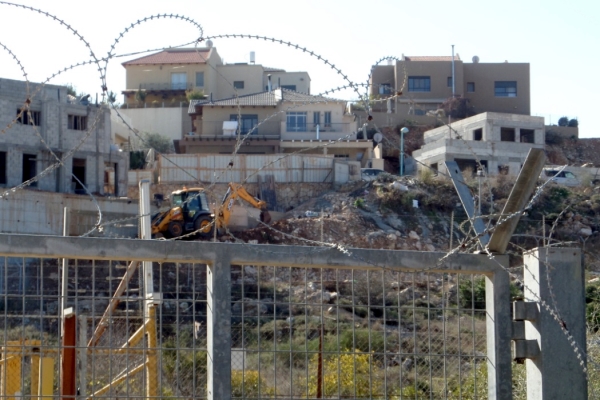
A new quarter is being built at Oranit; the earth-mover works at full power, very near the closed gate. At the next shift, we shall try to get to the checkpoint by way of Oranit.
We continue to the Abu Salman North (Near Jalud) No. 1419 gate. The gate is not supposed to be open at noon but only mornings and afternoons. From the gate, one sees the communal settlement Nirit.
T. from Jalud, 66 years old, comes towards us. When he finished high school he intended to study journalism but his father fell ill and he, as the oldest son, had to undertake the support of his family. Since then he has worked in Israel, learned Hebrew, including reading and writing, and worked as a builder, but read a lot and had many interests and became well versed in the history of the Middle East. Vivy will return to record him on video as he is a fascinating and eloquent man.
He works at Kfar Saba as a building manager and his wife works during the season at strawberry picking at Gan Haim. Their children are grown up, they left home, and he and his wife have a nice income, travel abroad and have a good time.
The last station – Habla checkpoint 1393. At 13:50 everything is already calm. Most of the Palestinians have passed.
A pedestrian passage to the checking post – Habla
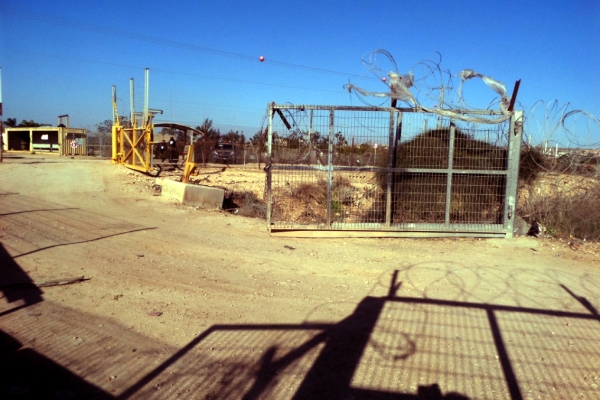
It is nice to see the container in which we usually wait together with the Palestinians for its opening. Today we arrive from the direction of Habla and not from the direction of the plant nurseries
14:15 The Eliyahu Passage – three Palestinian cars are at the checking post. The traffic flows.
A-Nabi Elias
See all reports for this place-
A-Nabi Elias this is a Palestinian village in the northern West Bank, east of Qalqilia on Road 55, north-east of Alfei Menashe colony and west of Karnei Shomron colony and the Palestinian city of Nablus. As of 2016, the village was populated by 1,458 inhabitants.
Near the village is a maqam (holy site memorializing a sanctified person) - the prophet Elisha. Until 2021 Road 55 crossed the village. Then a bypass road was paved through olive groves that were sequestered from the villagers. Consequently, the farmers were left with small olive groves that they could not access nor cultivate. Inhabitants protested against the road for weeks, supported by peace activists, but nothing helped and the road is now a given fact.
The village's main street had been a shopping center for all residents, including colonists. We even saw a Kashrut (kosher food) inspector in a butcher shop close to the falafel stand… The bypass road, according to tradesmen, has impacted their businesses and clients, while others claim that there are customers now for parking has become easier.
Alfei Menashe and Tzofim colonies nibble at the village lands from the north and south and get closer to it all the time. Colonists of Alfei Menashe have outdone themselves, sending their surplus sewage from the oxygenation pools toward a-Nabi Elias land, even reaching the houses.
The villagers are known as seekers of peace. For years there was no hostility towards Israelis. On the contrary, we were always welcomed warmly and stopped there to enjoy their delicious, inexpensive falafel.
-
Beit Amin South / Abu Salman (1447)
See all reports for this place-
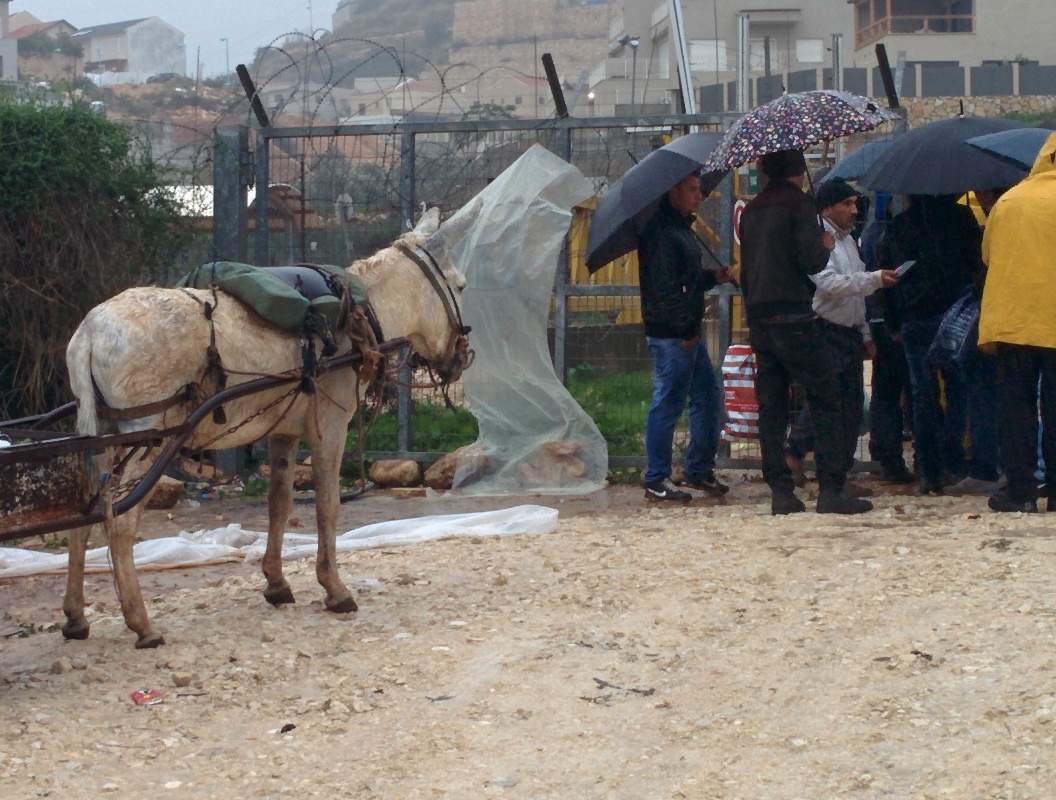
Beit Amin South / Abu Salman (1447) An agricultural checkpoint in the village of Abu Salman, which opens three times a day and is used by the farmers of Beit Amin and Abu Salman, and since the nearby gate has been inactive, also residents of 'Azzun' Atma, to reach their lands in the seamline zone adjacent to the settlement of Oranit.
-
Habla CP (1393)
See all reports for this place-
Habla CP (1393)
The Habla checkpoint (1393) was established on the lands of the residents of Qalqilya, on the short road that
connected it for centuries to the nearby town of Habla. The separation barrier intersects this road twice and cut off the residents of Qalqilya from their lands in the seam zone.(between the fence and the green line).
There is a passage under Road 55 that connects Qalqilya to the sabotage This agricultural barrier is used by the farmers and nursery owners established along Road 55 from the Green Line and on both sides of the kurkar road leading to the checkpoint.
This agricultural checkpoint serves the residents of Arab a-Ramadin al-Janoubi (detached from the West Bank), who pass through it to the West Bank and back to their homes. The opening hours (3 times a day) of this agricultural checkpoint are longer than usual, about an hour (recently shortened to 45 minutes), and are coordinated with the transportation hours of a-Ramadin children studying in the occupied in the West Bank.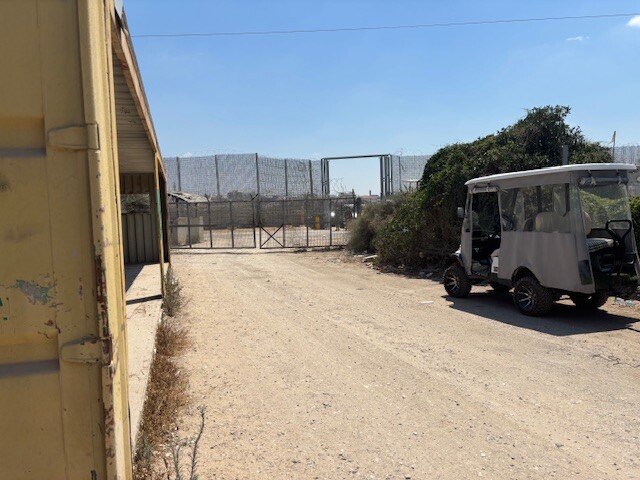 Nina SebaAug-18-2025Habla: The gate is in the process of closing
-