
Beit Furik, Habla, Irtah (Sha’ar Efrayim), Za’tara (Tapuah), Thu 27.1.11, Afternoon
Natanya translating.
 13.30 Shomron/Kassem crossing. There are no soldiers at the entrance to Palestina.
13.47 Checkpoint Za’tara/Tapuach There are soldiers at the checkpoint. Cars pass without being checked.
On the wall of a house at the entrance to Huwwara village, in a westerly direction, there is large graffiti written in Hebrew. We did not have time to photograph it but what we remember were the words “donkey” and “gentile”.
14.20 Checkpoint of Huwwara. There is pressure at the exit from Nablus. The soldiers were checking cars. We stood a while and watched and then the traffic jam let up. There was much traffic in both directions. When we went along the Madison route in the direction of the checkpoint of Beit Furik a Palestinian car passed us – only lately have Palestinians been allowed to travel on part of the road and so it is still an apartheid road.
14.29 Checkpoint of Beit Furik. A soldier is in the sentry tower. Cars are not stopped.
15.55 At the entrance to the settlement of Yitzhar is an army jeep.
16.00 Crossroads of Jit. On the left hand side a command car was parked across the road. On the other side on the hill an army jeep was waiting in ambush.
16.45 Habla checkpoint. The workers wait for permission to go through to get home. The gate was open. They arrange themselves in groups of five. They say that in the morning it takes a long time to get through the checkpoint to get through. “ Come in the morning. It is better than our telling you.
The checkpoint opens in the morning from 7.00 – 9.00. In the afternoon 12.00 – 13.00. Towards evening 16.45-18.00
We visited one of the villages. They showed us one room in which they had many dovecots for birds who are looked after in the hose. There was also a beautiful peacock wandering around the house and yard.
.
.
Beit Furik checkpoint
See all reports for this place-
One of the three internal checkpoints that closed on the city of Nablus - Beit Furik to the east, Hawara to the south, Beit Iba to the west. The checkpoint is located at the junction of Roads 557 (an apartheid road that was forbidden for Palestinians), leading to the Itamar and Alon Morea settlements and Road 5487. The checkpoint was established in 2001 for pedestrians and vehicles; The opening hours were short and the transition was slow and very problematic.Allegedly, the checkpoint is intended to monitor the movement to and from Nablus of the residents of Beit Furik and Beit Dajan, being the only opening outside their villages. Since May 2009 the checkpoint is open 24 hours a day, the military presence is limited, vehicles can pass through it without inspections, except for random inspections. (Updated April 2010)
-
Habla
See all reports for this place-
Habla CP (1393)
The Habla checkpoint (1393) was established on the lands of the residents of Qalqilya, on the short road that
connected it for centuries to the nearby town of Habla. The separation barrier intersects this road twice and cut off the residents of Qalqilya from their lands in the seam zone.(between the fence and the green line).
There is a passage under Road 55 that connects Qalqilya to the sabotage This agricultural barrier is used by the farmers and nursery owners established along Road 55 from the Green Line and on both sides of the kurkar road leading to the checkpoint.
This agricultural checkpoint serves the residents of Arab a-Ramadin al-Janoubi (detached from the West Bank), who pass through it to the West Bank and back to their homes. The opening hours (3 times a day) of this agricultural checkpoint are longer than usual, about an hour (recently shortened to 45 minutes), and are coordinated with the transportation hours of a-Ramadin children studying in the occupied in the West Bank.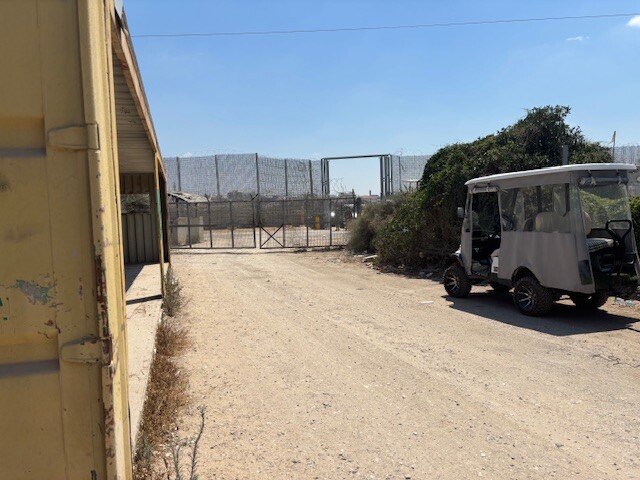 Nina SebaAug-18-2025Habla: The gate is in the process of closing
-
Irtah (Sha'ar Efrayim)
See all reports for this place-
The checkpoint is for Palestinians only. It is the main barrier to the passage of workers from the northern West Bank to Israel. Workers with a permit to work in Israel and also for trade (with appropriate permissions), medicine, and visiting prisoners. One can cross the checkpoint only on foot. The checkpoint is located north of Road 557 and south of Tulkarm. Operated by a civil security company, opening hours: between 4:00 and 19:00 on weekdays. As members of Machsom Watch, we began our shifts to this location in 2007. We arrived before it opened at 4 in the morning and report since, on the harsh conditions and the long and crowded queues of workers. The workers who pass by continue their journey by transportation to work throughout Israel. In the first period of its activity, about 3,000 and then 5,000 people passed through this checkpoint every day. Due to the small number of checking points and arbitrary delays for long periods of time in the "rooms", workers feared losing their transportation. Hence workers leave their homes at 2:30 at night to be among the first. Today, 15,000 pass and the transition is faster. Workers are still leaving their homes very early to get past the checkpoint at 7 p.m. In an adjacent compound, there is a terminal for the transfer of goods on a commercial scale, using the back-to-back method.
-
Za'tara (Tapuah)
See all reports for this place-
Za'tara (Tapuah) Za'tara is an internal checkpoint in the heart of the West Bank, at the intersection of Road 60 and Road 505 (Trans-Samaria), east of the Tapuah settlement. This checkpoint is the "border" marked by the IDF between the north and south of the West Bank, in accordance with the policy of separation between the two parts of the West Bank that has been in place since December 2005. At the Za'tara checkpoint, there are separate routes for Israelis and Palestinians. In the route for Israelis, there are no inspections and the route for Palestinians inspects. The queue lengthens and shortens suits. The checkpoint is open 24 hours a day. The checkpoint is partially staffed and the people who pass through it are checked at random.
 Shoshi AnbarSep-27-2023Za'atra (Tapuah Intersection). Signs
-