
Beit Furik, Huwwara, Jit, Sun 14.10.07, Afternoon
Huwwara and Beit Furik Checkpoints,
Translation: Tal H.
We traveled via Jit Junction. About 30 cars were lined up there waiting – coming from the north, as three soldiers alternated checking cars coming from three different directions, and letting through mainly those coming from the south and east. Drivers coming from the north complained of an hour-and-a-half waiting period. One driver told us he has been standing at checkpoints for three and a half hours already. We didn't even ask from he was coming from. Where – after all – could he be coming from? Three and a half hours?
The army hotline explains that "because of the holiday (Eid al Fitr festivities ending the Ramadan month of fasting) checking is more thorough than usual". What has thorough checking got to do with the Palestinians' holiday?? And when there is no holiday? We wondered what is more exasperating – the "thorough checking" and endless waiting, the flagrant lack of consideration pointedly during the holiday, or the idiotic answers.
This is how the army seems to convince itself.
Then, in honor of that very same holiday, came another roadblock at Yitzhar Junction, with about 12 cars waiting, again three soldiers checking everyone who has just now come from nearby Jit Junction checkpoint or Huwwara Checkpoint. The army's answer was already known, we didn't even bother asking.
15:30 – at Huwwara Checkpoint
"Hey, you! Go stand over there!" a soldier orders us, even before we get settled at our usual spot by the last turnstile. "There are new rules here now!" Said who? "Say I!"
And who says you say? "The Military Policeman, and he knows." We asked to speak only to the checkpoint commander, and when he arrived he silenced the soldier, asked us not to speak to soldiers, sent the soldier back to his job at the vehicle checking post where he had to tolerate our presence until after 6 p.m. when we left for Beit Furik Checkpoint.
At the checkpoint, not very many pedestrians. The special side line for women, children and the elderly is open, and many children and infants in their holiday best, holding on to new presents, especially toys. A second lieutenant checks this line quickly without harassing people. Many women smile and greet us. The pedestrian checks are conducted relatively fast and "matter-of-factly" (beyond the basic irrelevance of this whole machination – translator's note).
On the other hand, the vehicle-check procedures are very slow. People are required to disembark and stand away at a great distance while the driver approaches the soldiers with his passengers' IDs. Then he goes back to the car, brings it closer to the checking point, and only then the passengers join him. A female MP then conducts a manual metal-detector search on everyone's body – more or less massaging the men: front and back, all along inner and outer legs and arms, crotch and bottom, while joking around with her mates, slowly and thoroughly, and at the end – as an afterthought – hands the ID to the searched person with her head turned away, avoiding his/her eyes completely. (We have this on video). Are the few women traveling by car more suspect than the very many passing through the pedestrian special side line??
A private vehicle carrying a very ill child is allowed to speed into Nablus, and later another car with a wounded, bleeding child is also allowed through.
A young man wearing a suit is required to take off his jacket and shake it out in front of the girl soldier. Palestinian citizens of Israel exit Nablus beaming for having finally been allowed – for once – entry without too many problems. The young second lieutenant is seen helping two elderly people carry some extremely heavy luggage towards the taxi park going into Nablus.
16:08 – a fist detainee in the concrete holding cell, a 35-year old resident of Al 'Ein refugee camp in Nablus. He is accompanied by his brother and sister who live in Beita village and want to have him over for their holiday dinner. They tell us he is a Palestinian policeman who was incarcerated in Israel and released a year-and-a-half ago. Ever since, he has only seen trouble at the checkpoints. The cell door closes and the brother and sister are ordered to stand away from the turnstiles. From the moment he is detained, there is an endless stream of 'interrogators' approaching him one by one: the securing soldier, the sergeant, the staff sergeant and the second lieutenant, and then the MP and another MP and seemingly the GSS too by long phone conversation which he is allowed to have outside the cell (reception difficulties?). He is returned to the cell as the phone call ends.
At17:44 the hotline tells us that the man "is security-prevented all types of trave/passage, is actually not at all a Palestinian policeman, and since the time that he may be detained is almost up, he will soon be released and ordered to return to Nablus and not leave it." The man takes heart-breaking leave of his siblings and they go home without him, not before assuring us again that he is indeed a Palestinian policeman…
In the meantime, another detainee is sent to the hold, suspected of possessing a counterfeit ID. MP Sergeant A., local counterfeit document expert, takes a long time checking it and finds incriminating signs. About an hour later the man is released and sent back to Nablus. He stands again in line and when reaching the checking post, is sent to the hold again.
17:15 – the pedestrian waiting-lines are full. A long line of cars has accumulating Nablus-bound. The owner of the "counterfeit ID" insists on reaching his Qablan village home, argues with the CP commander, MP A. and the DCO representative whose intervention we request. He is sent once again back into Nablus but insists and begs and pleads and finally the DCO rep. hands him back his ID and lets him through. A.' alert eye catches him on his way out, and he chases him, grabs the ID and sends him back to Nablus for the fourth time. Luckily the DCO rep. stands there and intervenes again, and A. cedes – "I only wanted to make sure he wasn't sneaking out"..
A family with a child in a wheelchair requests passages into Nablus on the paved vehicle lane (instead of the dirt and stone incoming-path and through a narrow turnstile). Only one of them is allowed to push the wheelchair through, all the others are sent to the turnstile path.
A mother and her children – one of them holding on to a large furry stuffed giraffe have a hard time convincing the soldier that this is merely a stuffed toy. He sends them over to the X-Ray truck that is by now long long-gone. He then proceeds to pummel it again and again to the children's giggles, and – frankly, to ours as well.
Beit Furiq Checkpoint – wondering if here a 'band's visit' is at all possible?
18:30 – we were summoned here to see what can be done with a band that arrived from Tul Karm. One of the musicians is (alas) a blue ID (Israeli resident) holder, and they have been invited to play at the festivities in Beit Furik. Indeed, an uncommon combination – Palestinians wanting to play music for Palestinians in a Palestinian village on Palestinian soil. They have been waiting at the CP for two hours now, and must shortly return because the Beit Iba Checkpoint to which they are assigned exclusively (to get back to their own homes) closes at 8 p.m. After talking and talking again with the army hotline and the DCO, the instruction is finally given to let them in, and the feast begins almost at the checkpoint itself…
In the detainees pen, we see two boys. When we approach the CP commander to have a word with him, he roughly orders us away. We managed to understand that they are guilty of having 'tried to sneak through the CP" ( in other words: being too young to hold IDs of their own, they tried to sneak home without having their parents come to fetch them at the CP). Later, having done their punitive time in the pen, they are fetched by their father and go home.
Meanwhile, a bus arrives, full-to-bursting with wedding guests. Most are women and many many little boys, girls and babies, the youngest two weeks old carried asleep in the arms of her proud father. The bus waits until the soldiers signal it to approach (with a flashlight). All passengers are required to disembark and go through the turnstiles. One by one first the women and children go, some get caught inside the turnstile between the remote control operations, some kids get caught in there as well, wearing their fancy best, smiling and happy – even the checkpoint cannot kill their joy. All the while the bus is being checked lest a bomb will be delivered into Nablus amidst the crowd of infants aboard.
Finally, all this time – at the entrance to the CP, Nablus-bound – stands a private vehicle without license plates, belonging to a man leaning on crutches who argues with a soldier in vain. In spite of the documents he shows of having bought it for dismantling, the soldiers claim it is stolen and have taken off its license plates. The entire family – two men (brothers), a woman and four children wanted to go out and have some fun in town, on this festive night. They have been stuck at this checkpoint now for over an hour, now it's dark and cold and they want to give up and go back home. The soldiers wait for the civilian police that does not arrive, and the DCO promise us that if it does not get there soon (no definite time limit mentioned), he will personally see to it that they are released. 20 minutes and two phone calls later – which teach us that both the company and battalion commanders already know about this and the people will be released very soon… finally the company commander arrives, checks the documents, hands back the IDs, and even allows them to enter Nablus with their car. The children's expressions of joy made it all worthwhile.
And we watched these delighted kids with a very heavy heart. What kind of childhood are they having, and what kind of adults are they going to grow up into in the shadow of these checkpoints that make their lives, and the lives of their parents and families, night and day, workday and holiday, into a trudging living hell.
Beit Furik checkpoint
See all reports for this place-
One of the three internal checkpoints that closed on the city of Nablus - Beit Furik to the east, Hawara to the south, Beit Iba to the west. The checkpoint is located at the junction of Roads 557 (an apartheid road that was forbidden for Palestinians), leading to the Itamar and Alon Morea settlements and Road 5487. The checkpoint was established in 2001 for pedestrians and vehicles; The opening hours were short and the transition was slow and very problematic.Allegedly, the checkpoint is intended to monitor the movement to and from Nablus of the residents of Beit Furik and Beit Dajan, being the only opening outside their villages. Since May 2009 the checkpoint is open 24 hours a day, the military presence is limited, vehicles can pass through it without inspections, except for random inspections. (Updated April 2010)
-
Huwwara
See all reports for this place-
The Huwwara checkpoint is an internal checkpoint south of the city of Nablus, at the intersection of Roads 60 and 5077 (between the settlements of Bracha and Itamar). This checkpoint was one of the four permanent checkpoints that closed on Nablus (Beit Furik and Awarta checkpoints to the east and the Beit Iba checkpoint to the west). It was a pedestrian-only barrier. As MachsomWatch volunteers, we watched therre since 2001 two shifts a day - morning and noon, the thousands of Palestinians leaving Nablus and waiting for hours in queues to reach anywhere else in the West Bank, from the other side of the checkpoint the destination could only be reached by public transport. In early June 2009, as part of the easing of Palestinian traffic in the West Bank, the checkpoint was opened to vehicular traffic. The passage was free, with occasional military presence in the guard tower. Also, there were vehicle inspections from time to time. Since the massacre on 7.10.2023, the checkpoint has been closed to Palestinians.
On February 26, 2023, about 400 settlers attacked the town's residents for 5 hours and set fire to property, such as houses and cars. Disturbances occurred in response to a shooting of two Jewish residents of Har Bracha by a Palestinian Terrorist. The soldiers stationed in the town did not prevent the arson and rescued Palestinian families from their homes only after they were set on fire. No one was punished and Finance Minister Smotrich stated that "the State of Israel should wipe out Hawara." Left and center organizations organized solidarity demonstrations and support actions for the residents of Hawara.Hawara continued to be in the headlines in all the months that followed: more pogroms by the settlers, attacks by Palestinians and a massive presence of the army in the town. It amounted to a de facto curfew of commerce and life in the center of the city. On October 5, 2023, MK Zvi established a Sukkah in the center of Hawara and hundreds of settlers backed the army blocked the main road and held prayers in the heart of the town all night and the next day. On Saturday, October 7, 23 The "Swords of Iron" war began with an attack by Hamas on settlements surrounding Gaza in the face of a poor presence of the IDF. Much criticism has been made of the withdrawal of military forces from the area surrounding Gaza and their placement in the West Bank, and in the Hawara and Samaria region in particular, as a shield for the settlers who were taking over and rioting.
On November 12, 2023, the first section of the Hawara bypass road intended for Israeli traffic only was opened. In this way, the settlers can bypass the road that goes through the center of Hawara, which is the main artery for traffic from the Nablus area to Ramallah and the south of the West Bank. For the construction of the road, the Civil Administration expropriated 406 dunams of private land belonging to Palestinians from the nearby villages. The settlers are not satisfied with this at the moment, and demand to also travel through Hawara itself in order to demonstrate presence and control.(updated November 2023)
. Shoshi AnbarMay-18-2025Huwara: The old houses in Area C
-
Jit Junction
See all reports for this place-
The checkpoint is located on Route 60 near at the junction with Route 55, near the village of Jit. There was a checkpoint for vehicles passing between the north and south of the West Bank, which was abolished towards 2010. Since then, surprise checkpoints have been set up there from time to time with a police or Border Police vehicle, and vehicles and their passengers are inspected.
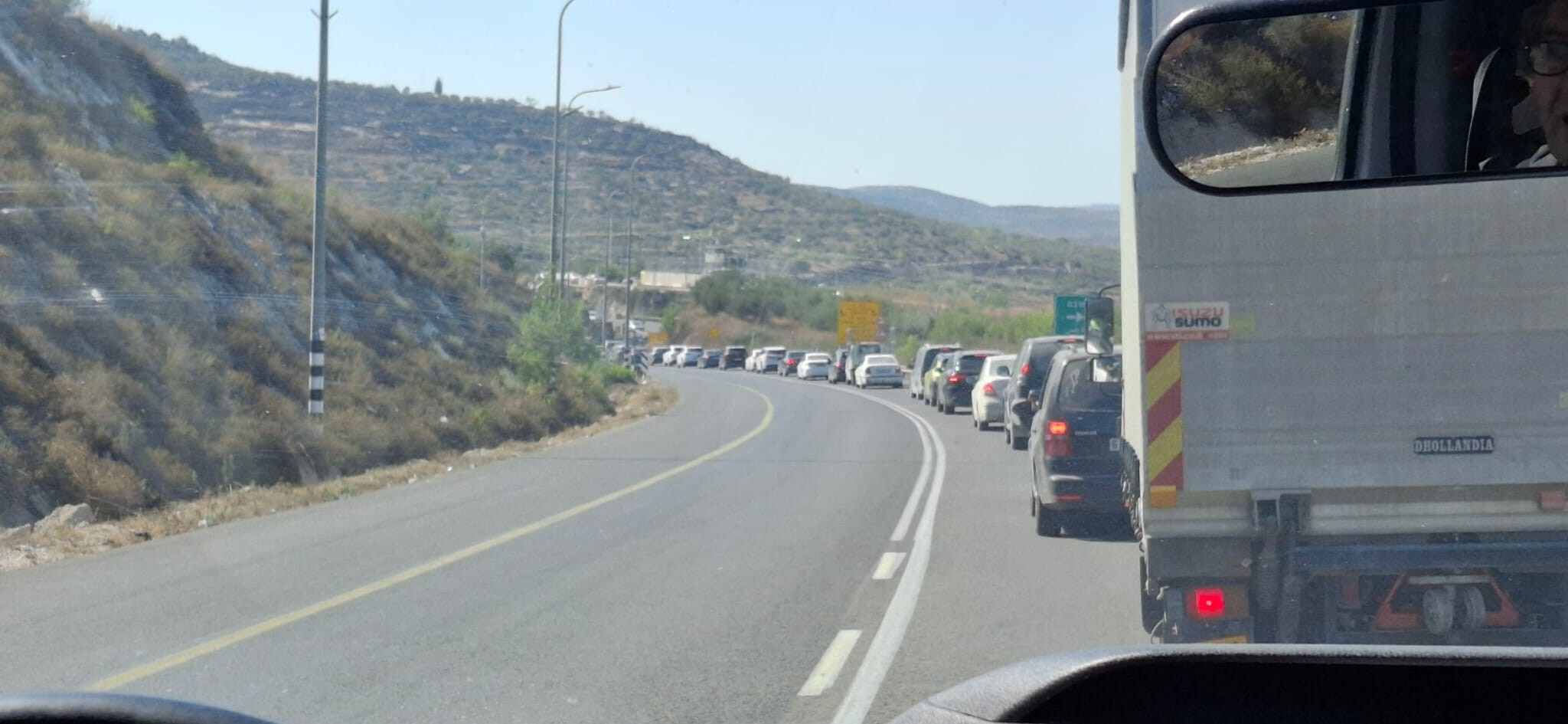 Anat PolakJul-17-2025Yitzhar Road, Jit Junction: traffic jam
-