
Beit Furik, Huwwara, Jit, Za’tara (Tapuah), Mon 22.9.08, Morning
Translator: Charles K.
6:50 Shomron gate. We leave for Palestine.
7:10 Za'tara (Tapuach) –
No one coming from the west. Two vehicles waiting to go south. Most of the traffic at this early morning hour is comprised of vehicles with yellow license plates, going through their lane.
7:15 On the main road to the village of Huwwara, opposite the entrance to the village of Beita, a flying checkpoint for traffic going north (those coming from Nablus). A Border Patrol jeep and a soldier stationed on the road. Three taxis waiting on the dirt lot nearby.
When we passed by again at 10:40, there was no checkpoint.
7:25 Beit Furik
Those passing through the checkpoint – all of them men – enter Nablus on foot. ID cards are checked. No one leaving Nablus, very light vehicle traffic. A female MP wants to shut down the checkpoint because of our presence. The checkpoint commander orders her to keep working.
7:45 Huwwara
Two lanes for men. The lines are short. Belts removed, then replaced on the other side of the checkpoint. People pass through the metal detector. Bags and packages are checked. Sometimes people have to remove their shoes. Going through takes only a short time, about five minutes. Most pedestrians this morning are women, who go through the line off to the side. Most pass quickly; only ID cards are checked. Some of the pedestrians are sent to the x-ray machine on the other side of the checkpoint to have their belongings examined. Little pedestrian traffic, and it flows without stopping.
Vehicle traffic – very sparse in both directions. ID cards and passes are checked at the entrance to Nablus. Passengers leaving Nablus get out of the vehicle a little before the checkpoint, the driver draws near by himself, the passengers continue on foot. They can come closer only after the vehicle is checked. ID cards are checked.
8:20 Two young men are removed from the men's line, asked to stand on the side. Their ID cards are taken. Shortly afterwards, other men join them. After about a minute there are already six of them. All about 20 years old. They lean against the wall of the line at the side. Shortly afterwards two of them are released. One is almost released, but at the last minute his ID card isn't returned. A., the DCO representative, says that it's because he's "being checked by the GSS." The soldier in charge of the detainees is very aggressive, but the camera startles him.
8:26 Three men are released, including the first two detainees.
8:28 The guy who was almost released asks to leave his belongings. A soldier stays to watch them. He's frisked, hands extended to the sides, then taken behind the building which is called, according to the sign, "the humanitarian point." I go over to see what happens there. I stand some distance away, don't hear anything indicating a beating. I come closer, two men in civilian clothing interrogate the young man. They have a military vehicle. The soldiers notice me and get hysterical.
8:32 Eight detainees at the moment, some of them new. They're joined by the young man who was being interrogated.
8:36 The young man who was interrogated returns, takes his belongings and leaves. Someone else is called over. He's also asked to empty his pockets, is frisked and taken behind the humanitarian point.
8:40 One man is released, others are added. There are now 11 detainees, in addition to the one being interrogated. At the moment there are more men being detained than men passing through the checkpoint. The detainees are now older, in their thirties. We talked with one of them, 35 years old, says he's never been detained before.
8:43 Three more detainees.
8:45 The one who was interrogated returns to the checkpoint, takes his bag and leaves.
8:47 Seven people released. The man we spoke to is called over. "Empty your pockets, turn them inside out, everything. Empty." He puts down the briefcase he was carrying near the soldier who's watching them. Displays his wallet, that there's money in it. The soldier refuses, points to the one keeping watch over the belongings. The wallet stays in the briefcase. He's frisked near the humanitarian point. Then – taken in back.
8:50 12 detainees and the person being interrogated.
8:52 Soldiers jump up, fire four or five times into the air. Someone threw acid at a soldier, his face were hurt badly.
A chase, screaming. Life comes to a standstill. Soldiers flee in every direction. Two minutes of tremendous confusion. Palestinians are moved away from the checkpoint, including those who were detained and whose ID cards were taken by the soldiers. Everyone is moved back to the market. The PA from the observation tower: "Alja l'warra." We both hear the soldiers say they didn't see who threw the acid.
Two Palestinians, who were standing near the soldiers, were also injured. There's no water in the field sinks. The soldiers don't help them. Only after Amira argues with the soldiers they change their minds and send him over to the checkpoint to receive medical assistance.
Hysteria. Soldiers with their finger on the trigger. Yelling. They're arguing about the rules, are they allowed to fire at peoples' legs below the knee, maybe shoot to kill, capital punishment. It doesn't occur to anyone to see whether anyone was injured by the shooting, does anyone need medical help.
9:02 A woman, hands raised, dressed in a purple hijab, face covered by a purple scarf, stands next to the humanitarian point (photo attached). She's brought inside. Only men are dealing with her.
9:04 An army doctor arrives.
9:05 The ID cards are returned to the men who were detained; two are missing. The soldiers demand that the men stand far from them. Yelling; the checkpoint commander: "Stop it, calm down."
9:07 An ambulance arrives.
9:13 The women is taken out of the humanitarian point.
9:19 The two ID cards that disappeared are given back.
In the midst of all this, the person who was interrogated comes back. He wasn't beaten. He was asked about himself – where he grew up, where he went to school, his work, his education, his family. He'd never been arrested, never detained.
Many people who had been on their way to Nablus gathered in the market. Many women and children. We see a mother on the way to the hospital with a sick child. At 9:22 the path to Nablus opens. A mass of people flows along the narrow path to the turnstile. The woman and sick child are allowed to pass, after our intervention, through the exit lanes from Nablus.
At 9:27 people are allowed to enter Nablus via the vehicle lanes. It's hard to estimate how many people were there. Both of us think that 1,500 wouldn't be an overestimate (photos attached).
9:32 People and vehicles begin leaving Nablus. They pass through quickly; the soldiers are concerned about the checkpoint getting crowded. In any case there weren't many people leaving Nablus and by 9:45 the lines are again pretty short. Elderly people leave Nablus, leaning on canes or helped by family members.
9:50 The checkpoint routine returns.
10:10 A taxi driver is detained. He's on the way to Nablus. He has to leave his vehicle off to the side, is taken to the isolation pen. His ID is checked against the list.
10:15 The handcuffed woman is taken to a military jeep. The jeep leaves the checkpoint. The checkpoint commander (a different one, a replacement) reports that she admitted throwing the acid, admitted that she also did so two weeks ago, and that she's being mistreated at home and wants to die.
Taxi drivers at the Huwwara market: three people were injured by shots. It isn't clear what their condition is. They're hospitalized in hospitals in Nablus. They say that the person who threw the acid was dressed in black and fled back to Nablus. People on line saw it. We spoke on the phone to the brother of one of the people who was injured. He was shot in the stomach. Undergoing surgery.
The road to Jit is closed because of an accident on the road to Za'tara.
At 11:10 the Jit junction was open.
At 11:25 we returned to Israel through the Eliyahu gate.
Beit Furik checkpoint
See all reports for this place-
One of the three internal checkpoints that closed on the city of Nablus - Beit Furik to the east, Hawara to the south, Beit Iba to the west. The checkpoint is located at the junction of Roads 557 (an apartheid road that was forbidden for Palestinians), leading to the Itamar and Alon Morea settlements and Road 5487. The checkpoint was established in 2001 for pedestrians and vehicles; The opening hours were short and the transition was slow and very problematic.Allegedly, the checkpoint is intended to monitor the movement to and from Nablus of the residents of Beit Furik and Beit Dajan, being the only opening outside their villages. Since May 2009 the checkpoint is open 24 hours a day, the military presence is limited, vehicles can pass through it without inspections, except for random inspections. (Updated April 2010)
-
Huwwara
See all reports for this place-
The Huwwara checkpoint is an internal checkpoint south of the city of Nablus, at the intersection of Roads 60 and 5077 (between the settlements of Bracha and Itamar). This checkpoint was one of the four permanent checkpoints that closed on Nablus (Beit Furik and Awarta checkpoints to the east and the Beit Iba checkpoint to the west). It was a pedestrian-only barrier. As MachsomWatch volunteers, we watched therre since 2001 two shifts a day - morning and noon, the thousands of Palestinians leaving Nablus and waiting for hours in queues to reach anywhere else in the West Bank, from the other side of the checkpoint the destination could only be reached by public transport. In early June 2009, as part of the easing of Palestinian traffic in the West Bank, the checkpoint was opened to vehicular traffic. The passage was free, with occasional military presence in the guard tower. Also, there were vehicle inspections from time to time. Since the massacre on 7.10.2023, the checkpoint has been closed to Palestinians.
On February 26, 2023, about 400 settlers attacked the town's residents for 5 hours and set fire to property, such as houses and cars. Disturbances occurred in response to a shooting of two Jewish residents of Har Bracha by a Palestinian Terrorist. The soldiers stationed in the town did not prevent the arson and rescued Palestinian families from their homes only after they were set on fire. No one was punished and Finance Minister Smotrich stated that "the State of Israel should wipe out Hawara." Left and center organizations organized solidarity demonstrations and support actions for the residents of Hawara.Hawara continued to be in the headlines in all the months that followed: more pogroms by the settlers, attacks by Palestinians and a massive presence of the army in the town. It amounted to a de facto curfew of commerce and life in the center of the city. On October 5, 2023, MK Zvi established a Sukkah in the center of Hawara and hundreds of settlers backed the army blocked the main road and held prayers in the heart of the town all night and the next day. On Saturday, October 7, 23 The "Swords of Iron" war began with an attack by Hamas on settlements surrounding Gaza in the face of a poor presence of the IDF. Much criticism has been made of the withdrawal of military forces from the area surrounding Gaza and their placement in the West Bank, and in the Hawara and Samaria region in particular, as a shield for the settlers who were taking over and rioting.
On November 12, 2023, the first section of the Hawara bypass road intended for Israeli traffic only was opened. In this way, the settlers can bypass the road that goes through the center of Hawara, which is the main artery for traffic from the Nablus area to Ramallah and the south of the West Bank. For the construction of the road, the Civil Administration expropriated 406 dunams of private land belonging to Palestinians from the nearby villages. The settlers are not satisfied with this at the moment, and demand to also travel through Hawara itself in order to demonstrate presence and control.(updated November 2023)
. Shoshi AnbarMay-18-2025Huwara: The old houses in Area C
-
Jit Junction
See all reports for this place-
The checkpoint is located on Route 60 near at the junction with Route 55, near the village of Jit. There was a checkpoint for vehicles passing between the north and south of the West Bank, which was abolished towards 2010. Since then, surprise checkpoints have been set up there from time to time with a police or Border Police vehicle, and vehicles and their passengers are inspected.
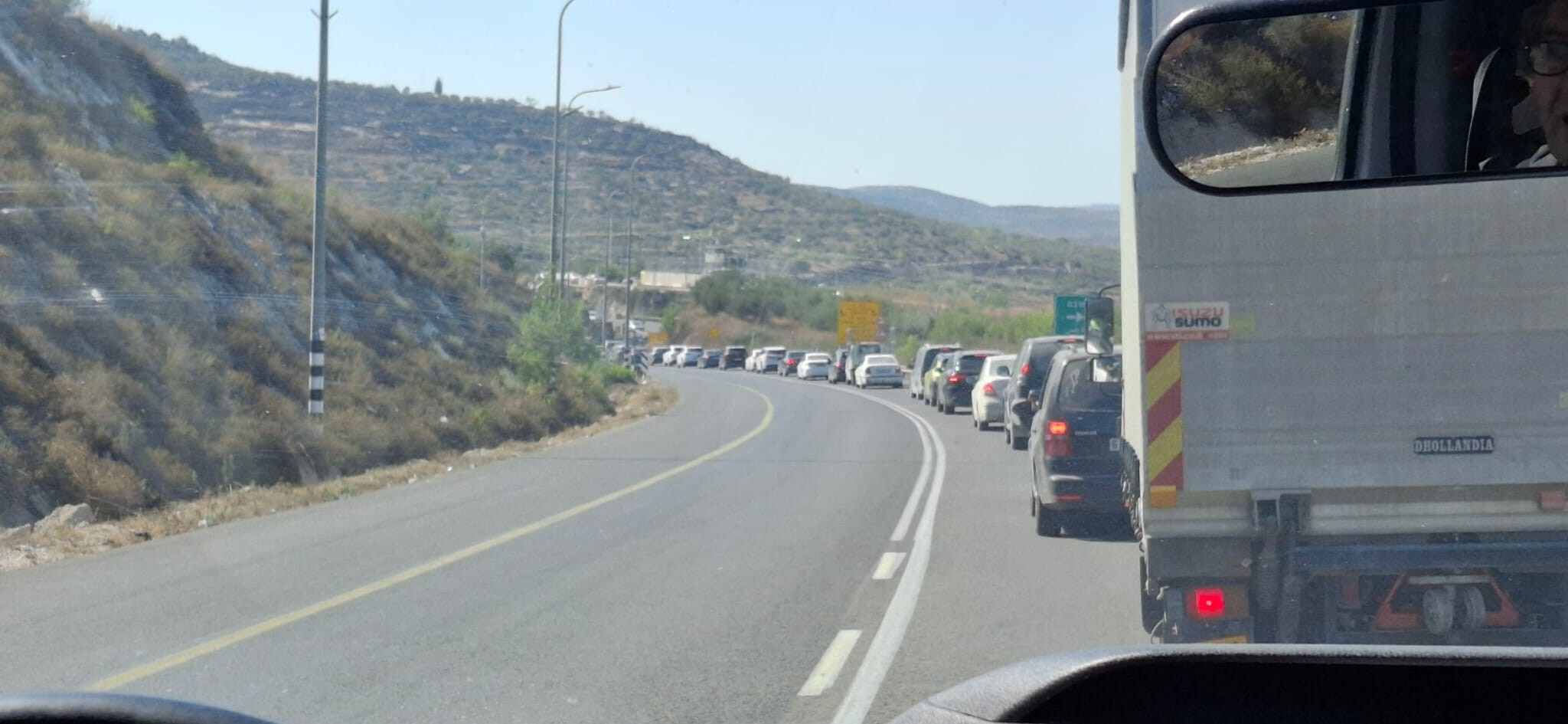 Anat PolakJul-17-2025Yitzhar Road, Jit Junction: traffic jam
-
Za'tara (Tapuah)
See all reports for this place-
Za'tara (Tapuah) Za'tara is an internal checkpoint in the heart of the West Bank, at the intersection of Road 60 and Road 505 (Trans-Samaria), east of the Tapuah settlement. This checkpoint is the "border" marked by the IDF between the north and south of the West Bank, in accordance with the policy of separation between the two parts of the West Bank that has been in place since December 2005. At the Za'tara checkpoint, there are separate routes for Israelis and Palestinians. In the route for Israelis, there are no inspections and the route for Palestinians inspects. The queue lengthens and shortens suits. The checkpoint is open 24 hours a day. The checkpoint is partially staffed and the people who pass through it are checked at random.
 Shoshi AnbarSep-27-2023Za'atra (Tapuah Intersection). Signs
-