
Beit Furik, Huwwara, Qalqiliya, Mon 25.2.08, Afternoon
Translation: Maureen A.
A tour to Qalqiliya, Ras-Atiya, Azzun-Atma, Huwwara & Beit Furik.
The tour had been planned in advance, but, since Merav let me know that there would not be a shift at Huwwara, we planned a shortened shift.
12:45 – Ras-Atiya –
The gate in the fence. Children and teachers move from one side to the other on their way home from school. What kind of a childhood is it when a child must move past guns, wait until he or she is called and then go through "one by one"? The movement through is quick, though a horse-drawn cart and two passengers are not allowed through. We left while the passengers were arguing – begging to be let through.
13:15 – Qalqiliya –
The only entrance to the Qalqiliya ghetto – long lines – 15 vehicles, all Palestinian, at the entrance, and a line waiting to be checked before leaving, so long we could not see the end. A car with Israeli license plates that had been in the line entering the city gives up, the driver makes a U-turn and goes back the way he came.
14:00 – Azzun Atma –
Near a huge dirt roadblock which prevents the inhabitants of the village, which is on the west (Israeli) side of the fence from driving out, there's a truck with Israeli license plates. On the other side of the roadblock – there's a Palestinian truck. Three men are skillfully tossing cardboard boxes from one to another, till the boxes are all on the Israeli truck, ready to be shipped to Israel.
The western entrance to Marda –
Blocked by an iron gate, and now a barbed-wire fence has been added.
The eastern entrance to Marda – the gate is open.
The entrance to Zeita –
Like in recent months – blocked by concrete blocks and, in addition, a locked iron gate.
14:40 – Za'tara Junction –
3 vehicles from the west, and about 15 vehicles from the south (from Nablus).
The entrance to Beit'a – open; no military presence.
14:50 – Huwwara –
No segregation and no age limits. ("But it can all come back tomorrow", says the commander). The soldiers are efficient, no long lines, passage
is quick and quiet, relatively. The soldiers come up to us, speak to us a little and leave. They don't relate to the line, be it white, red or green. The vehicle passage
is also quick, no lines.
At 15:30 a soldier (female) from the canine unit arrives and starts checking the cars. There's a young man detained in the solitary confinement area who has been there for about half an hour. Two of his friends are waiting for him in the detainees' shed. The moment I go over to him the Checkpoint Commander is right by my side, forbidding me from speaking to him, "You know you're not allowed to cross the line…" etc. He threatens to call the police. The young man has told me that he is being detained because he "talked back". The commander refuses to tell me why he's being detained. I move away and ask the detainee's friends, who supply the missing details – the soldiers asked him to take off his shoes but because of the rain, the floor was wet and he refused. Now he's being punished. A phone call to the "Humanitarian Centre" (they'll take care of it), to Rudy (he's not in the area), to Iman ("If the soldiers decided to detain him, they probably know what they're doing and I can't interfere.") I bring him something to drink and we go on to Beit Furik; we will get back to Huwwara and the detainee.
15:45 – Beit Furik. There are not a lot of people and the pedestrian crossing is quick. The vehicle crossing, on the other hand, is slow enough to make you mad, though there are not many cars. Between cars the soldiers stand around talking for at least ten minutes. Only then do they call the next car, signal the driver to turn off the motor, get out of the car, pull up his shirt and turn around to give them his identity card; finally, he's asked to move away and wait at a distance. When his card is verified, they check the car very thoroughly. The whole story takes at least 10 minutes a car. We approach
the soldiers and the guest takes pictures. The soldiers ignore him, don't answer when we say hello, but don't bother us either. Great!!
16:15 – Huwwara – The young man is still detained, his friends are still waiting for him. Now the District Coordination Officer, Tomer, who has arrived, says that the young man will be detained for another two hours, so he learns a lesson. The soldiers say, "five hours". Once again – I call the Humanitarian Centre and Iman and try to convince him that this kind of punishment is illegal. He says he will try to help, although they are allowed to detain him for three hours. There still aren't a lot of people at the checkpoint (maybe because of the rainy weather), or maybe it only seems that there are few people since the passage through is quick.
16:40 – We took the detainee's friend's phone number and headed back.
At 17:00 he was released.
17:00 – Za'tara – A long line of about 20 cars is waiting to cross from north to south. 5 are waiting to go from west to east.
Beit Furik checkpoint
See all reports for this place-
One of the three internal checkpoints that closed on the city of Nablus - Beit Furik to the east, Hawara to the south, Beit Iba to the west. The checkpoint is located at the junction of Roads 557 (an apartheid road that was forbidden for Palestinians), leading to the Itamar and Alon Morea settlements and Road 5487. The checkpoint was established in 2001 for pedestrians and vehicles; The opening hours were short and the transition was slow and very problematic.Allegedly, the checkpoint is intended to monitor the movement to and from Nablus of the residents of Beit Furik and Beit Dajan, being the only opening outside their villages. Since May 2009 the checkpoint is open 24 hours a day, the military presence is limited, vehicles can pass through it without inspections, except for random inspections. (Updated April 2010)
-
Huwwara
See all reports for this place-
The Huwwara checkpoint is an internal checkpoint south of the city of Nablus, at the intersection of Roads 60 and 5077 (between the settlements of Bracha and Itamar). This checkpoint was one of the four permanent checkpoints that closed on Nablus (Beit Furik and Awarta checkpoints to the east and the Beit Iba checkpoint to the west). It was a pedestrian-only barrier. As MachsomWatch volunteers, we watched therre since 2001 two shifts a day - morning and noon, the thousands of Palestinians leaving Nablus and waiting for hours in queues to reach anywhere else in the West Bank, from the other side of the checkpoint the destination could only be reached by public transport. In early June 2009, as part of the easing of Palestinian traffic in the West Bank, the checkpoint was opened to vehicular traffic. The passage was free, with occasional military presence in the guard tower. Also, there were vehicle inspections from time to time. Since the massacre on 7.10.2023, the checkpoint has been closed to Palestinians.
On February 26, 2023, about 400 settlers attacked the town's residents for 5 hours and set fire to property, such as houses and cars. Disturbances occurred in response to a shooting of two Jewish residents of Har Bracha by a Palestinian Terrorist. The soldiers stationed in the town did not prevent the arson and rescued Palestinian families from their homes only after they were set on fire. No one was punished and Finance Minister Smotrich stated that "the State of Israel should wipe out Hawara." Left and center organizations organized solidarity demonstrations and support actions for the residents of Hawara.Hawara continued to be in the headlines in all the months that followed: more pogroms by the settlers, attacks by Palestinians and a massive presence of the army in the town. It amounted to a de facto curfew of commerce and life in the center of the city. On October 5, 2023, MK Zvi established a Sukkah in the center of Hawara and hundreds of settlers backed the army blocked the main road and held prayers in the heart of the town all night and the next day. On Saturday, October 7, 23 The "Swords of Iron" war began with an attack by Hamas on settlements surrounding Gaza in the face of a poor presence of the IDF. Much criticism has been made of the withdrawal of military forces from the area surrounding Gaza and their placement in the West Bank, and in the Hawara and Samaria region in particular, as a shield for the settlers who were taking over and rioting.
On November 12, 2023, the first section of the Hawara bypass road intended for Israeli traffic only was opened. In this way, the settlers can bypass the road that goes through the center of Hawara, which is the main artery for traffic from the Nablus area to Ramallah and the south of the West Bank. For the construction of the road, the Civil Administration expropriated 406 dunams of private land belonging to Palestinians from the nearby villages. The settlers are not satisfied with this at the moment, and demand to also travel through Hawara itself in order to demonstrate presence and control.(updated November 2023)
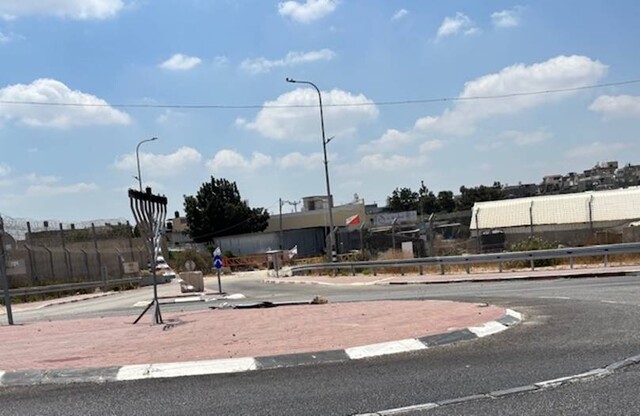
. Shoshi AnbarMay-18-2025Huwara: The old houses in Area C
-
Qalqiliya checkpoint
See all reports for this place-
Qalqilya is surrounded on all sides by the separation barrier. The only exit from the city is in the east of the city on the road that leaves the city in an easterly direction. This is where the checkpoint was located. When the checkpoint was active until 2009 our shifts watched long queues of cars being inspected at the only exit from the city to the West Bank. The checkpoint was canceled, but there is a military presence at the entrance to the city.
 Nina SebaAug-18-2025Azzun: Enclosed by a high fence and the gate to the village is closed
-