
Beta: Palestinians protest. The army is destroying. again
12:40 Habla
A military pickup truck was parked next to the gate, a few soldiers standing beside it. As soon as they saw us they approached, asked who are we, why we’re here. We replied, of course. They requested we remain in the vehicle because they’re involved in military activity.
13:50 Huwwara
A military pickup vehicle and a jeep stood at the plaza on the Yizhar-Huwwara road, soldiers getting out.
Burin
The military emplacement opposite the school is manned by three soldiers.
Doha accompanied us to the fields because peace groups had planted olive trees. Not many remained; the area looked neglected. The owners don’t dare approach it.
14:30 We drove to Beta. The soldiers at the Yizhar-Huwwara road plaza began to detain vehicles for inspection. One soldier stood in position with weapon drawn, and, of course, a huge line of vehicles was waiting.
15:00 Beta


We drove up the hill to the protest tent. A few young people and two adults were there. They told us what happens every Thursday – the army destroys all the roads used by the ambulances to evacuate the injured. Two days ago the soldiers came and damaged the tents. They cut the ropes and slit the sides of the tents lengthwise. The villagers repaired the cuts and retied the ropes. And, of course, the jeep is always parked at the southern entrance, in readiness.
17:15 We left Burin.
Beta
See all reports for this place-
Beta is a town of 12,000 people, high unemployment rate. Many work in Israel, others in agriculture. Neat ornamental system. Unemployment is high. Young people, even the educated, are forced to look for work in Israel. Medical services are available once a week.
Settlers from Yitzhar and Itamar harass residents frequently and prevent them from cultivating their fields: Permits are required from the DCO / DCL / DCL / DCL to go to work.
-
Burin (Yitzhar)
See all reports for this place-
Burin (Yitzhar)
This is a Palestinian village in the Nablus governorate, a little south of Nablus, on the main road passing through the West Bank. The settlements: Yitzhar and Har Bracha, settled in locations that surrounded the village, placed fences so it is cut off the main road.
There are around 4000 inhabitants. Most of them are engaged in agriculture and pasture, although many graduates of the two secondary schools continue to study at the university. Academic positions are hardly available, they find work as builderd, or leave for the Gulf countries.
The village lands were appropriated several times for the establishment of Israeli settlements and military bases, and as a result, Burin's land and water resources dwindled. lSince 1982, more than 2,000 dunams of village land have been declared "state land" and then transferred to Har Bracha settlement.
Over the past few years and more so since 2017, the villagers have been terrorized by the residents of Yitzhar and Har Bracha, the Givat Ronen outpost and others. Despite the close proximity of soldiers to an IDF base close to one of the village's schools, residents are suffering from numerous stone-throwing events, vehicle and fire arson, also reported in the press.
In 2023, the prevention of the olive harvest in the village plot was more violent than ever. Soldiers and settlers walked with drawn weapons between the houses of the village and demanded that people stop harvesting in the village itself and in the private plots outside the village. The settlers from Yitzhar and Giv'at Roned raided the olive groves and stole crops. 300 olive trees belonging to the residents of Burin, near Yitzhar, were uprooted. The loss of livelihood from the olives causes long-term economic damage to the farmers' families, bringing them to the point of starvation.
(updated for November 2023)
-
Habla CP (1393)
See all reports for this place-
Habla CP (1393)
The Habla checkpoint (1393) was established on the lands of the residents of Qalqilya, on the short road that
connected it for centuries to the nearby town of Habla. The separation barrier intersects this road twice and cut off the residents of Qalqilya from their lands in the seam zone.(between the fence and the green line).
There is a passage under Road 55 that connects Qalqilya to the sabotage This agricultural barrier is used by the farmers and nursery owners established along Road 55 from the Green Line and on both sides of the kurkar road leading to the checkpoint.
This agricultural checkpoint serves the residents of Arab a-Ramadin al-Janoubi (detached from the West Bank), who pass through it to the West Bank and back to their homes. The opening hours (3 times a day) of this agricultural checkpoint are longer than usual, about an hour (recently shortened to 45 minutes), and are coordinated with the transportation hours of a-Ramadin children studying in the occupied in the West Bank.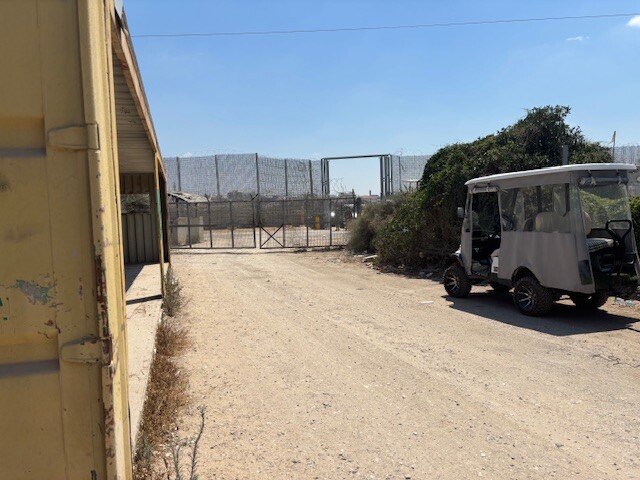 Nina SebaAug-18-2025Habla: The gate is in the process of closing
-