
Bethlehem (300), Nuaman (Mazmuria)

Bethlehem checkpoint, Route 60 south, Efrat East settlement – Abdullah Ibrahim checkpoint, Givat Eitam checkpoint, travel and return to Jerusalem via Tuku’ and the southern American road,
7:15 Bethlehem checkpoint
Many workers are standing outside the checkpoint. Looking for a job. They say there really is no work. Among them are quite a few older people. Inside the barrier there is a silent acceptance of our presence. Only two open positions – one distant and one close. The humanitarian checkpoint is closed. The traffic is sparse. We were a few minutes and left. In the meantime, the recent attacks have not reduced the number of workers with work permits or looking for work. We’ll see how it goes.
Driving on the tunnel road (60 South)
The road is very busy towards Jerusalem. The construction of the additional one-way tunnel under El Khader has not yet been completed. These are traffic jams for the settlers of Efrat, Gush Etzion, Beitar and Kiryat Arba-Hebron. This is what they complain about, even though Palestinian vehicles are not allowed to pass through the tunnel checkpoint to Jerusalem, so this simply indicates that there are too many settlers who work in Jerusalem and live in Efrat and Gush Etzion who are seen as its suburbs…
Palestinian cars can be seen leaving for Route 60, only from the Efrat East intersection mainly to the south, where the Palestinians arrive from the north of the West Bank and Bethlehem after many detours on bumpy and winding roads on their way to Hebron and South Hebron Hills.
Abdullah Ibrahim checkpoint
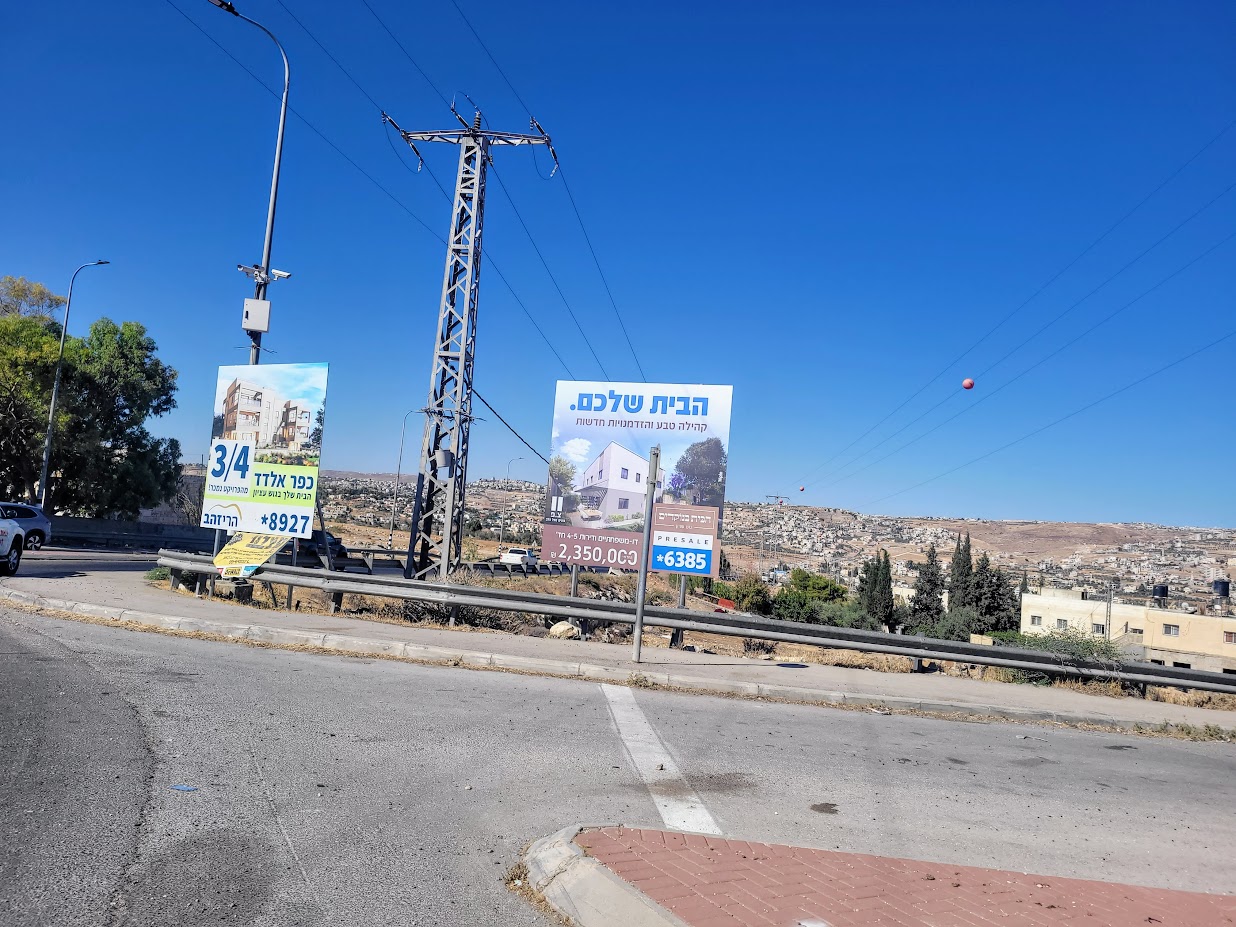
Found on the fence surrounding Efrat from the east, Hana calls it the “slave checkpoint” (certainly there are some in other large settlements as well). The checkpoint is run purely by settlers. “The army doesn’t come here at all,” laments one of the settlers, There are several fancy high-rise buildings have popped up since we visited here about a year ago. The settlement of Efrat is being built intensively.
At this checkpoint, they pass according to lists provided by a number of Palestinian contractors to Israeli contractors. When we were there a contractor sent through a large group of young and old workers by numbers. Only the magnetic card and their belongings were checked. The decision of who passes is in the hands of the contractor. We also met women there, including some who work cleaning at a school in Efrat. They arrive daily by shuttle, mostly from Hebron. Everything is ticking and everything is in the gray area – both the security and the payment.
We talked to some of the workers – they are used to the situation and are not complaining. This is the only livelihood open to them. Because Palestinian vehicles are not allowed to pass through the tunnel checkpoint to Jerusalem, so this simply indicates that there are too many settlers who work in Jerusalem and live in Efrat and Gush Etzion which are seen as its suburbs…
The search for Givat Eitam (also known as 2E)
On Givat Eitam we heard from the holiday of Afrin from Shalom now. It is already marked on the map (including ours), because about 2000 dunams were allocated to it back in the days of the Bibi-Ganz government, most of which were areas declared for that purpose as state lands. The Ministry of Housing plan is already ready. Only a conditional order of the Supreme Court prevents the building. But it also only concerns the question of whether they will agree to allocate some land on the margins to the Palestinians as well, not because of the precedent of a petition if such land can at all be used to build settlements, and block the development of Bethlehem to the south. By the way, the distance from Tuku’ is not great, a few kilometers. This is how another enclave of a large and suffocated Palestinian city is being built.
Let’s see if they started building there. After hardships, we found the area in the east. There is already a road to it and there is a farm and an outpost. It will the probably be built by the Palestinians, including the young people from Hebron and Bethlehem.
The return journey was through the Mazumaria checkpoint, which was a little busier than usual. We connected to the Southern American Road, which is part of the big plan to connect the South Bank to the North Bank – for Israelis only (Jerusalem residents included).
Bethlehem (300)
See all reports for this place-
Located adjacent to the Separation Wall ("Jerusalem Wrap") at the north entrance to Bethlehem, this checkpoint cuts off Bethlehem and the entire West Bank from East Jerusalem, with all the serious implications for health services, trade, education, work and the fabric of life. The checkpoint is manned by the Border police and private security companies. It is an extensive infrastructure barrier and is designated as a border terminal, open 24 hours a day for foreign tourists. Israeli passport holders are not allowed to pass to Bethlehem, and Palestinian residents are not allowed to enter Jerusalem, except those with entry permits to Israel and East Jerusalem residents. Israeli buses are allowed to travel to Bethlehem only through this checkpoint.The checkpoint, which demonstrated harsh conditions of crowding and extreme passage delays for years, started employing advanced electronic identification posts and has upgraded its gates' system as of the middle of 2019 - and conditions improved.Adjacent to the checkpoint, in an enclosure between high walls and another passage, is the historic Rachel's Tomb, which is now embedded within a concrete fortified building. It contains prayer and study complexes for Jews only, as well as a residential complex. updated November 2019 .
-
Nu'man (Mazmuria)
See all reports for this place-
situated on the Wall route as part of "Jerusalem Envelope," in its southeastern stretch, east of Zur Baher, Um Tuba and the small Nuaman Village, on Beit Sahur road, the checkpoint will serve as the main crossing for commercial goods from the southern West Bank to Jerusalem.
-
Sheikh Abdallah Ibrahim / Wadi Rahal (Efrat, Gush Etzion)
See all reports for this place-
The Sheikh Abdallah Ibrahim / Wadi Rahal (Efrat, Gush Etzion) CP is located on the access road to the Efrat settlement.
The road also leads to land owned by Palestinians from Wadi Rahal and manned by the security guards of the Efrat settlement. The checkpoint is open to passing Israelis 24 hours a day. Palestinian workers and cleaners can pass only according to a list of contractors and in their presence.
In light of the enormous expansion of Efrat, it sounds reasonable that about 1000 workers pass there every morning.
We met a laborer on his way to the checkpoint and asked whether he had a work permit. He showed us a permit that was bought from a contractor for a considerable amount of money.The last time we visited this checkpoint (07:00 in the morning) we could witness the "slave market" held there. Contractors "sell" each other workers and professionals. The workers come mainly from the surrounding villages and they are spared the detour through the Bethlehem checkpoint. The eastward expansion of the Efrat is a link in a broader plan that aims to create a territorial continuum between the Gush Etzion bloc and the Dead Sea area while crossing the occupied territories (thereby preventing continuous Palestinian control of the West Bank." (From a MahsomWatch report, 2022)
 Jul-9-2025Gush Etzion: Settlements from the East Are Expanding
-