
Bidu checkpoint, Bir Nabala (Rafat), Kafr `Aqab, Nabi Samwil, Qalandiya

Nebi Samuel and the northern enclaves of Jerusalem, Qalandiya checkpoint seen from the outside
7:45 Nebi Samuel
We went to visit the kindergarten and the elementary school in the Palestinian enclave, Nebi Samuel, between Ramot and Givat Ze’ev. We hadn’t been there for a few months and we were happy to see that it was renovated by the Palestinian Authority and although the classrooms remained tiny, everything was well kept and colorful, the leaks from the roof were repaired, and the atmosphere in the school is also more cheerful. A Palestinian volunteer from Beit Hanina, who conducts workshops for growing house plants in several schools around Jerusalem, is responsible for adding the pots (financed by the Belgians). We were warmly received.
About six months ago, several teachers complained to us that they have to go through the Qalandiya checkpoint to school and arrive at the school after a huge detour, even though they live in nearby villages with a direct road connection – all because only construction workers go through Givat Ze’ev at the Jib checkpoint. We then asked them to send us documents and we would try to help, but they did not send the necessary. This time the Palestinian volunteer promised that she would take care to deliver to us what Hanna had asked of them: a letter from the school confirming that they work there, an ID card (blue or green) and an explanatory letter. Hanna says that it is not certain that we will succeed, but we will try.
It turns out that we arrived at the school in time for the morning preparations before the classes began. It was really nice: a short morning exercise with a song in English; Singing the Palestinian National Anthem https://tinyurl.com/24kbnujr; And a conversation with a local sheikh about the Hadith of Muhammad and the wisdom for success in the future https://tinyurl.com/2bdq423b.
Anyone who thinks there is no Palestinian people is advised to look at the faces of the children singing the anthem.
9:00 Mount Shmuel checkpoint
We were curious to see if the break in the fence which leads from the Biddu enclave (and 6 other Palestinian villages) has been closed. The break is used by the workers who are digging the Jerusalem tunnels to improve the movement of Israelis (mainly the settlers). They have work permits, but if they travel on the “Fabrid of Life” roads, they will have to travel on congested roads to the Qalandiya checkpoint, pass it and return to work in a place very close to their village behind the separation barrier. We checked on our way back by driving part of the way – to the Qalandiya checkpoint – it took us 40 minutes at 10 am (not rush hour).
And the update: the break is open to pedestrians. According to the passers-by, the soldiers often come here but do not stay permanently.
Under the separation barrier passes the “Fabric of Life” road for Palestinian traffic to Ramallah and the Qalandiya checkpoint. Today because of maintenance work, the gate is open. The security is carried out by two men wearing black caps, employees of a company called “Mishmar Jerusalem” (the Jerusalem Guard) – “in the service of the border and seam management”. I checked on the internet and found that its full name is “Cleaning, Security and Maintenance Company Ltd”, according to the records its purpose is to “engage in any legal occupation”. But it is a company that violates the law, limited, last annual report was submitted in 2015. I sent this to Hagit Ofran and Aviv Tatarsky so that they could deal with it if they think necessary.
El Layla and Givat Ze’ev
We looked at Givat Ze’ev from the village of El Layla (whose children study with the children of Nebi Samuel). It is growing all the time in width and height. The lateral extension will surely lead it to Ma’ale Horon settlement, while imprisoning all the villages north of Jerusalem.
Qalandiya checkpoint and the surroundings
It took a lot of time to get through the Bir Nabala enclave (we drove, we didn’t ask, they would have forbidden us to enter there even though it was area C – the soldiers are convinced it was area A). The road is long, narrow and winding and as you get closer to Kafr Aqab and Qalandiya camp, the road becomes very busy. When we arrived at the Qalandiya checkpoint roundabout, we were in the heart of a traffic jungle. We fled to the hill opposite Ar-Ram (another enclave that was sealed off by the separation wall) and watched the progress of the settlement road intended for the passage of Israelis only which is making good progress. It was difficult to assess from a distance the public transport terminal, which was written on Y-net in a propaganda article about the Atarot crossing. We wrote a piece in response (we hope they will publish it).
Al-Jib CP Givat Zeev (Jerusalem)
See all reports for this place-
Al-Jib CP GivatZeev (Jerusalem)
It is located on the separation fence, west of the al-Jib enclave. The checkpoint is regularly manned by Border Police and private security companies. Palestinians are not allowed to cross except for residents of the al-Khalaila neighborhood of the village of al-Jib, residents of al-Jib who own land on the western side of the fence, residents of a-Nabi Samuel, which is their only access road to Ramallah and the villages in northwest Jerusalem, as well as Palestinians with work permits in the Givat Zeev settlement and UN workers passing through UN vehicles.
(Updated January 2020)
-
Bidu CP
See all reports for this place-
Bidu CP A closed gate in the Separation Fence blocks the road connecting Bidou village and six other villages to Jerusalem. Underneath passes a “fiber of life” road for Palestinian only, leading Bidou villagers and its surrounding area to the enclave of Al Jib and through there to Aqab and Qalandiya – 14 kilometers of a potholed track. The checkpoint disconnects the entire Bidou enclave and the surrounding villages from Jerusalem and Israel in general.
-
Kufr 'Aqab
See all reports for this place-
Kufr 'Aqab
25,000 people live in this village, and since the erection of the Separation Wall, it has been disconnected from Jerusalem and become a neighborhood totally abandoned as far as law enforcement and planning and construction are concerned. The thousands of inhabitants of this undefined urban area pay municipal taxes to the city of Jerusalem but the Israeli authorities – municipality, police, and various service companies – hardly enter these places, and the Palestinian authorities avoid them too since the Oslo Accords forbid them to act within Jerusalem’s jurisdiction.
MachsomWatch teams coming to their Qalandiya vigils sometimes go through the village itself, and the organization’s tours include the enclaves north of Jerusalem.
-
Nabi Samwil
See all reports for this place-
Nabi Samwil - a village literally placed in a transparent cage.
This Palestinian village is 800 years old. It is located on top of a hill, its altitude 890 meters above sea level, and overlooks the entire area. According to Jewish, Christian, and Muslim traditions, the Prophet Samuel was buried here. In recent years the mosque has been turned into a popular Jewish prayer site. Jews use the basement for prayer, and Muslims the upper part of the mosque. New signs are placed here, containing verses from the Jewish scriptures and mention of exclusively Israeli historical times. The nearby spring has become a popular site of ritual bathing. On Iyar 28th, every year, a mass-celebration is held in memory of the Prophet Samuel.
Until 1967 this was a well-off village that developed around the mosque, with a population of 1,000 owning thousands of dunams of farmland. In 1967 most of the villagers fled, and only 250 remained. In 1971 Israel expelled them, and until the 1990s completely razed its houses that were sitting on a Crusader and Hellenist archeological stratum, without any kind of compensation for the expelled inhabitants. Parts of the village lands are at present used for the settler-colony of Har Shmuel, another part has been declared a national park. Villagers have tried to restore their lives on their remaining lands, a short distance from their original homes, in an area that formerly held structures to house the village’s livestock.
Then the Separation Fence was erected in the West Bank, the village remained an enclave caught between the Green Line and the Fence, and its inhabitants were torn away from other West Bank villages. Any exit to the West Bank requires crossing the distant Jib checkpoint, with a permit. The movement to Israel inside the Green Line is forbidden as well. In 1995 the entire village area was declared a national park – not only around the mosque and antiquities around it which take up about 30 dunams, but an area of no less than 3,500 dunams including the new village and all of its land. Any additional construction is forbidden: any room, caravan, fence, a newly planted tree. Work permits are issued sparingly. There is a tiny school made up of several caravans.
Watch the movie by Eran Turbiner and MachsomWatch: NABI SAMWIL 1099-2099, a film by Eran Torbiner
-
Qalandiya Checkpoint / Atarot Pass (Jerusalem)
See all reports for this place-
Click here to watch a video from Qalandiya checkpoint up to mid 2019 Three kilometers south of Ramallah, in the heart of Palestinian population. Integrates into "Jerusalem Envelope" as part of Wall that separates between northern suburbs that were annexed to Jerusalem in 1967: Kafr Aqab, Semiramis and Qalandiya, and the villages of Ar-Ram and Bir Nabala, also north of Jerusalem, and the city itself. Some residents of Kafr Aqab, Semiramis and Qalandiya have Jerusalem ID cards. A terminal operated by Israel Police has functioned since early 2006. As of August 2006, northbound pedestrians are not checked. Southbound Palestinians must carry Jerusalem IDs; holders of Palestinian Authority IDs cannot pass without special permits. Vehicular traffic from Ramallah to other West Bank areas runs to the north of Qalandiya. In February 2019, the new facility of the checkpoint was inaugurated aiming to make it like a "border crossing". The bars and barbed wire fences were replaced with walls of perforated metal panels. The check is now performed at multiple stations for face recognition and the transfer of an e-card. The rate of passage has improved and its density has generally decreased, but lack of manpower and malfunctions cause periods of stress. The development and paving of the roads has not yet been completed, the traffic of cars and pedestrians is dangerous, and t the entire vicinity of the checkpoint is filthy. In 2020 a huge pedestrian bridge was built over the vehicle crossing with severe mobility restrictions (steep stairs, long and winding route). The pedestrian access from public transport to the checkpoint from the north (Ramallah direction) is unclear, and there have been cases of people, especially people with disabilities, who accidentally reached the vehicle crossing and were shot by the soldiers at the checkpoint. In the summer of 2021, work began on a new, sunken entrance road from Qalandiya that will lead directly to Road 443 towards Jerusalem and Tel Aviv. At the same time, the runways of the old Atarot airport were demolished and infrastructure was prepared for a large bus terminal. (updated October 2021)
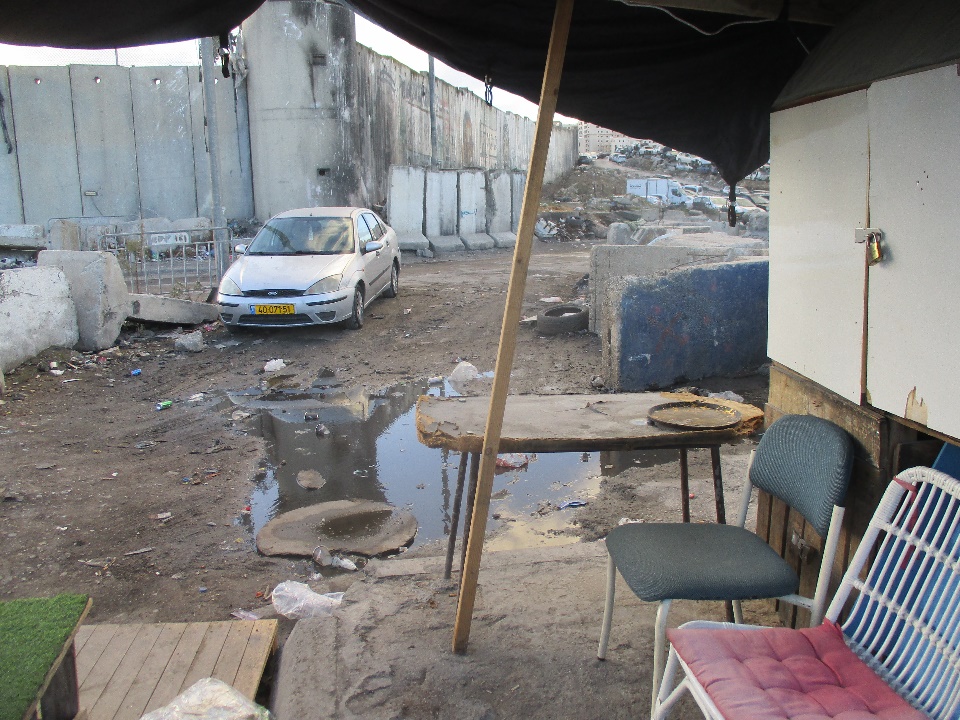 Tamar FleishmanNov-30-2025Qalandiya: Puddles and dirt after the rain
-
Rafat (Bir Nabala)
See all reports for this place-
Rafat (Bir Nabala) With the completion of the Bir Nabala enclave, which includes also Al Jib, Al Judeira and Beit Hanina al Balad, a checkpoint was put at enclave exit. The passage into the enclave is allowed only to the enclave inhabitants and to Ramallah District people.
-