
Burin, Madama - Olive trees were cut off. A young man was wounded
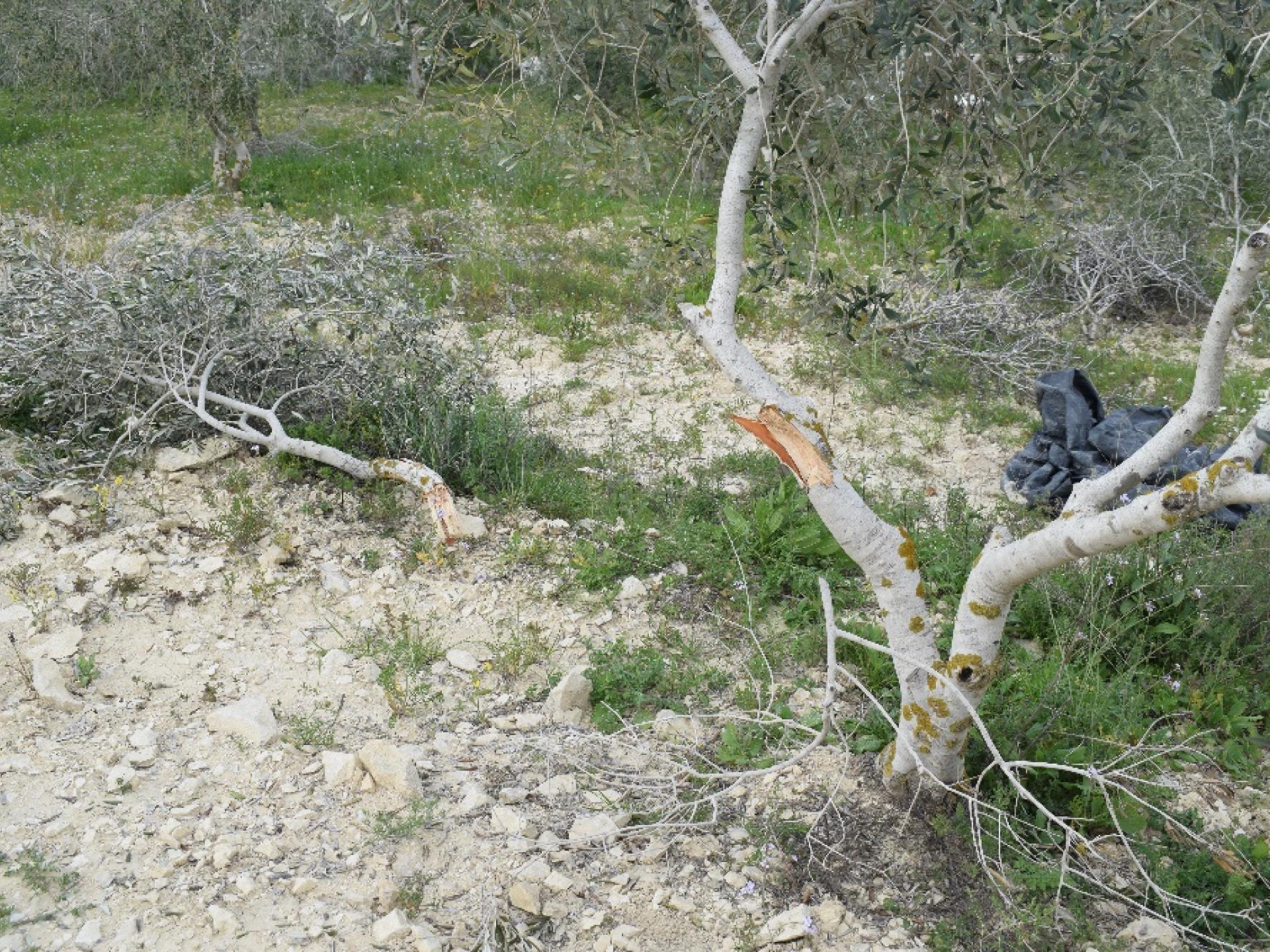
Olive trees in Madama were cut down by settlers who beat and wounded with an iron bar a Palestinian who tried to stop them.
Burin. We had arranged a meeting in the home of our friend D. with a member of Yesh Din following a series of reports from her about harassment by settlers in their fields and in the village itself. The frequency of such incidents is increasing. Settlers, backed by armed soldiers, are apparently on the lookout from their outposts on the hilltops and descend as soon as they see the Palestinian farmers working their land. From time to time the soldiers fire tear gas grenades to chase away the Palestinians. Videos documenting these confrontations are regularly sent to us via WhatsApp. We want to keep receiving updates and jointly consider how we can help. The Yesh Din representative said that about 1000 dunums in Area B that belong to Burin, in the eastern part of the village below the outposts of Sneh Ya’akov and Giv’at Ronen, are particularly exposed. In response the head of Burin village, together with the Palestinian Authority in Ramallah, are organizing to renovate buildings in the area, including an isolated large house that had been abandoned in the early days of the occupation, and have people reoccupy it. An isolated house in the middle of fields in the southwest portion of the village, near Yizhar, in which a widow lives, will also be renovated. Convenient routes of access will be prepared in order to create facts on the ground that will make it difficult for Israel to take control of the area.
We hope to keep track of in the project if it actually gets underway.


We asked about the status of the land adjacent to the Burin high school, where there are many confrontations. The Yesh Din representative said there are 55 dunams belonging to the school but located in Area C. This area had once been owned by the Kingdom of Jordan and after the occupation it (automatically) became state land. The Civil Administration intends to erect a fence that will purportedly separate the area of the school from the settlers.
During our visit to Burin we were told by our friend D. about an incident involving her nephew, the son of her husband’s sister. Rioting settlers from Yizhar hit him on the leg with an iron bar while he and eight friends were defending a grove of young olive trees that the settlers tried to cut down. The son, aged 20, a student at Al-Najah, was taken by ambulance to the hospital after being injured. He’s now at home with limited mobility. He may have suffered nerve damage because he can’t move his toes. The incident occurred on March 11, a few days before our visit.
The family lives in the village of Madama, adjacent to Burin. The father chose to build his house on an elevated, isolated location in the village because he wanted to be close to nature. The proximity of the settlement didn’t dissuade him. He added that a few days earlier Yitzhak Levy, Yitzhar’s head of security, was seen in the village armed with a rifle and behaving provocatively, as is his wont.
We drove with D. and her daughter, who’s graduating from high school this year, to the family’s home in Madama. All of us, including the father and the mother of the youth, climbed the hill to see and photograph the damaged trees. We saw about six trees that had been roughly sawed or cut down. The work appeared to have been done recently. The family’s small flock of sheep grazed near us, the younger sons accompanying them. We were struck by the pastoral scene around us. We’re in the midst of spring. An abundance of wildflowers – anemones, buttercups, tulips, irises and others. It was obvious how deeply the father felt connected to his surroundings and to nature.


16:30 A flying checkpoint at the exit from Burin. Palestinian vehicles being inspected by IDF soldiers.

On the way to Burin we drove through Nabi ‘Ilyas and Khaja.
We stopped by the shops on the main street in Nabi ‘Ilyas. Little traffic on the road. The shop owners told us that the bypass road has caused a significant reduction in midweek sales. We saw a rabbi providing a kashrut certificate to one of the butcher shops. A glatt-kosher store. It invites Jewish customers. We were told many come to shop on Friday and Saturday, including Israelis from Tel Aviv.
In Khaja we went to M’s restaurant to ask the customers what they know about the Nabi Rabah maqam located on a nearby hill. A., a 45-year-old Palestinian, who spoke Hebrew, said that when he was a child they’d climb up to pray and have parties. They haven’t done so for years. He doesn’t know why. Maybe because the situation is so bad today, he said, without elaborating. The owners of the olive groves on the hill are not limited in their ability to access them for plowing and harvesting. They’re not aware it’s a designated nature preserve and that one day they’re liable to be notified that plowing and planting is restricted, as has occurred in the designated nature preserve in Wadi Qana.
There are four mosques today in Khaja. In the past, when they’d gone up to the maqam, there had been only one.
During the entire time we spent in the restaurant, the owner was busy serving youths and men. We saw no girls or women.
A-Nabi Elias
See all reports for this place-
A-Nabi Elias this is a Palestinian village in the northern West Bank, east of Qalqilia on Road 55, north-east of Alfei Menashe colony and west of Karnei Shomron colony and the Palestinian city of Nablus. As of 2016, the village was populated by 1,458 inhabitants.
Near the village is a maqam (holy site memorializing a sanctified person) - the prophet Elisha. Until 2021 Road 55 crossed the village. Then a bypass road was paved through olive groves that were sequestered from the villagers. Consequently, the farmers were left with small olive groves that they could not access nor cultivate. Inhabitants protested against the road for weeks, supported by peace activists, but nothing helped and the road is now a given fact.
The village's main street had been a shopping center for all residents, including colonists. We even saw a Kashrut (kosher food) inspector in a butcher shop close to the falafel stand… The bypass road, according to tradesmen, has impacted their businesses and clients, while others claim that there are customers now for parking has become easier.
Alfei Menashe and Tzofim colonies nibble at the village lands from the north and south and get closer to it all the time. Colonists of Alfei Menashe have outdone themselves, sending their surplus sewage from the oxygenation pools toward a-Nabi Elias land, even reaching the houses.
The villagers are known as seekers of peace. For years there was no hostility towards Israelis. On the contrary, we were always welcomed warmly and stopped there to enjoy their delicious, inexpensive falafel.
-
Burin (Yitzhar)
See all reports for this place-
Burin (Yitzhar)
This is a Palestinian village in the Nablus governorate, a little south of Nablus, on the main road passing through the West Bank. The settlements: Yitzhar and Har Bracha, settled in locations that surrounded the village, placed fences so it is cut off the main road.
There are around 4000 inhabitants. Most of them are engaged in agriculture and pasture, although many graduates of the two secondary schools continue to study at the university. Academic positions are hardly available, they find work as builderd, or leave for the Gulf countries.
The village lands were appropriated several times for the establishment of Israeli settlements and military bases, and as a result, Burin's land and water resources dwindled. lSince 1982, more than 2,000 dunams of village land have been declared "state land" and then transferred to Har Bracha settlement.
Over the past few years and more so since 2017, the villagers have been terrorized by the residents of Yitzhar and Har Bracha, the Givat Ronen outpost and others. Despite the close proximity of soldiers to an IDF base close to one of the village's schools, residents are suffering from numerous stone-throwing events, vehicle and fire arson, also reported in the press.
In 2023, the prevention of the olive harvest in the village plot was more violent than ever. Soldiers and settlers walked with drawn weapons between the houses of the village and demanded that people stop harvesting in the village itself and in the private plots outside the village. The settlers from Yitzhar and Giv'at Roned raided the olive groves and stole crops. 300 olive trees belonging to the residents of Burin, near Yitzhar, were uprooted. The loss of livelihood from the olives causes long-term economic damage to the farmers' families, bringing them to the point of starvation.
(updated for November 2023)
-
Madama
See all reports for this place-
Madama
This village is situated in the Nablus district, about 5 kilometers south of the city of Nablus, at an altitude of 517 meters above sea level. Madama was founded 400 years ago and its villagers originate from the Arabian Peninsula. It numbered 1,728 inhabitants in 2007. 62% of the village area is categorized as Area B, and 38% as Area C.
Over the years, hundreds of dunams have been robbed of the village for the purpose of building settler-colonies, army bases, and paving roads:139 dunams were sequestered to found settler-colony Yitzhar south of the village, and the land was also confiscated for paving road 60. The road and its buffer zone (75 meters on each side) lined by barbed wire fences separate the village’s farmlands to the north and the village farmers are denied access to tend them. The road also separates Madama and Burin, two villages with close neighborly ties, and now not able to access the road directly.
The settler-colony Yitzhar has become a daily threat to the village. The settler-colonists planted trees in fenced-in groves, steal crops, burn, uproot and vandalize Palestinians’ trees, and harm both holy sites and property. They also attack the Palestinian landowners in order to terrorize them and prevent them from accessing their lands.
For further information: http://vprofile.arij.org/nablus/pdfs/vprofile/Madama_vp_en.pdf
-