
Burin (Yitzhar), Habla
Habla, Burin, Huwwara, Beit Furiq, Za’tara junction, Tuesday, 19.11.13, afternoon
In the wake of the article that appeared in “Il Iltihal” we decided to spend most of our shift in Burin.
13:10 Habla
When we arrived we encountered a Machsom Watch tour led by Leora and Shoshi Inbar. They told us the participants were members of HaShomer HaTza’ir’s Shomriyya youth group. Anyone who’s heard of it can imagine how old they are… Having once been a member of HaShomer HaTza’ir, of course I knew some of them.
Shoshi told us the gate opened only at 13:10, not at 13:00 as “posted.”
14:30 Burin – on the way to the adjacent village of Madameh.
Most of the rioting was in Madameh. Before our friend Munir arrived we asked passersby where the incident occurred, but they didn’t know. When Munir came he said it was a family living on the outskirts of the village; that’s why nobody knew.
Here’s what happened:
Settlers from Yitzhar came down at 9 AM toward the isolated house on the southern side of Burin (nearer to Yitzhar), to the olive grove, and began breaking tree limbs. The residents called Munir; when the settlers saw his vehicle approaching they moved away. The villagers contacted the Palestinian DCO, but two Israeli police jeeps and an army jeep in the area didn’t’ intervene! It’s Area B; the Palestinian Authority is responsible for building permits. That night settlers from Yitzhar came, reinforced by settlers from Beracha, wrote slogans on bricks at the construction site and tried to set fires by pouring oil at a number of spots on the site; they didn’t succeed, “thank G_d.” They damaged nearby beehives. The slogan we saw read, “Rock throwing” – in other words, retaliation… They broke many of the concrete blocks and tried to burn the electric pole and the lumber for construction that was on the site. They stole the water pump and also uprooted pine trees that had been planted there.
There’s neither law nor justice in the settlers’ land.
Munir will send me the photos he took and I’ll upload them.
Huwwara and Beit Furiq: No military presence (not in the towers either).
16:15 Za’tara junction
One soldier stands in the tower; a second, at the hitchhiking station, provides security for settlers returning to their illegal localities.
According to another report from “Il Iltihal,” the government plans to expand the Za’tara checkpoint and will expropriate lands from residents of Za’tara for that national endeavor. It’s important to follow what happens/will happen there.
16:40 The tower at Kifl Hars is manned.
Burin (Yitzhar)
See all reports for this place-
Burin (Yitzhar)
This is a Palestinian village in the Nablus governorate, a little south of Nablus, on the main road passing through the West Bank. The settlements: Yitzhar and Har Bracha, settled in locations that surrounded the village, placed fences so it is cut off the main road.
There are around 4000 inhabitants. Most of them are engaged in agriculture and pasture, although many graduates of the two secondary schools continue to study at the university. Academic positions are hardly available, they find work as builderd, or leave for the Gulf countries.
The village lands were appropriated several times for the establishment of Israeli settlements and military bases, and as a result, Burin's land and water resources dwindled. lSince 1982, more than 2,000 dunams of village land have been declared "state land" and then transferred to Har Bracha settlement.
Over the past few years and more so since 2017, the villagers have been terrorized by the residents of Yitzhar and Har Bracha, the Givat Ronen outpost and others. Despite the close proximity of soldiers to an IDF base close to one of the village's schools, residents are suffering from numerous stone-throwing events, vehicle and fire arson, also reported in the press.
In 2023, the prevention of the olive harvest in the village plot was more violent than ever. Soldiers and settlers walked with drawn weapons between the houses of the village and demanded that people stop harvesting in the village itself and in the private plots outside the village. The settlers from Yitzhar and Giv'at Roned raided the olive groves and stole crops. 300 olive trees belonging to the residents of Burin, near Yitzhar, were uprooted. The loss of livelihood from the olives causes long-term economic damage to the farmers' families, bringing them to the point of starvation.
(updated for November 2023)
-
Habla
See all reports for this place-
Habla CP (1393)
The Habla checkpoint (1393) was established on the lands of the residents of Qalqilya, on the short road that
connected it for centuries to the nearby town of Habla. The separation barrier intersects this road twice and cut off the residents of Qalqilya from their lands in the seam zone.(between the fence and the green line).
There is a passage under Road 55 that connects Qalqilya to the sabotage This agricultural barrier is used by the farmers and nursery owners established along Road 55 from the Green Line and on both sides of the kurkar road leading to the checkpoint.
This agricultural checkpoint serves the residents of Arab a-Ramadin al-Janoubi (detached from the West Bank), who pass through it to the West Bank and back to their homes. The opening hours (3 times a day) of this agricultural checkpoint are longer than usual, about an hour (recently shortened to 45 minutes), and are coordinated with the transportation hours of a-Ramadin children studying in the occupied in the West Bank.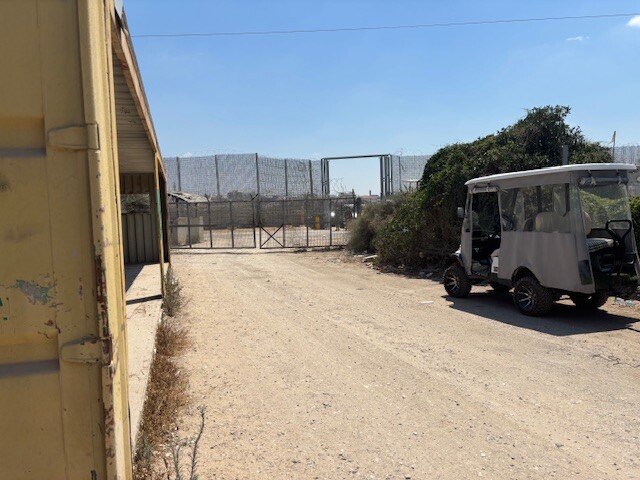 Nina SebaAug-18-2025Habla: The gate is in the process of closing
-