
Hebron – Aided by Kiryat Arba settlers, both Civil and Water administrations dismantled the Ja’abari family’s irrigation system and stole the pumps
The shift was mainly devoted to visiting the Ja’abari family, who live at the foot of the Nofei Mamre neighborhood in Kiryat Arba. Almost all of their land was expropriated to establish Kiryat Arba in 1968. They now live in the valley with the few dunams left to them, but are constantly threatened by the Civil Administration, which cuts off their water supply and accuses them of stealing it — causing much of the vegetables they sow or plant to dry up. We saw a large tomato plot that had withered because their water had been shut off.
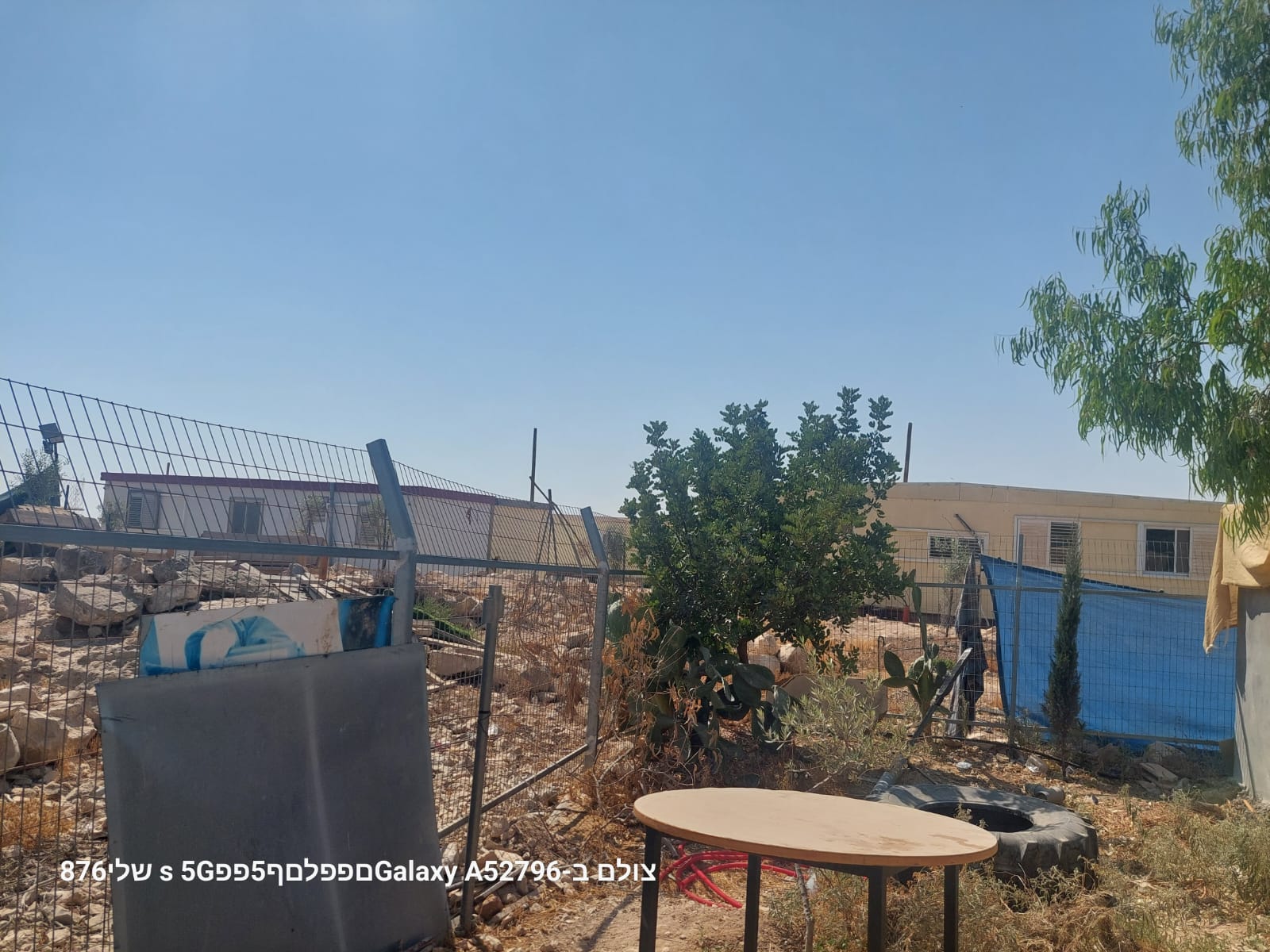
But first, we drove to Umm al-Kheir after yet another episode of harassment. For a whole day, they still had no water, because the settlers moving in right next to them were being connected to the water system — so the authorities disconnected theirs. The Civil Administration promised to reconnect them, but what do they care about leaving an entire community thirsty for more and more hours in this heat? So we bought them several cartons of water in addition to the supplies we had already brought and drove over.
At the entrance to their village, we met Eid al-Hathalin, one of their leaders. He asked to get into the car, but there was no room because it was packed with bags of clothes and games we brought, along with food supplies and water cartons. This time we came in a regular car, since you don’t need a 4×4 to get there, so we really had no space at all.
When we arrived at the spot where everyone gathers, we saw a police vehicle arrive and detain Eid. He was put into the car and questioned about why he was standing there — they “checked on his well-being” and made sure he wasn’t “disturbing” the security forces. None of them seemed in a hurry to reconnect the people’s water pipe. Apparently, it wasn’t urgent for them (a video of the events is attached). When we left, Eid was still in the police car. Two hours later, I called to ask how he was, and he said that for about 20 minutes they tried to “express their concern” for his well-being and then released him without filing any complaint (this time). It seems that the strong presence of volunteers from Israel and abroad, who documented everything, helped convince the police to let Eid go this time.
At Nabil’s grocery store, we left money from our friends for those they had asked us to help, and we also bought supplies for the Ja’abari family. We also brought money that our friends had sent for their Arabic teacher and gave it to him at the Sa’ir junction. There, they told us that recently, the checkpoints at the entrances to all the villages surrounding Hebron — and inside Hebron itself — have been tightened even more. Everyone walks long distances now, from place to place. We saw those yellow barriers “decorating” every possible entrance to every community in the Hebron area.
The shuttle station to Kiryat Arba is crowded with concrete barriers and soldiers providing security.
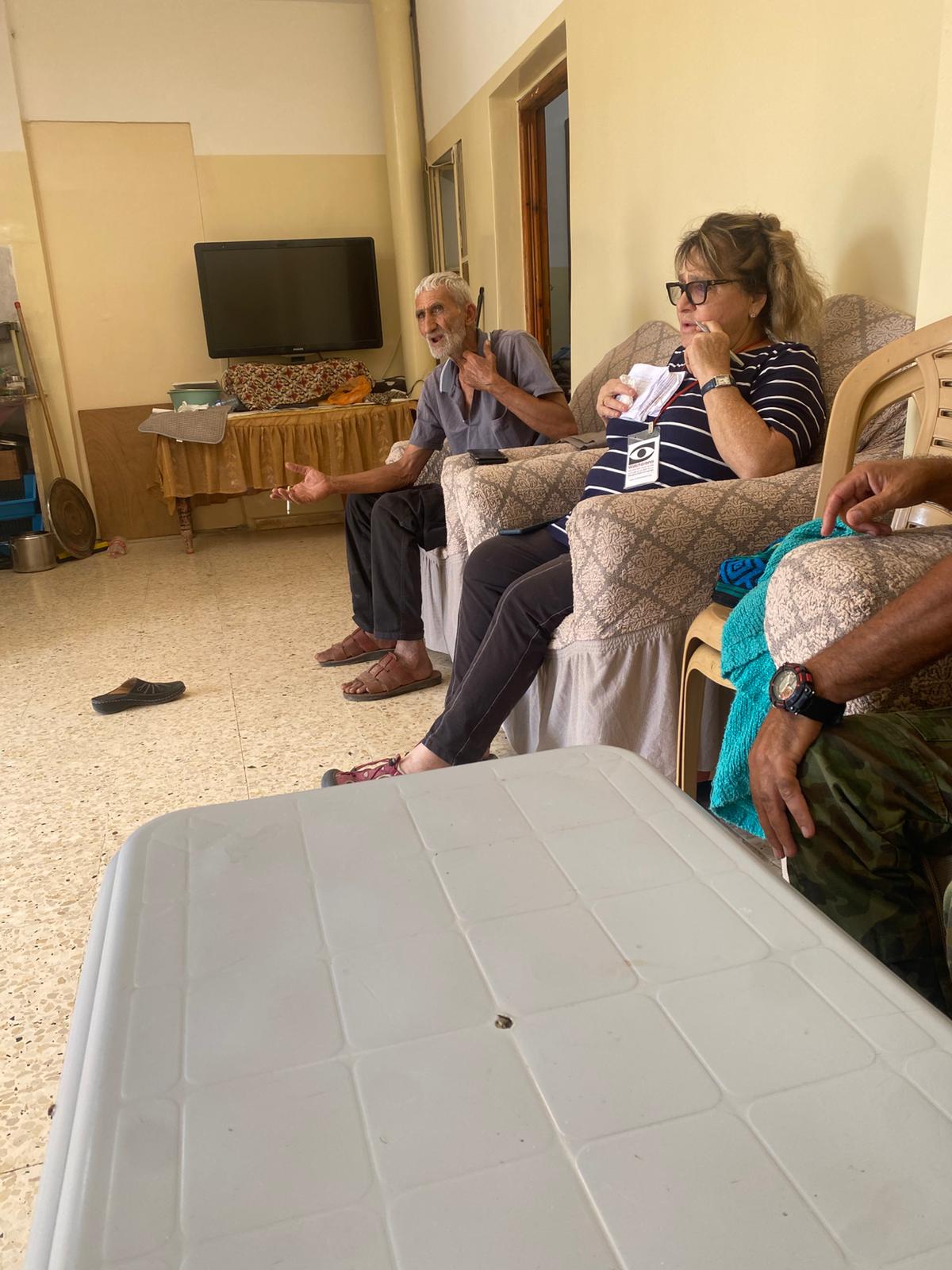
Atta is waiting for us at his late mother’s house — she passed away a month ago. The grape vineyard next to the house is still in decent condition, but the vegetables nearby are drying up because two months ago, personnel from the Civil Administration and Mekorot, assisted by settlers from Kiryat Arba, dismantled their irrigation system and stole the pumps, accusing them of stealing water.
Now he is forced to buy water at 400 shekels per 10 cubic meters, and the man who sells them the water comes at night for fear of being arrested and accused of stealing water from Mekorot. They feel there’s a plan to “dry them out” as well.
He says there was an agreement years ago with the Palestinian Authority to provide them with water, but it’s not functioning — it too seems to have been “dried up.” Smotrich and Netanyahu’s “burden and asset” plan seems to have succeeded. No doubt about it.
Location Description
Hebron
See all reports for this place-
According to Wye Plantation Accords (1997), Hebron is divided in two: H1 is under Palestinian Authority control, H2 is under Israeli control. In Hebron there are 170,000 Palestinian citizens, 60,000 of them in H2. Between the two areas are permanent checkpoints, manned at all hours, preventing Palestinian movement between them and controlling passage of permit holders such as teachers and schoolchildren. Some 800 Jews live in Avraham Avinu Quarter and Tel Rumeida, on Givat HaAvot and in the wholesale market.
Checkpoints observed in H2:
- Bet Hameriva CP- manned with a pillbox
- Kapisha quarter CP (the northern side of Zion axis) - manned with a pillbox
- The 160 turn CP (the southern side of Zion axis) - manned with a pillbox
- Avraham Avinu quarter - watch station
- The pharmacy CP - checking inside a caravan with a magnometer
- Tarpat (1929) CP - checking inside a caravan with a magnometer
- Tel Rumeida CP - guarding station
- Beit Hadassah CP - guarding station
Three checkpoints around the Tomb of the Patriarchs
 Raya YeorDec-18-2025Hebron - Yusri Jaber and part of his family
-
Masafer Yatta*
See all reports for this placeMesafer Yatta
See all reports for this place-
This is happening in Fire Area 918 in the South Hebron Hills
On the eve of Remembrance Day (the day before Israel Independence Day), 4th May, 2022, the Israeli High Court decided on the transfer and expulsion of residents from 8 Palestinian communities in the area of Masafar Yata in the South Hebron Hills. Residents of the villages have been living under the threat of demolition, evacuation and expropriation since the IDF issued evacuation orders in 1999 based on the 1980s proclamation of their area of residence as a firing zone for IDF drills. None of the nearby settlements were included in this zone. The Masafer Yata Palestinian villages retain a special lifestyle and ancient agricultural culture. They also posess a clear historical documentation that testifies to a Palestinian settlement in this area, generations before the establishment of Israel, long ago in the caves and at later times outside them.
Evacuating residents from the area means destroying these historic villages and leaving entire families (about 2,000 people, children, adults, and the elderly) homeless. This is contrary to international law.
In June 2022, a firing drill started, and life became harder.
-
South Hebron Hills
See all reports for this place-
South Hebron Hills
South Hebron Hills is a large area in the West Bank's southern part.
Yatta is a major city in this area: right in the border zone between the fertile region of Hebron and its surroundings and the desert of the Hebron Hills. Yatta has about 64,000 inhabitants.
The surrounding villages are called Masafer Yatta (Yatta's daughter villages). Their inhabitants subsist on livestock and agriculture. Agriculture is possible only in small plots, especially near streams. Most of the area consists of rocky terraces.Since the beginning of the 1980s, many settlements have been established on the agricultural land cultivated by the Palestinians in the South Hebron Hills region: Carmel, Maon, Susia, Masadot Yehuda, Othniel, and more. Since the settlements were established and Palestinians cultivation areas have been reduced; the residents of the South Hebron Hills have been suffering from harassment by the settlers. Attempts to evict and demolish houses have continued, along with withholding water and electricity. The military and police usually refrain from intervening in violent incidents between settlers and Palestinians do not enforce the law when it comes to the investigation of extensive violent Jewish settlers. The harassment in the South Hebron Hills includes attacking and attempting to burn residential tents, harassing dogs, harming herds, and preventing access to pastures.
There are several checkpoints in the South Hebron Hills, on Routes 317 and 60. In most of them, no military presence is apparent, but rather an array of pillboxes monitor the villages. Roadblocks are frequently set up according to the settlers and the army's needs. These are located at the Zif Junction, the Dura-al Fawwar crossing, and the Sheep Junction at the southern entrance to Hebron.
Updated April 2022
 Michal TsadikJan-29-2026Umm al-Khair - a security risk for Carmel settlers
-
Umm al-Khair
See all reports for this place-
Umm al-Kheir

A Palestinian village in the southern Hebron governorate, populated by five families. The Palestinian residents settled there decades ago, after Israel expelled them from the Arad desert and purchased the land from the residents of the Palestinian village of Yatta. The village suffers from the violence of nearby Carmel settlers, from water shortage and is subject to frequent demolition of buildings by the Civil Administration.
-