
Companions of Palestinian shepherds in the Jordan Valley protect them from Settler thugs
We were a very enlarged team on Saturday. Some were after Friday’s night shift and some of us came to Al-Farisiya on Saturday morning.
We got into teams and went out for our day shift.
Saturday day shift, March 29th
Almaqassar – grazing passed shepherd N. peacefully. Three accompniers were with him and said the grass almost ran out and grazing grounds were reducing by the day with excuses that “these are firing zones” or “belong to settlement and outposts”. N. doesn’t dare cross the road to the west, not even to his own field with wheat that has grown, because of the arrest threats by settlers who come backed up by soldiers. Even at Khalat Makhoul grazing was peaceful.
At Ein Al Hilwa there were separate accompaniments for the two flocks (sheep and cattle) without hampering.
At Al-Farisiya this time there were sufficient accompaniers for both A.’s flock and for his cousins’. Because of threats in recent days, the shepherds were afraid to go beyond a few hundred meters from their locality in spite of the fact that grass had almost run out.
It has been harsh attack by settlers. The shepherds had gone all the way to Ein Shaq, the local spring, to water their flocks. While grazing, the shepherds and accompaniers sat down to rest, when a car showed up. Three boys disembarked and wildly clubbed to death three sheep. At the same time, settlers in another car shot the sheep. Consequently, three more died. Other harassments ended without casualties, but with threats: A. had distanced his flock on the previous day to the hill between Al-Farisiya and Ein Al Hilwa. A settler from Bentzi’s outpost showed up on his ATV, called the army and chased away the shepherd and his flock claiming this was a firing zone. A. decided not to confront him and went elsewhere.
Continuing this event, complaints will be lodged with the police containing a veterinary report on the sheeps’ cause of death. Will it help? Let’s see. The police, its investigators and policemen are held hostage by the ruling messianic right-wing so fair trial is not likely. This is how the thugs manage to push out Palestinians shepherds and steal their miserable property, word for word.
Our Saturday shift was not over. Peace was imaginary: at 3 p.m. the colonists had gained forces and began harassments in various places. Eight young thugs, ages 16-22, came down from the expanding outpost near Maskiyot settlement to the Ein Al Hilwa spring. They tried to disrupt H. watering his cattle. The two accompaniers must have startled the thugs and enabled H. to finish watering his flock and return home.
The thugs crossed under the road over to shepherd S.’s encampment. They crossed it, she pen and the cowshed, scaring the house inhabitants. From there they continued and crossed the road going up to Hamam Al Malih, went up to their observation hut (overlooking shepherd Q.) and rested there for half an hour. On their way back, they continued to harass and scare the families in the encampment, and actually frightened the women who were preparing the Iftar dinner.
The shepherds live in constant fear that the thugs will steal cattle and sheep on their way. This time it didn’t happen.
Half a day was over but the saga continued. Harassments were not over, there was only a short pause.
The night accompaniers came at 5:30 p.m. to replace the day shift. One team was to sleep at the Ein Al Hilwa shepherds’ houses, the other at Farisiya. All seemed quiet. The accompaniers were invited for the Iftar meal and sat down to drink tea, the Ein Al Hilwa team left and the Farisiya volunteers sat down in their own tent.
At 9:30 p.m., about 20 settler thugs (ages 19-22) invaded Al-Farisiya: some came down the hill in their ATV, others came up the road in two cars. They marched in groups on the narrow road among the inhabitants’ homes and kept looking for confrontations, hoping to escalate the situation so that the indigenous inhabitants would have to be expelled.
All accompaniers were alarmed to serve as a buffer between the invaders and the villagers.
We called the police to notify them what was happening, we reminded them, about three times of the invasion taking place while trying to stop the settlers. The phone operators promised that a police car was on its way to Al-Farisiya, but this never arrived, and must never even had been sent.
In combined efforts we managed to have the settlers retreat to a hill above Al-Farisiya, where they sat down and lit a campfire, promising they would be back soon. At the same time we called the army commander and warned that things were explosive and a violent event might break out. We told the soldiers what had happened. They promised to check whether there were settlers on the hill and to go through the various outposts from which the young thugs came. We all went to sleep.
At midnight the 8-10 thugs raided again, waking up all inhabitants. They marched again along the main track in Farisiya. One of the elder inhabitants had an anxiety attack and a Palestinian ambulance was summoned for him. It was clear to us that the colonists had decided to hold a violence event in order to expel the locals. This time too we summoned police and the army.
The police never arrived in spite of its promises. The army came after we had managed to make the settler thugs retreat to their cars. This time the army came with apparent auxiliary forces: a reserves unit whose soldiers listened to us; as well as soldiers from a hostile battalion 444 whose soldiers are especially hostile to us, and their commander most of all. The soldiers doubted what we told them even though they were shown trustworthy videos. The soldiers left and this time didn’t even promise anything. We welt to sleep around 2 a.m. in stand-by mode. The rest of the night passed peacefully. Tension remained and stress only worsened.
Location Description
'Ein al-Hilwe
See all reports for this place-
Ein al-Hilwe is a natural spring and a Palestinian grazing area in the Jordan Valley that was used by the Palestinian shepherd communities for watering their flocks and for daily use. As of 2021, settlers from the Maskyot settlement took control of the spring: they fenced it off, built a wading pool and a mikveh, and installed flags and recreational facilities.
Palestinians are effectively denied access to the spring, and are forced to make do with running water in a remote wadi or, when the road is blocked, buy water from vendors at high prices.
The spring is located in the heart of an area where illegal outposts are being established, as part of a broader trend of pushing Palestinian communities away by denying them access to essential resources. Neighboring communities such as Umm Jamal and Khirbet Samra have already left due to the pressure.
Over the years, MachsomWatch members have reported arrests on false claims by settlers, harassment and violence, including damage to herds, intrusion into homes, and the intimidation of children. MachsomWatch volunteers participate in a protective presence in areas around the spring to prevent harassment of shepherds due to the presence of settlers.
-
Al-Farisiya / 'Ein a-sakut
See all reports for this place-
Al-Farisiya / 'Ein a-sakutA community of shepherds in the Jordan Valley opposite the settlement of "Rotem". Making a living from grazing sheep, the residents are exposed to harassment, abuse and theft from settlers who come to them from outposts and settlements in the area, and their grazing area is shrinking due to settler takeovers, fire zones and declared nature reserves.Machsom Watch companies participate in shepherd escort activities and provide a 24/7 protective presence, and there is continuous and warm contact with the community.
-
Jordan Valley
See all reports for this place-
Jordan Valley The Jordan Valley is the eastern strip of the West Bank. Its area consists of almost a third of the West Bank area. About 10,000 settlers live there, about 65,000 Palestinian residents in the villages and towns. In addition, about 15,000 are scattered in small shepherd communities. These communities are living in severe distress because of two types of harassment: the military declaring some of their living areas, as fire zones, evicting them for long hours from their residence to the scorching heat of the summer and the bitter cold of the winter. The other type is abuse by rioters who cling to the grazing areas of the shepherd communities, and the declared fire areas (without being deported). The many groundwaters in the Jordan Valley belong to Mekorot and are not available to Palestinians living in the Jordan Valley. The Palestinians bring water to their needs in high-cost followers.
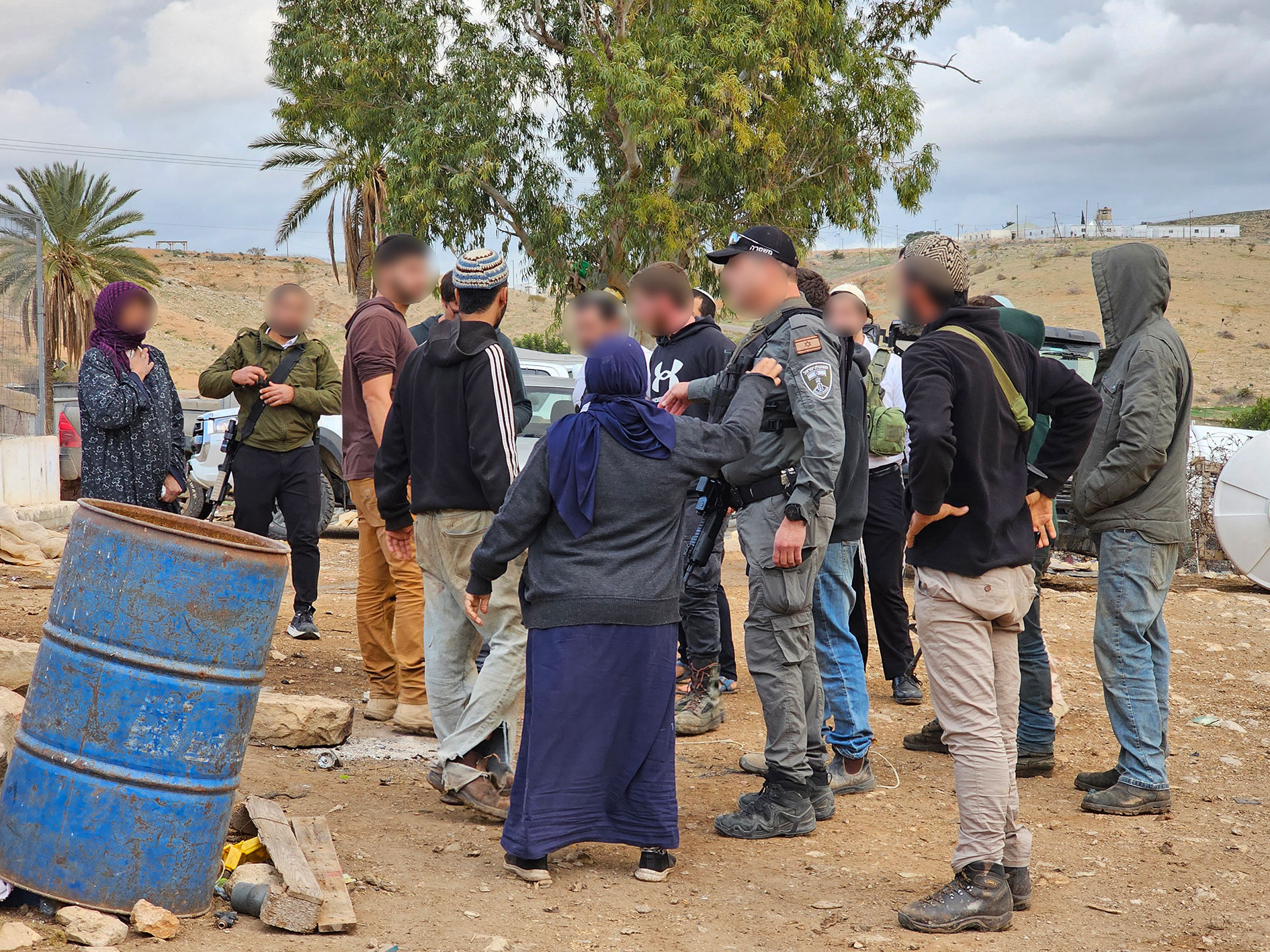 Sarah PostecDec-27-2026Hammam al-Malih: Border Guard and settlers in the compound
-
Khalet Makhul
See all reports for this place-
Khalet Makhul
A small settlement of a shepherd community located on the way to the settlement of Hemdat. Two nearby outposts make life miserable for the Palestinians, who make a living from grazing, and the army backs the settlers. As a result, the possible grazing areas are getting smaller.
The local children attend school in the settlement of Ein Al-Beida. Long lines of 3 hours sometimes stretch out at the Hamra and Tayasir checkpoints leading to the town of Tubas, making it difficult to get water, supplies, and sell the cheese, milk, and meat that the residents produce for their living.
Following a deadly attack at the Tayasir checkpoint in February 2025, the checkpoint was closed completely for the time being.
(Updated March 2025)
-